

Snail anatomy at a glance
A snail's body has four parts: the shell, the head-foot, the visceral mass and the mantle. The coiled shell protects the soft body. The muscular head-foot is the part you see crawling; it carries the head, with two pairs of tentacles and the mouth. The visceral mass is coiled inside the shell and holds the digestive gland, stomach, heart, kidney and reproductive organs. The mantle covers the visceral mass, makes the shell, and in land snails forms the lung, which opens to the air through the pneumostome.
Snails are gastropods, the largest class of molluscs, with more than 62,000 described living species. All of them share three features you can find on the model: a radula (a tongue covered in tiny teeth), a single muscular foot, and torsion, a twist during development that brings the mantle cavity and anus forward over the head. The garden snail is a pulmonate: it breathes with a lung, has no operculum (shell door), and is a hermaphrodite. Many aquatic snails differ on all three points, so this page compares them at the end.
Orientation. The head is anterior and the sole is ventral. Because the shell coils to the right (dextral), the openings of the lung, anus, kidney and reproductive system are all on the snail's right side. That is why the 3D model opens on the right-hand view.
Snail anatomy diagram: external parts labeled
On the outside of a garden snail you can identify the shell (apex, spire, body whorl, suture, aperture and lip), the mantle collar with the pneumostome, the head with four tentacles, the eyes, the mouth and the genital pore, and the foot with its sole. The upper, longer tentacles carry the eyes at their tips. The lower, shorter pair is used for touch and smell close to the ground. The genital pore is a small opening on the right side of the head, just behind the right upper tentacle. Under the edge of the shell, the thick mantle collar seals the gap between body and shell, and the round pneumostome opens and closes in it as the snail breathes.
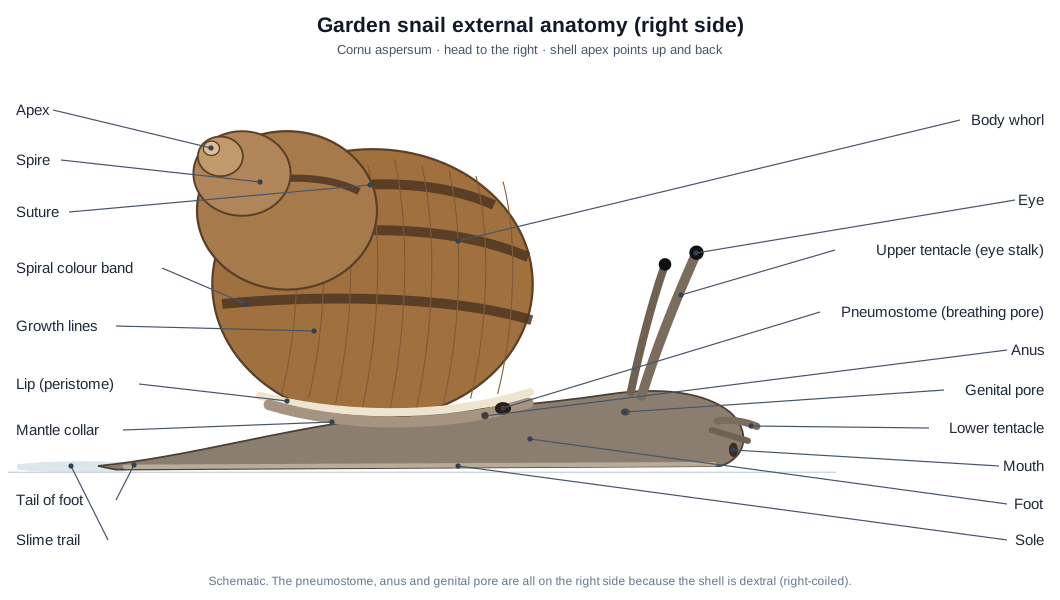
The foot is a muscular hydrostat: it has no skeleton, and is stiffened by the pressure of the blood in the body cavity. Waves of muscle contraction run forward along the sole, pushing the snail over a layer of mucus from the pedal gland, which opens just under the mouth. The mucus is mostly water, which is why land snails are most active at night and in damp weather.
External vs internal anatomy of a snail
External anatomy is everything you can see on a live snail; internal anatomy is what lies inside the shell and body wall. Use this table to sort the structures for a worksheet or quiz.
| Region | External structures | Internal structures |
|---|---|---|
| Shell | Apex, spire, whorls, suture, body whorl, aperture, lip, umbilicus, growth lines, colour bands | Columella (central pillar), inner walls of the whorls |
| Head | Upper tentacles with eyes, lower tentacles, mouth, genital pore (right side) | Buccal mass, jaw, radula, odontophore, nerve ring (brain), statocysts, penis, dart sac |
| Foot | Sole, tail, slime trail | Pedal gland, pedal retractor muscles, pedal ganglia |
| Mantle | Mantle collar and pneumostome (breathing pore), anus beside it | Lung, heart in its pericardium, kidney, ureter, rectum |
| Visceral mass | Hidden by the shell | Crop, stomach, digestive gland, intestine, ovotestis, albumen gland, spermoviduct, bursa copulatrix |
Snail shell anatomy
A snail shell is a single, hollow tube of calcium carbonate coiled round a central pillar, the columella. The tip is the apex, the oldest part, formed in the egg (the protoconch). Each complete turn is a whorl, and the line where one whorl meets the next is the suture. All the whorls above the last one make up the spire. The last and largest whorl, the body whorl, ends at the aperture, the opening the body comes out of, edged by the lip (peristome). On the base, the hollow axis may open as an umbilicus. Fine growth lines across each whorl mark former positions of the lip.
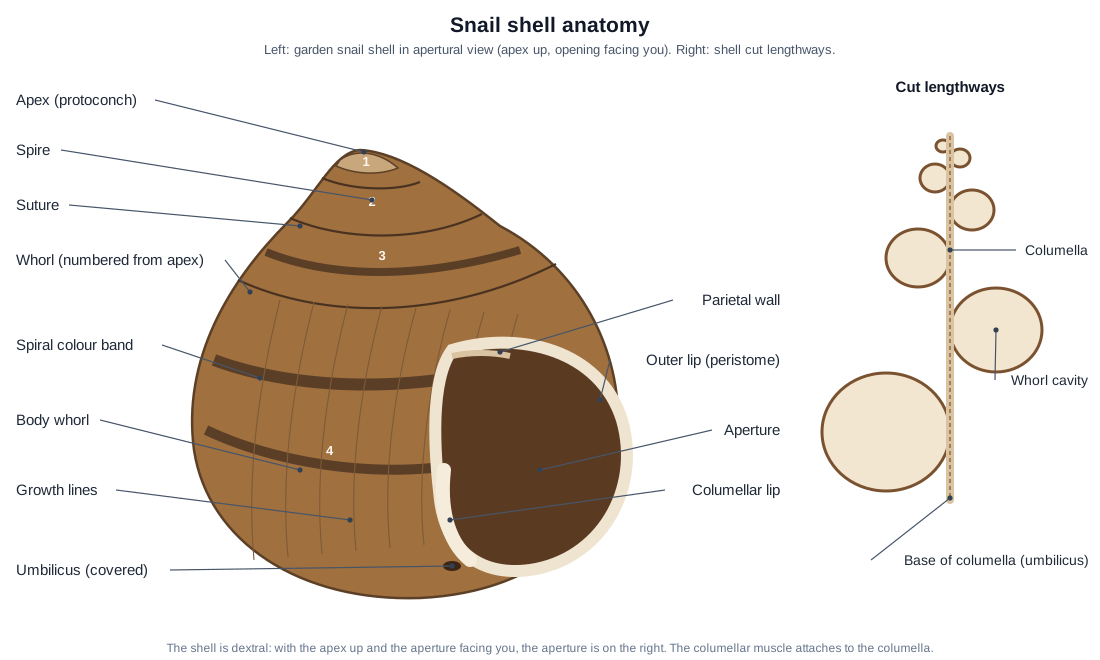
The garden snail shell is thin and globular, about 28–33 mm across in adults, with four to five whorls. It is mottled dark brown, golden brown or chestnut, with interrupted brown bands and yellow flecks. Almost all garden snails are dextral: hold the shell with the apex up and the opening facing you, and the aperture is on the right. Left-handed (sinistral) garden snails exist but are rare. The aperture is large and oblique, and in adults the lip is white and turned outward. A juvenile has a thin, sharp lip, so a thick reflected lip is a quick sign of an adult snail.
The shell is made by the mantle. Only the mantle collar at the aperture adds new length, but the whole mantle can thicken or repair the shell from inside. A snail cannot leave its shell: the columellar muscle attaches the body to the columella, and the visceral organs fill the upper whorls. In dry or cold weather the garden snail pulls back inside and seals the aperture with an epiphragm, a sheet of dried mucus that cuts water loss. It is not an operculum: the operculum of aquatic snails is a permanent lid carried on the back of the foot.
Snail head, face, eyes and mouth
A land snail's face has four tentacles: two long upper tentacles with an eye at each tip, and two short lower tentacles beside the mouth. The upper tentacles are also called optic tentacles or ommatophores. When touched, a tentacle rolls inside itself from the tip, like the finger of a glove being pulled in, drawn by a retractor muscle that runs up its centre. The eyes sense light, shadow and movement; garden snails find food mainly by smell, using receptors on the tentacle tips and the lower tentacles.
The mouth opens on the underside of the head. Just inside it is a single dark jaw, and behind that the large muscular buccal mass containing the radula. Garden snails are mainly plant eaters: they rasp living and decaying leaves, fungi, soil and some animal matter. The genital pore is on the right side of the head, a little behind the right upper tentacle; during courtship you can see it swell.
How many teeth does a snail have? The radula explained
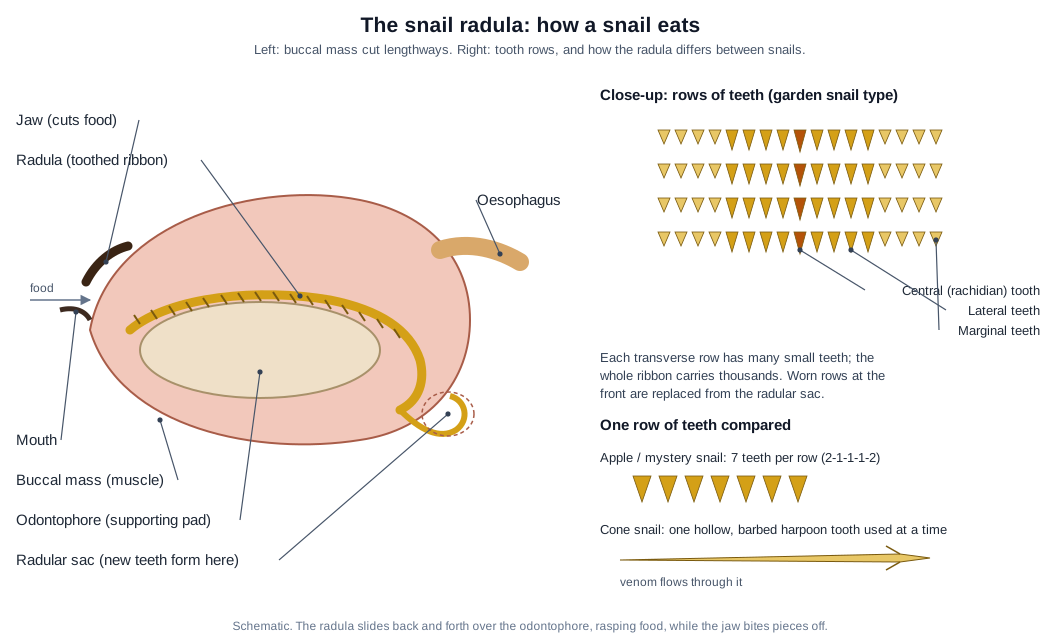
A snail's teeth are on its radula, a ribbon-like membrane covered with rows of tiny teeth made of chitin. The radula moves back and forth over a cartilage ridge called the odontophore, scraping food like sandpaper, and the scraped bits are drawn into the oesophagus. The shapes of the teeth are used to identify some land snail species. (Carnegie Museum of Natural History: land snail diet and behavior.)
The number of teeth depends on the species. A radula can carry more than 100,000 teeth in total, and in Pleurotomaria a single row has over 200 teeth. Teeth wear away at the front and are replaced from a radular sac at the back; some species produce up to five new rows a day. Each row can be written as a tooth formula: for example, 3 + D + 2 + R + 2 + D + 3 means three marginal teeth, one dominant tooth, two laterals and one central (rachidian) tooth, repeated in mirror image. Cone snails have a formula of just 1 + 0 + 1, with only one tooth in use at a time. (Radula, Wikipedia.)
Most snails have thousands of microscopic teeth on the radula. You will often read that a garden snail has about 14,000 teeth, or even 25,000. We could not find a primary count for Cornu aspersum to confirm these figures, and the number grows as the snail grows, so treat any single number as approximate. For comparison, an apple snail has only 26–53 rows of seven teeth: a few hundred at most. (Snail, Wikipedia.)
In the garden snail, the radula is a wide, golden-brown sheet on the dorsal surface of the odontophore, on the floor of the pharynx. A single dark, heavy, toothed jaw sits over the mouth opening. When the snail feeds, the radula rasps food and presses it against the jaw, which cuts it off. (Fox, Invertebrate Anatomy OnLine: Helix aspersa, Lander University.)
Internal anatomy of a snail
Inside the shell, a snail's visceral mass is coiled into a spiral: the brown digestive gland and the ovotestis fill the upper whorls, while the lung, heart and kidney sit under the roof of the last whorl. In the head and neck lie the buccal mass, the nerve ring (the brain), the crop and most of the reproductive organs. A long columellar muscle runs from the columella into the head-foot and splits into branches for the foot, tentacles and buccal mass; contracting it pulls the snail into its shell.
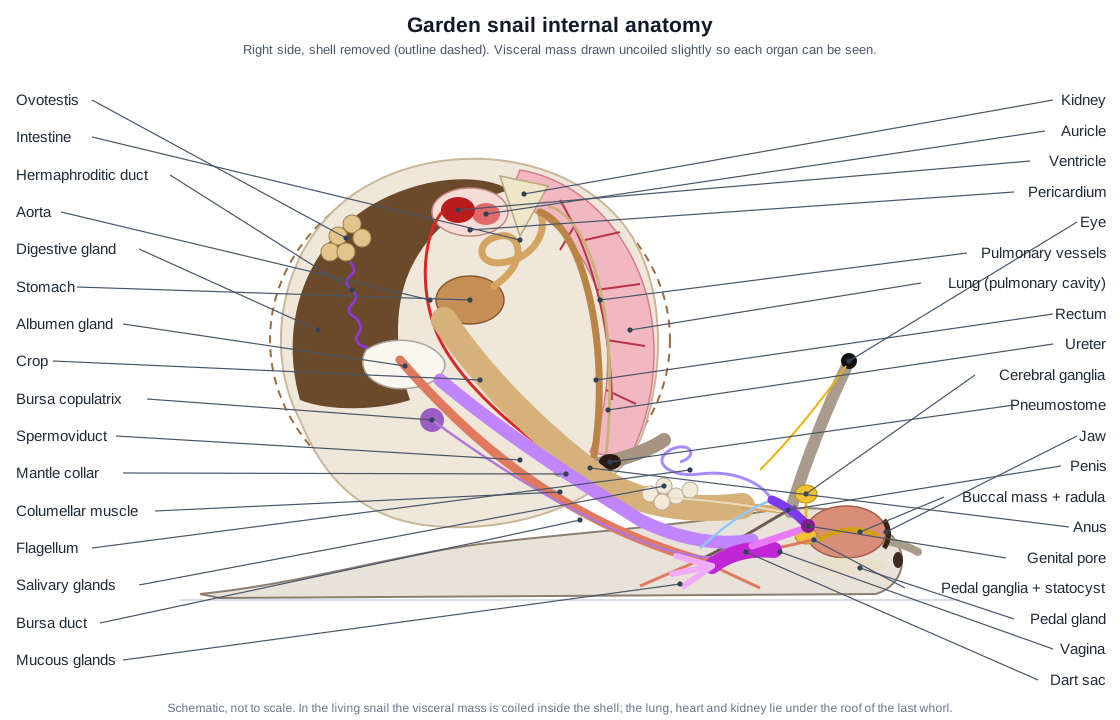
The digestive system follows a U-shaped route because of torsion. Food passes, in order, through:
- Mouth, with the jaw above it
- Buccal mass: radula and odontophore
- Oesophagus, passing through the nerve ring
- Crop, with the salivary glands on its front part
- Stomach, where the digestive gland opens
- Digestive gland (hepatopancreas) in the upper whorls
- Intestine, looping through the lower digestive gland
- Rectum, along the right side of the lung
- Anus, next to the pneumostome
The thin-walled crop is the longest part of the gut and runs along the left side of the body cavity. The digestive gland (often called the hepatopancreas or liver) is the largest organ in the visceral mass. It produces enzymes, absorbs food and stores reserves. In a lab dissection it is the brown tissue that fills the spire, with the pale ovotestis embedded near the top.
The excretory system is a single large, creamy-white kidney at the back of the lung, next to the heart. Its ureter runs forward beside the rectum and opens in the pneumostome, so the breathing pore, the anus and the kidney opening all lie together on the right side.
Snail lungs vs gills: how snails breathe
A garden snail breathes air with a lung: its mantle cavity is filled with air, and the roof of the cavity is covered in a network of blood vessels. Air enters and leaves through the pneumostome, which the snail opens and closes. Oxygen diffuses into the blood in the lung roof, and the pulmonary vein carries it to the heart. There are no gills. This mantle cavity is the same cavity that holds the gill in sea snails; in pulmonates it has become a lung.
Aquatic snails use three strategies. Most sea snails, nerites and assassin snails keep a gill and breathe dissolved oxygen. Ramshorn, bladder and pond snails are aquatic pulmonates: they have a lung and come to the surface to breathe. Apple and mystery snails have both: a gill on the right side of the mantle cavity and a lung on the left, filled through a snorkel-like siphon. The table compares the snails on this page.
| Snail | Breathing | Operculum | Eyes | Sexes | Habitat |
|---|---|---|---|---|---|
| Garden snail (Cornu) | Lung only | None | Upper tentacle tips | Hermaphrodite | Land |
| Giant African land snail | Lung only | None | Upper tentacle tips | Hermaphrodite | Land |
| Ramshorn, bladder, pond snails | Lung (surface to breathe) | None | Base of tentacles | Hermaphrodite | Fresh water |
| Apple / mystery snail (Pomacea) | Gill + lung, air siphon | Horny (corneous) | Base of tentacles, on stalks | Separate sexes | Fresh water |
| Nerite (Neritina, Theodoxus) | Gill | Chalky (calcified) | Base of tentacles | Separate sexes | Fresh, brackish and sea water |
| Assassin snail (Anentome) | Gill | Horny | Base of tentacles | Separate sexes | Fresh water |
| Cone, conch, moon, turban snails | Gill | Present (small in cones, thick and chalky in turbans) | Base of tentacles or on long stalks (conch) | Separate sexes | Sea |
Snail heart and circulation
A snail has a two-chambered heart, with one auricle and one ventricle, enclosed in a pericardium at the back of the lung next to the kidney. The thin-walled auricle (atrium) lies in front and receives oxygenated blood from the lung. The thicker ventricle behind it pumps blood into the aorta, which branches to the visceral mass and forward to the head. Snails have an open circulation: the blood leaves the arteries and bathes the organs directly in body spaces called the haemocoel before returning to the lung.
Snail blood is usually colourless to pale blue. Like most molluscs, the garden snail carries oxygen on haemocyanin, a copper-containing protein. Ramshorn snails are an exception: their blood contains iron-based haemoglobin, which is why albino ramshorns look red. In a young garden snail with a thin, pale shell you can sometimes see the heart beating through the shell near the back of the lung.
Snail nervous system and senses
A snail's brain is a ring of paired ganglia around the oesophagus, just behind the buccal mass. The large cerebral ganglia sit on top and receive the optic nerves from the eyes and nerves from the tentacles and lips. Below the oesophagus are the pleural, pedal, parietal and visceral ganglia. The pedal ganglia control the foot; the visceral loop ganglia control the organs inside the shell. Two tiny balance organs, the statocysts, rest on the pedal ganglia. The oesophagus, the salivary ducts and the buccal retractor muscle all pass through the nerve ring, which is a useful check in a dissection.
Torsion explained: why the anus is near a snail's head
Torsion is a 180-degree rotation of the visceral mass, mantle and shell (together called the visceropallium) relative to the head and foot. All gastropods descend from a torted ancestor, and the rotation is echoed during the early development of living snails: in limpets and top snails it happens in the larva, while in many other groups, including pulmonates, development takes a more direct route to the same adult arrangement. Torsion is different from coiling. Coiling winds the visceral mass and shell into a spiral; torsion rotates that whole hump on top of the foot. (Page 2006, Integrative and Comparative Biology 46: 134–143 (gastropod torsion and development).)
Torsion has three big consequences that you can see in a dissection. First, the mantle cavity and anus end up at the front, above the head, instead of at the back. In the garden snail, the anus and the kidney opening sit next to the pneumostome, just behind the head. Second, the gut becomes U-shaped: food travels back into the shell and then forward again. Third, in many sea snails the nerve cords to the visceral ganglia cross over in a figure of eight, a condition called streptoneury. Torsion also explains why many snails have only one gill, one auricle and one kidney: organs on one side were reduced or lost. (Torsion (gastropod), Wikipedia.)
Gastropods share a body that has undergone torsion so that the pallial (mantle) cavity faces forward, and they show many kinds of asymmetry as a result. Most snails coil their shells to the right, around a central columella to which a large retractor muscle attaches. Some species coil to the left. (UC Museum of Paleontology: Introduction to the Gastropoda.)
Snail reproductive anatomy
A garden snail is a hermaphrodite: one ovotestis makes both eggs and sperm, and every snail has both a penis and a vagina opening at a single genital pore on the right side of the head. The reproductive tract runs from the ovotestis in the spire, down the hermaphroditic duct to the albumen gland, then forward along the spermoviduct to the head. Near the head it divides into a male branch (vas deferens, flagellum and penis) and a female branch (free oviduct and vagina), with the dart sac, mucous glands and the long duct of the bursa copulatrix joining the female side.
Snail reproduction: hermaphrodites and love darts
Garden snails are simultaneous hermaphrodites: one gonad, the ovotestis, makes both eggs and sperm. Cross-fertilisation is the normal route, so two snails mate and each fertilises the other. Mating takes four to 12 hours. Three to six days later the snail digs a nest 2.5–4 cm deep with its foot and lays 30 to 120 white, spherical eggs about 3 mm across, hidden under soil, mucus and droppings. In summer the eggs hatch in about two weeks, and the young take from about ten months to two years to mature, depending on climate. (Dekle & Fasulo, UF/IFAS Featured Creatures EENY-240: brown garden snail, Cornu aspersum.)
Before mating, garden snails court for up to several hours, and each may stab the other with a love dart: a sharp dart of calcium carbonate made and stored in the dart sac (stylophore). Just before it is shot, the dart is coated with mucus from the mucous glands. The mucus carries a hormone-like substance (an allohormone) into the partner's blood. It reduces the digestion of incoming sperm in the bursa copulatrix, the organ where most received sperm is broken down, so more of the dart shooter's sperm reaches the sperm-storage tubules and fertilises eggs. (Koene & Schulenburg 2005, BMC Evolutionary Biology 5: 25 (love darts).)
An experiment on Cornu aspersum tested whether the stab or the mucus matters. Donors whose partners were injected with mucus from the dart's glands sired about 39% of the offspring, against about 17% for donors paired with saline injections, more than double. The dart therefore works by delivering a bioactive substance, not just by wounding. Paternity also tended to favour the first of two mating partners, although that difference was not statistically significant in this study. (Chase & Blanchard 2006, Proc. R. Soc. B 273: 1471–1475.)
Inside the snail, sperm and eggs leave the ovotestis through the hermaphroditic duct, which also stores the snail's own sperm. Fertilisation happens in a chamber in the albumen gland, which coats each egg with nutritive material. The thick spermoviduct then splits: its large, folded oviduct side adds a calcareous shell to the egg, and its narrow sperm-duct side leads to the penis. A long flagellum on the male duct packs sperm into spermatophores. The penis and vagina open into a short common chamber with a single genital pore on the right side of the head. (Fox, Invertebrate Anatomy OnLine: Helix aspersa, Lander University.)
Snail vs slug anatomy
A slug has the same organs as a land snail, but its shell is lost, reduced or hidden inside the body, and its visceral mass is not coiled into a hump. The word slug is a term of convenience: shell loss has evolved many times in different snail groups, so slugs are not one family. Snails whose small shell is too little to retreat into are called semi-slugs.
| Feature | Land snail | Land slug |
|---|---|---|
| Shell | External coiled shell big enough to retreat into | No shell, a small plate under the mantle, or a tiny external shell (semi-slugs) |
| Visceral mass | Coiled into a hump inside the shell | Not coiled; packed into the body |
| Mantle | Lines the shell; forms the mantle collar at the aperture | A saddle-shaped shield on the back, behind the head |
| Pneumostome | On the right side of the mantle collar | On the right side of the mantle shield |
| Tentacles and eyes | Two pairs; eyes on the tips of the upper pair (land snails) | The same in land slugs |
| Radula and jaw | Present | Present |
| Reproduction | Hermaphrodite; genital pore on the right of the head | Also hermaphrodite in land slugs; genital pore on the right |
| Drought survival | Retreats into the shell and seals it with an epiphragm | Hides in damp places; depends more on mucus |
Aquatic snail anatomy: freshwater and sea snails
Aquatic snails differ from the garden snail mainly in how they breathe, in having an operculum, in where their eyes are, and in usually having separate sexes. Most freshwater aquarium snails (mystery, nerite and assassin snails) and nearly all sea snails belong to groups that kept the gill and operculum of their marine ancestors. Ramshorn and bladder snails are the main exception: they are pulmonates that returned to the water.
Mystery snail and apple snail anatomy
The aquarium mystery snail is an apple snail, usually Pomacea diffusa, the spike-topped apple snail. Its shell has five to six whorls with flat, square shoulders and is about 40–50 mm wide and 45–65 mm high. The shell can be yellow, green or brown, with or without dark bands, and breeders have produced white (ivory), blue and golden forms. The colour of the body ranges from pale yellow to almost black. Unlike the garden snail, a mystery snail carries an operculum: a moderately thick, horny, brown lid that closes the aperture when the snail withdraws. (Applesnail.net: Pomacea diffusa.)
Apple snails breathe both water and air. The gill (ctenidium) hangs from the roof of the right side of the mantle cavity, and the lung is an air-filled sac on the left side of the roof. Water enters on the left, passes over the osphradium (a chemical sense organ) and then the gill, and leaves on the right. To breathe air, the snail stretches a siphon to the surface. The siphon is a fold of the mantle (the left nuchal lobe) on the left side of the neck. At rest it is barely visible; when its muscles contract it becomes a flexible tube that works like a snorkel, while the snail pumps its head in and out to fill and empty the lung. (Applesnail.net: respiration.)
Lab descriptions of Pomacea call the left nuchal lobe the inhalant siphon and the right one the exhalant siphon. The operculum is a thin, teardrop-shaped disc of the protein conchiolin attached to the back of the foot. The heart has two chambers in a pericardial cavity on the left of the visceral mass, and the radula is taenioglossate, with seven teeth in each row. (Fox, Invertebrate Anatomy OnLine: Pomacea, Lander University.)
The head of a mystery snail looks different from a garden snail's. It has one pair of long cephalic tentacles, sometimes longer than the shell, and a shorter pair of labial palps (labial tentacles) beside the mouth. The eyes are not on the tentacle tips: they sit on short eye stalks at the base of the tentacles, and they sense the direction of light rather than forming images. Two statocysts with chalky statoliths lie near the pedal ganglia. (Applesnail.net: senses.)
The radula of an apple snail carries 26–53 rows of seven chitinous teeth each, so it has only a few hundred teeth, far fewer than a garden snail's. Calcareous jaws in the buccal cavity cut off food. The oesophagus widens into a crop with salivary glands beside it, and the pink, U-shaped stomach lies on the left of the body whorl, with a dark brown digestive gland on top. The anus opens on a papilla in the roof of the right mantle skirt. (Applesnail.net: digestion.)
Male vs female mystery snail: how to tell
Apple snails have separate sexes; they are not hermaphrodites. The reliable way to sex one is to look inside the shell. Take the snail out of the water and hold it upside down for a minute or so, until it starts to turn itself upright. Then look into the right side of the mantle cavity, in front of the gill. Males have a large penis sheath there; females do not. In some species adult males also have a wider, flared lip, while females are larger with a straight opening, but shell shape is not reliable for a single snail. (Applesnail.net: reproduction.)
The penis sheath is an extension of the right side of the mantle skirt, and the penis itself lies coiled in a penial sac when not in use. The female opening (gonopore) sits on a papilla of the shell gland, just to the right of the anus. Hobbyists often say that the operculum of a male is more domed or curved than a female's. We found no published study that supports this, so treat it as a rough guide at best. (Fox, Invertebrate Anatomy OnLine: Pomacea, Lander University.)
Inside, the testis of a male lies in the upper whorls next to the digestive gland, and sperm passes through the vas deferens to a seminal vesicle and prostate. In a female, the ovary lies in the same position. A receptaculum seminis stores sperm and is where fertilisation happens, then albumen glands add yolk and a shell gland finishes each egg before it leaves through the gonopore. Pomacea diffusa lays clutches of about 200–600 pale pink eggs above the waterline. (Applesnail.net: reproduction.)
Nerite snail anatomy
Nerites (family Neritidae) are small to medium-sized sea, brackish and freshwater snails with a gill and a distinctive operculum. Unlike pulmonates, they keep the gill of their marine ancestors and breathe dissolved oxygen. (Theodoxus fluviatilis, Wikipedia.)
The river nerite, Theodoxus fluviatilis, is a well-studied example. Its sexes are separate, its eggs are laid in capsules (usually only one egg in each capsule develops), and its operculum is calcified, D-shaped and reddish, with an inner rib to which the columellar muscle attaches. The radula is rhipidoglossan: each row has a fan of many small marginal teeth that brush up algae. The shell is only 5–9 mm wide. The popular aquarium nerites (Neritina, Vittina) have the same basic plan, and most of them need brackish or salt water for their larvae, which is why they rarely breed in freshwater tanks. (Theodoxus fluviatilis, Wikipedia.)
Ramshorn and bladder snails: aquatic snails with a lung
Ramshorn snails (Planorbidae) are freshwater pulmonates: like the garden snail they breathe with a lung and have no operculum. Unlike most molluscs, their blood carries iron-based haemoglobin instead of copper-based haemocyanin, which makes the body reddish, especially in albino animals. Their flat, coiled shells are actually sinistral (left-handed), but the snail carries them upside down, so they look right-handed. (Planorbidae, Wikipedia.)
Being a pulmonate does not mean living on land. Snails that breathe with a lung form the group Pulmonata, but many freshwater snails have lungs, a few marine species do too, and some land snails have gills. Bladder snails (Physidae) and pond snails are other common freshwater pulmonates: they surface to fill the lung through the pneumostome and, like ramshorns, have no operculum. Their eyes sit at the base of a single pair of tentacles rather than on the tips. (Snail, Wikipedia.)
Cone snail anatomy: the venom harpoon
A cone snail hunts with a single modified radular tooth. Its radula is toxoglossan: instead of a ribbon of rasping teeth, it has a few long, hollow, barbed teeth made mainly of chitin. These are stored in the radular sac in the snail's throat. Only one tooth is in use at a time. The snail loads it with venom from the venom bulb, extends its long, flexible proboscis towards the prey, and fires the tooth like a harpoon. Then it draws the paralysed prey into its mouth. (Cone snail, Wikipedia.)
High-speed filming of the fish-hunting cone snail Conus catus showed that the harpoon is fired hydraulically. A latch of cells holds the tooth back until pressure overcomes it, then the tooth accelerates very rapidly and also tethers the snail to the fish. It is the fastest strike recorded in any mollusc. The venom is a mix of short peptides (conotoxins) that act on the prey's nerves. (Schulz et al. 2019, Current Biology 29: R788–R789.)
Some large fish-eating cone snails, especially the geography cone, Conus geographus, can kill a human, and the tooth can pierce gloves and wetsuits. Never pick up a live cone shell. The operculum of cone snails is small and horny, much smaller than the aperture. (Cone snail, Wikipedia.)
Sea snail anatomy: gills, siphon and operculum
Most sea snails breathe with a gill (ctenidium) in a mantle cavity that, because of torsion, faces forward over the head. Most also keep an operculum on the foot that seals the aperture when the head-foot is pulled in; it is present in all gastropod larvae but lost in many adult heterobranchs, including nearly all pulmonates. (UC Museum of Paleontology: Introduction to the Gastropoda.)
Many carnivorous sea snails, such as whelks, cones and moon snails, also have a siphon: a tube-shaped extension of the mantle edge that draws water into the mantle cavity, often lying in a notch or canal at the front of the shell. The incoming water passes over the osphradium, a chemical sense organ, so the siphon also works like a nose that the snail can point towards the scent of prey. Do not confuse this siphon with the air siphon of apple snails, which is a separate fold of the neck used as a snorkel.
Moon snails (Naticidae) are predators that feed mostly on clams and other molluscs. A moon snail wraps its prey in its large foot and bores a hole through the shell with its radula and an acid secretion. The hole is countersunk, with bevelled edges, and is a sure sign of moon snail attack on beach shells. Once the shell is open, the snail eats the soft tissues with its proboscis. (Naticidae, Wikipedia.)
Conchs (Strombidae) have long eye stalks; the shell has a notch near the front, the stromboid notch, through which one eye looks out. Their operculum is pointed, sickle-shaped and horny. Instead of gliding, conchs move by a leaping motion, pushing the operculum against the sea floor. They are mainly herbivores, grazing algae. (Strombidae, Wikipedia.)
Turban snails (Turbinidae) have a strong, thick, calcareous operculum, unlike the horny lid of top snails (Trochidae). It shields the aperture against predators. Polished turban opercula, with a swirl on one side and a dome on the other, are sold as Pacific cat's eye shells. Many turbinids also have a nacreous (mother-of-pearl) inner shell layer, a primitive feature. (Turbinidae, Wikipedia.)
Assassin snail anatomy
The assassin snail, Anentome helena, is a freshwater snail with an operculum and separate sexes. It is a carnivore that eats other snails, often larger than itself, as well as worms, and it spends much of its time buried in the substrate to ambush prey. Adults usually reach 18–32 mm. (Anentome helena, Wikipedia.)
Giant African land snail anatomy
The giant African land snail, Lissachatina fulica (formerly Achatina fulica), has the same pulmonate body plan as the garden snail: a lung with a pneumostome, two pairs of tentacles with eyes on the upper pair, and one ovotestis. It is much larger, with a tall, conical shell reaching about 20 cm long and 7 cm across, with 7–9 whorls in adults. It is a protandric hermaphrodite: the male function matures first, at about 5–8 months. A snail lays around 200 eggs per clutch, several times a year, and can live 3–5 years in the wild. (Lissachatina fulica, Wikipedia.)
This snail is one of the world's worst invasive species and is a federally prohibited species in the United States. It often carries the rat lungworm, Angiostrongylus cantonensis, which can cause meningitis in people who eat raw or undercooked snails or handle wild ones. Wash your hands after handling any wild land snail. (Lissachatina fulica, Wikipedia.)
Snail anatomy for kids
A snail is a soft animal that carries its house on its back. Here are the main parts to remember:
- Shell: a spiral home made of the same stuff as chalk. The snail grows it bigger from the edge.
- Foot: one big muscle the snail slides on, using slime to help it move and stick.
- Tentacles: four feelers. The two long ones have eyes on the tips; the two short ones smell and feel.
- Mouth and radula: a tongue covered in thousands of tiny teeth that scrapes up food like a file.
- Breathing hole: a little hole on the right side, under the shell, that opens into the lung.
- Heart: a small two-part heart inside the shell.
- Boy or girl? Garden snails are both at once, so any two can mate and both lay eggs.
Snail anatomy labeled: every part in the model
These are all 69 structures in the 3D model, grouped by system. Click any of them in the viewer above to find it.
Shell
- Apex (Protoconch, embryonic shell)
- The pointed tip of the shell: the oldest part, formed while the snail was still in the egg. Records the snail's earliest growth. All later whorls are added around it.
- Spire (Upper whorls)
- All the whorls above the body whorl, from the apex down to the last suture. Houses the top of the visceral mass: the digestive gland and the ovotestis.
- Body whorl (Last whorl)
- The last and by far the largest whorl, ending at the aperture. Holds most of the soft body: the lung, heart, kidney, stomach and the coils of the reproductive tract.
- Suture
- The spiral line where each whorl meets the one above it. A landmark for counting whorls: follow the suture round from the apex and count each turn.
- Growth lines (Growth ridges, striae)
- Fine ridges across each whorl, each one a former edge of the aperture. Show how the shell grows: the mantle collar adds new shell only at the aperture margin.
- Spiral colour bands (Shell bands)
- Dark brown bands that spiral round the whorls, usually broken into flecks and streaks. Pigment patterns laid down by the mantle edge; they help camouflage the snail.
- Aperture (Shell opening, mouth of the shell)
- The large opening of the shell through which the head and foot come out. Lets the head-foot extend and withdraw. When the snail is inactive it seals the aperture with an epiphragm of dried mucus.
- Lip (Peristome, outer lip)
- The thickened, whitish rim of the aperture, turned slightly outward in adults. Strengthens the opening. A thick, reflected lip shows that the snail has stopped growing and is adult.
- Umbilicus
- The opening of the hollow axis on the underside of the shell; in adult garden snails it is covered. A key identification feature: some snails have a wide, open umbilicus, others a closed one.
- Columella (Central axis)
- The central pillar of the shell, formed by the inner walls of the whorls, round which the shell coils. Anchors the columellar muscle, which holds the snail in its shell and pulls it back inside.
Head, foot & mantle
- Head
- The front of the body, carrying two pairs of tentacles, the mouth and, on the right, the genital pore. Senses the surroundings and takes in food. It can be pulled right back into the shell.
- Foot (Head-foot)
- The long, muscular body under the shell that the snail crawls on. Moves the snail by waves of muscle contraction that run along the sole over a layer of mucus.
- Sole (Creeping sole)
- The flat underside of the foot, in contact with the ground. Generates the waves of contraction that push the snail forward; it also grips by adhesion through the mucus.
- Pedal gland (Suprapedal gland, slime gland)
- A long mucus gland in the front of the foot that opens just below the mouth. Secretes the slime the snail crawls on.
- Slime trail (Pedal mucus)
- The shiny ribbon of mucus left behind on the ground. The mucus reduces friction where the snail moves and acts as an adhesive where it grips.
- Mantle collar (Mantle skirt, mantle edge)
- A thick, fleshy rim of the mantle that fills the shell opening around the neck. Secretes new shell at the aperture margin and seals the opening against the lip. The pneumostome opens in it.
- Pneumostome (Breathing pore, respiratory pore)
- The opening of the lung, a round hole in the mantle collar on the snail's right side. Opens and closes to let air into and out of the lung. The anus and the kidney opening lie next to it.
- Upper tentacles (Posterior tentacles, optic tentacles, ommatophores, eye stalks)
- The long upper pair of tentacles, each with an eye at its tip. Carry the eyes and also sense smell and touch. They roll inward (invaginate) like a glove finger when touched.
- Lower tentacles (Anterior tentacles, oral tentacles)
- The short lower pair of tentacles, without eyes. Touch and smell (chemical sensing) of the ground and food just in front of the mouth.
- Mantle (Visceral hump covering)
- The thin sheet of tissue that covers the visceral mass and lines the shell. Secretes the shell, forms the lung, and encloses the visceral organs.
Lung
- Lung (Pulmonary cavity, mantle cavity)
- The air-filled mantle cavity, whose roof is a network of blood vessels. Gas exchange with air: oxygen diffuses into the blood in the vessels of the lung roof.
- Pulmonary vessels (Pulmonary vein, pulmonary plexus)
- The branching blood vessels on the lung roof, draining into the pulmonary vein. Carry blood across the lung surface and return oxygenated blood to the auricle.
Digestive
- Mouth
- The opening on the underside of the head, behind the lips. Takes in food. The jaw sits just inside its upper edge and the radula rasps food through it.
- Jaw
- A single dark, horny, ridged plate in the roof of the mouth. The radula presses food up against the jaw, which cuts or bites it off.
- Buccal mass (Pharynx)
- The large, muscular, oval feeding organ in the head. Contains the buccal cavity, radula and odontophore, and moves them to rasp up food.
- Odontophore
- A firm, cartilage-like pad in the floor of the buccal mass that supports the radula. Works like a pulley: muscles slide the radula back and forth over it to scrape food.
- Radula (Rasping tongue)
- A golden-brown ribbon covered in rows of tiny chitinous teeth. Rasps food like a file and carries the particles back to the oesophagus.
- Salivary glands
- A pair of whitish, lobed glands lying on the front of the crop. Produce saliva (mucus and enzymes) that lubricates the radula and starts digestion.
- Salivary ducts
- Two thin tubes from the salivary glands to the buccal mass. Carry saliva into the buccal cavity.
- Oesophagus (Esophagus, gullet)
- The narrow tube from the buccal mass to the crop. Carries food from the mouth to the crop.
- Crop
- A large, thin-walled storage section of the gut. Stores food and is where much digestion begins, with enzymes from the saliva and digestive gland.
- Stomach
- A small chamber between the openings of the digestive gland. Receives food from the crop and mixes it with secretions of the digestive gland.
- Digestive gland (Hepatopancreas, liver, digestive caecum)
- The large, brown gland that fills most of the upper whorls. Produces digestive enzymes, absorbs food and stores reserves such as glycogen and calcium.
- Intestine
- The coiled tube from the stomach to the rectum. Absorbs water and nutrients and forms faecal pellets.
- Rectum
- The last straight part of the gut. Carries faeces to the anus.
- Anus
- The end of the gut, opening beside the pneumostome. Releases faeces outside the shell, close to the head, because of torsion.
Circulatory
- Pericardium (Pericardial cavity)
- The thin, transparent sac that encloses the heart. Gives the heart room to beat; fluid from it passes to the kidney.
- Auricle (Atrium)
- The thin-walled front chamber of the heart. Receives oxygenated blood from the lung and passes it to the ventricle.
- Ventricle
- The muscular back chamber of the heart. Pumps blood into the aorta and out to the body.
- Aorta
- The main artery leaving the ventricle. Distributes blood to the organs. The circulation is open: blood leaves the arteries into body spaces (the haemocoel).
Excretory
- Kidney (Nephridium)
- A large, creamy-white, triangular organ at the back of the lung. Removes nitrogen waste (mostly as uric acid, which saves water on land) and regulates water and salts.
- Ureter
- The duct from the kidney to the outside. Carries urine from the kidney to the excretory pore in the pneumostome.
Nervous & sensory
- Eyes
- Small dark eyes at the tips of the upper tentacles. Detect light, dark and movement; garden snails rely mostly on smell and touch to find food.
- Cerebral ganglia
- A pair of large ganglia above the oesophagus, joined by a short commissure. Process signals from the eyes, tentacles and lips and help control feeding and behaviour.
- Pleural ganglia
- A pair of ganglia on the sides of the nerve ring, below the oesophagus. Link the cerebral ganglia to the visceral ganglia and supply the mantle.
- Pedal ganglia
- A pair of ganglia at the bottom of the nerve ring. Control the muscles of the foot.
- Visceral and parietal ganglia (Visceral loop ganglia)
- A small cluster of ganglia at the bottom of the nerve ring that supplies the organs in the shell. Control the heart, kidney, gut and reproductive organs of the visceral mass.
- Statocysts
- Two tiny fluid-filled balance organs containing crystals (statoconia). Sense gravity, so the snail knows which way is up.
- Optic and tentacle nerves
- Nerves running up the tentacles from the cerebral ganglia. Carry signals from the eyes and the sensory tips of the tentacles to the brain.
Muscles
- Columellar muscle (Columellar retractor)
- The main retractor muscle, attached to the columella of the shell. Holds the body in the shell and pulls the head and foot back inside when the snail is disturbed.
- Tentacle retractor muscles
- Branches of the columellar muscle that run into the upper tentacles. Pull the tentacles in by rolling them inside out from the tip.
- Buccal retractor muscle
- A branch of the columellar muscle that attaches to the back of the buccal mass. Pulls the buccal mass back when the head is withdrawn.
- Pedal retractor muscles
- Fan-shaped branches of the columellar muscle in the foot. Pull the foot up into the shell.
- Penis retractor muscle
- A small muscle that pulls the penis back inside after mating. Retracts the everted penis.
Reproductive
- Genital pore (Common gonopore)
- The single opening of the reproductive system, on the right side of the head. Both the penis and the female tract open here; during mating the penis is everted through it.
- Ovotestis (Hermaphrodite gland, gonad)
- The single gonad, which makes both sperm and eggs. Produces sperm and eggs; the garden snail is a simultaneous hermaphrodite.
- Hermaphroditic duct
- A thin, convoluted duct from the ovotestis to the albumen gland. Carries both eggs and sperm, and stores the snail's own sperm (acts as a seminal vesicle).
- Albumen gland
- A large, white, tongue-shaped gland in the middle of the visceral mass. Coats each fertilised egg with a nutritious perivitelline fluid (albumen).
- Spermoviduct (Common duct)
- The thick common duct in which a sperm groove runs beside the much larger egg channel. The large, folded oviduct side adds the chalky shell to each egg; the narrow sperm duct carries sperm towards the penis.
- Vas deferens (Sperm duct)
- The thin male duct from the spermoviduct to the penis. Carries sperm to the penis and flagellum.
- Penis
- A muscular tube that is everted through the genital pore during mating. Transfers a spermatophore (a sperm packet) to the partner.
- Epiphallus
- The muscular section of the male duct between the penis and the vas deferens. Shapes the body of the spermatophore around the sperm, while the flagellum moulds the spermatophore's long tail.
- Flagellum
- A long, slender blind tube attached to the male duct near the penis. Together with the epiphallus, forms the spermatophore that packages the sperm; the flagellum moulds its long tail.
- Dart sac (Stylophore)
- A muscular, pear-shaped sac that makes and fires a calcareous love dart. Secretes the dart and shoots it into the partner during courtship.
- Mucous glands (Digitiform glands)
- A pair of finger-like, branched glands opening near the dart sac. Make the mucus that coats the love dart.
- Vagina
- The short female passage from the free oviduct to the genital atrium. Receives the partner's penis and spermatophore, and the eggs pass out through it.
- Bursa copulatrix (Gametolytic sac, spermatheca)
- A small round sac at the end of a long duct, where most of the sperm a snail receives ends up and is digested. Receives the spermatophore and digests most of the incoming sperm; only a fraction escapes to the sperm storage organ.
- Bursa duct (Spermathecal duct)
- The long duct linking the bursa copulatrix to the vagina. Carries the spermatophore from the vagina to the bursa.
- Genital atrium
- The short common chamber into which the penis and vagina open. Joins the male and female openings to the single genital pore.
Frequently asked questions
What are the main parts of a snail?
A snail has four main parts: the coiled shell; the muscular head-foot that it crawls on, with the head, tentacles and mouth; the visceral mass inside the shell, holding the digestive gland, heart, kidney and reproductive organs; and the mantle, which covers the visceral mass, makes the shell and forms the lung.
How many teeth does a snail have?
A garden snail has thousands of microscopic teeth, but they are not in jaws: they sit in rows on the radula, a ribbon-like tongue. The exact count depends on the species and the size of the snail. Popular figures such as 14,000 or 25,000 are repeated widely, but we could not find a primary count for Cornu aspersum, so treat them as rough. Apple snails have only 7 teeth per row in about 26–53 rows, and cone snails use one harpoon-like tooth at a time.
Do snails have lungs or gills?
Land snails such as the garden snail breathe with a lung: an air-filled mantle cavity that opens through the pneumostome on the right side. Most sea snails and many freshwater snails, such as nerites, use a gill instead. Apple and mystery snails have both a gill and a lung, and use a siphon like a snorkel to breathe air from under water.
Where are a snail's eyes?
In land snails the eyes are the dark dots at the tips of the two long upper tentacles. In aquatic snails such as apple snails, ramshorns and pond snails, the eyes are at the base of the tentacles instead.
Is a snail male or female?
Garden snails are both at once: each snail is a hermaphrodite with one ovotestis that makes eggs and sperm. When two snails mate, both give and receive sperm. Many aquatic snails, including mystery snails, nerites and assassin snails, have separate males and females.
Do snails have a heart?
Yes. A snail's heart has two chambers, an auricle and a ventricle, inside a sac called the pericardium. It lies at the back of the lung, next to the kidney, and pumps blood through an open circulatory system.
What is the difference between a snail and a slug?
A slug is essentially a snail whose shell is lost, reduced or hidden inside the body. Its visceral mass is not coiled into a hump, and the mantle is a small shield on its back. Slugs evolved several times from different groups of snails, so the word slug does not name one family.
Can a snail live without its shell?
No. The shell is part of the snail's body: the mantle makes it and the columellar muscle attaches to it, and it protects the visceral organs and stops the snail drying out. A snail cannot leave its shell or move into an empty one. Small cracks can be repaired by the mantle, but losing the shell is fatal.
What is torsion in snails?
Torsion is a 180-degree rotation of the visceral mass, mantle and shell relative to the head and foot. All gastropods inherit it from a torted ancestor; in limpets and top snails it can still be watched as a twist in the larva, and in textbook descriptions it runs anticlockwise when seen from above. It brings the mantle cavity and anus forward over the head, makes the gut U-shaped and, in many sea snails, crosses the visceral nerves into a figure of eight.
References
- Fox, R. Invertebrate Anatomy OnLine: Helix aspersa, the brown garden snail (lab exercise). Lander University.
- Fox, R. Invertebrate Anatomy OnLine: Pomacea, apple snail (lab exercise). Lander University.
- Chase, R. & Blanchard, K.C. (2006). The snail's love-dart delivers mucus to increase paternity. Proceedings of the Royal Society B 273: 1471–1475.
- Schulz, J.R., Jan, I., Sangha, G. & Azizi, E. (2019). The high speed radular prey strike of a fish-hunting cone snail. Current Biology 29: R788–R789.
- University of California Museum of Paleontology. Introduction to the Gastropoda.
- Carnegie Museum of Natural History. Land snails: diet and behavior.
- Ghesquiere, S. Applesnail.net: apple snail respiration.
- Ghesquiere, S. Applesnail.net: apple snail reproduction and sexing.
- Ghesquiere, S. Applesnail.net: apple snail digestive system and radula.
- Ghesquiere, S. Applesnail.net: apple snail senses.
- Ghesquiere, S. Applesnail.net: Pomacea diffusa, the spike-topped apple snail (mystery snail).
- Dekle, G.W. & Fasulo, T.R. Brown garden snail, Cornu aspersum. UF/IFAS Featured Creatures EENY-240.
- Page, L.R. (2006). Modern insights on gastropod development: reevaluation of the evolution of a novel body plan. Integrative and Comparative Biology 46: 134–143.
- Koene, J.M. & Schulenburg, H. (2005). Shooting darts: co-evolution and counter-adaptation in hermaphroditic snails. BMC Evolutionary Biology 5: 25.
- Wikipedia: Torsion (gastropod).
- Wikipedia: Radula; Cone snail; Planorbidae; Theodoxus fluviatilis; Naticidae; Strombidae; Turbinidae; Anentome helena; Lissachatina fulica (overview articles used for comparison species, checked against their cited primary sources where possible).
More interactive anatomy models
- Human anatomy1,000+ bones, muscles, organs, vessels and nerves from real anatomical data.
- Octopus anatomyThree hearts, a ring-shaped brain, eight arms and a beak, in 3D.
- Squid anatomyPen, eight arms, two tentacles, giant axons and three hearts of the longfin squid.
- Squid dissectionStep-by-step guided squid dissection with every structure labeled.
- Fish anatomyExternal and internal anatomy of a bony fish: fins, gills, swim bladder, heart and brain.
- Perch dissectionGuided yellow perch (fish) dissection, from scales to the swim bladder.