

Whale anatomy at a glance
A whale is an air-breathing, warm-blooded mammal that lives entirely in water. Its body is a streamlined torpedo with no visible neck, a blowhole (nostril) on top of the head, front limbs turned into flippers, no hind limbs, and a tail ending in horizontal flukes that beat up and down. A thick layer of blubber under the skin keeps it warm. Inside, it has the same organ systems as any mammal: lungs, a four-chambered heart, a chambered stomach, kidneys and a large brain.
Whales (order Cetacea, which also includes dolphins and porpoises) fall into two groups. Toothed whales (Odontoceti), such as orcas, sperm whales, belugas and dolphins, have teeth, one blowhole and a fatty melon used for echolocation. Baleen whales (Mysticeti), such as blue, humpback, fin, gray, bowhead and right whales, have no teeth as adults: they filter food through plates of baleen and have two blowholes.
Why an orca as the 3D reference? It is the most searched whale, its anatomy is typical of toothed whales (which are also the group most often stranded and dissected), and its bold markings make it easy to recognise. Where baleen whales differ, the text and the baleen-versus-toothed diagram say so. Directions: anterior is towards the rostrum, posterior towards the flukes, dorsal the back and ventral the belly.
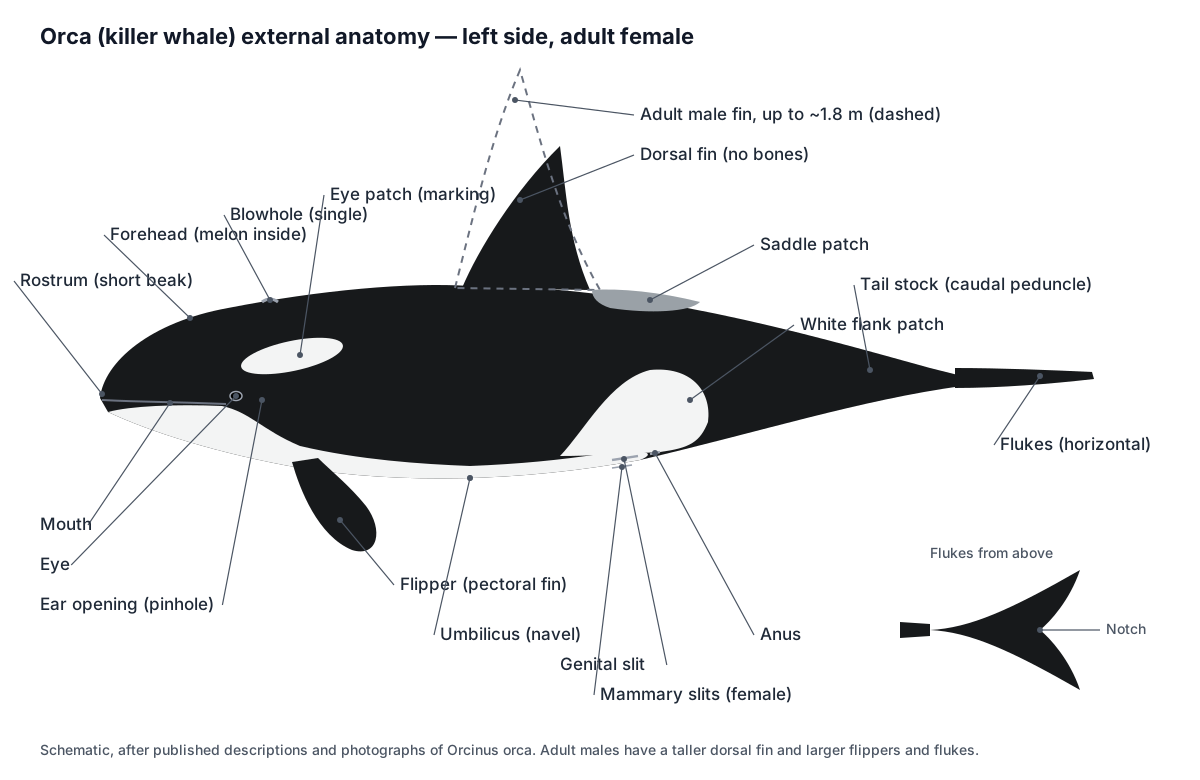
Whale anatomy diagram: external parts of an orca
The external anatomy of a whale includes the rostrum, melon (forehead), blowhole, eyes, tiny ear openings, mouth, two flippers, a dorsal fin (absent in some species), the tail stock or caudal peduncle, the flukes, the umbilicus, the genital slit and the anus. Females also have two mammary slits beside the genital slit.
| Fin | Paired? | Bones inside? | Main job |
|---|---|---|---|
| Flippers | Yes | Yes: arm and hand bones | Steering, turning and braking |
| Dorsal fin | No | No: dense connective tissue | Stability against rolling; heat exchange |
| Flukes | No (two blades) | No, apart from the last tail vertebrae in the middle | Thrust, up and down |
The orca's colour pattern is also part of its external anatomy: the white eye patch above and behind the real eye, the grey saddle patch behind the dorsal fin, and a white belly that sweeps up into a flank patch. Researchers use these markings, along with nicks in the dorsal fin, to identify individuals.
Whale internal anatomy
Inside a whale, the long, unlobed lungs lie high in the chest along the spine, above the heart. A very oblique diaphragm separates them from the abdomen, which holds the two-lobed liver (with no gallbladder), the multi-chambered stomach, the long intestine, the reniculate kidneys on the roof of the abdomen and the internal gonads. The head contains the brain, the melon and the nasal passages that lead from the blowhole to the larynx.
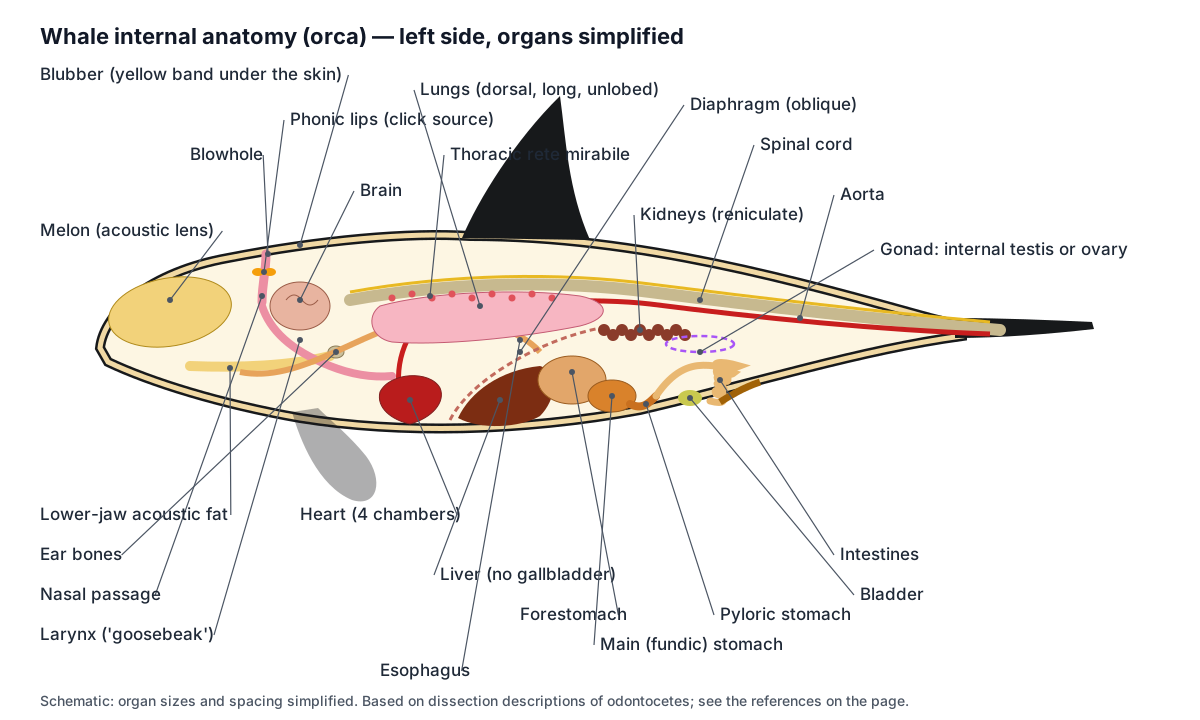
Whale anatomy labeled: every part and its function
This is the text version of the 3D model: every labeled structure of the orca, grouped by body system.
External
- Head (Rostrum and forehead (melon region))
- The blunt, rounded front of the orca, from the short, indistinct beak (rostrum) back past the blowhole. Holds the brain, jaws, eyes, ears and the sound-producing nasal complex. The rounded forehead is shaped by the fatty melon underneath.
- Trunk (Body, skin over the thorax and abdomen)
- The thick, spindle-shaped middle of the body, black above with a white belly and a white flank patch. Encloses the thoracic and abdominal cavities. The smooth, hairless skin lowers drag; the bold colour pattern is used by researchers to identify individuals.
- Tail stock (Caudal peduncle)
- The muscular, tapering, side-to-side flattened region between the anus and the flukes. Moves the flukes up and down. It is deep and narrow, so it slices through the water with little drag on each stroke.
- Mouth (Gape, lips)
- A long mouth line running from the tip of the rostrum back to below the eye. Takes in prey. Orcas grip and tear prey with their teeth and swallow pieces whole; they do not chew.
- Blowhole (External naris (nostril))
- A single crescent-shaped nostril on top of the head, closed by a muscular flap except when breathing. The only airway opening. The whale exhales explosively (the visible 'blow' or spout) and inhales quickly at the surface, then the blowhole closes.
- Eye
- A small eye just above and behind the corner of the mouth, below the white eye patch. Sees both in water and in air. A reflective layer (tapetum lucidum) helps in dim light.
- Eye patch (Postocular patch)
- The oval white marking above and behind each eye. It is not the eye itself. Pigment pattern only. Its shape and angle differ between populations and help scientists recognise orca ecotypes.
- Ear opening (External auditory meatus)
- A pinhole-sized opening behind the eye, with no outer ear flap (pinna). The external ear canal is extremely narrow and probably plays little part in hearing underwater; sound reaches the ear mainly through fat in the lower jaw.
- Saddle patch
- The grey saddle-shaped area on the back just behind the dorsal fin. Pigment pattern. Together with nicks and scars on the dorsal fin, it is used to identify individual orcas in photographs.
- Dorsal fin
- The tall fin in the middle of the back: up to about 1.8 m and triangular in adult males, about 0.9 m and curved (falcate) in females. Stabilises the whale against rolling and helps shed heat. Switch between Female and Male to compare its size.
- Flippers (Pectoral flippers, forelimbs)
- Broad, rounded, paddle-shaped front limbs, much larger in adult males. Steering, turning and braking. Thrust comes from the flukes, not the flippers.
- Flukes (Tail flukes, caudal fin)
- The two horizontal tail blades, with a notch between them in the midline. Produce thrust on both the up- and downstroke. They work like a hydrofoil.
- Genital slit (Urogenital opening)
- A slit on the belly that hides the penis in males and holds the vaginal opening in females. Keeps the genitals inside the streamlined body except during mating, urination or birth.
- Anus
- The opening of the rectum, behind the genital slit. Releases faeces.
- Mammary slits · females only
- Two short slits, one each side of the female's genital slit, each hiding a nipple. The nipples protrude from these slits when the calf nurses; the calf takes the nipple and milk is squirted into its mouth by muscles around the gland.
- Umbilicus (Navel)
- The belly button: the scar where the umbilical cord attached before birth. No function after birth; it shows that whales are placental mammals.
- Blubber (Hypodermis)
- A thick layer of fat and collagen fibres under the skin that wraps the whole body. Insulates, stores energy, streamlines the body and helps buoyancy. Its collagen fibres also make it springy, which may store energy during swimming.
Skeletal
- Cranium (Braincase, telescoped skull)
- The short, high, wide back part of the skull that encloses the brain, with the bony nostrils (nares) on its top. Protects the brain and anchors the jaw, neck and nasal muscles. The bony nares on its vertex lead up to the blowhole.
- Rostrum (Maxillae and premaxillae (upper jaw))
- The long front part of the skull formed by the maxillae and premaxillae, which carries the upper teeth. Forms the upper jaw and supports the melon above it.
- Mandible (Lower jaw, pan bone)
- The two long, straight halves of the lower jaw; their thin, hollow back portion is called the pan bone. Holds the lower teeth for gripping prey, and its fat-filled hollow pan bone channels sound back to the ear.
- Teeth (Conical teeth (homodont))
- Large, cone-shaped teeth, all alike, that interlock when the jaws close. Orcas typically have 10–12 (occasionally up to 14) per jaw quadrant, about 40–56 in total. Grip and tear prey. Whales have only one set of teeth for life (monophyodont) and do not chew.
- Hyoid apparatus
- A U-shaped set of bones in the throat that anchors the tongue and throat muscles. Moves the tongue and throat. In suction feeders such as beaked whales and belugas it is large and drives suction.
- Cervical vertebrae (Neck vertebrae (7))
- Seven very short, flat neck vertebrae, several of them fused together in the orca. Give the head a stiff, stable connection to the body, which helps streamlining at speed.
- Thoracic vertebrae (Rib-bearing vertebrae (11–13))
- The 11–13 vertebrae of the chest, each carrying a pair of ribs. Support the ribs and the roof of the thorax.
- Lumbar vertebrae (10–12 in the orca)
- Large vertebrae with long side processes and tall spines, behind the last rib. Anchor the huge swimming muscles that power the flukes.
- Caudal vertebrae (Tail vertebrae (20–24))
- The 20–24 tail vertebrae, getting smaller towards the flukes. Form the flexible axis that the swimming muscles bend up and down.
- Chevron bones (Haemal arches)
- Small V- or Y-shaped bones under the joints between caudal vertebrae. Protect the main tail artery and vein and give extra leverage to the muscles that pull the flukes down.
- Ribs
- Long, curved ribs, one pair per thoracic vertebra; only the first few connect to the sternum. Protect the heart and lungs while letting the chest collapse safely under water pressure during deep dives.
- Sternum (Breastbone)
- A short, flat breastbone on the underside of the chest. Anchors the first few pairs of ribs.
- Scapula (Shoulder blade)
- A broad, fan-shaped shoulder blade that lies against the body wall above each flipper. Forms the shoulder joint, the only freely movable joint of the flipper.
- Humerus (Upper arm bone)
- A short, stout upper arm bone at the base of the flipper. Connects the flipper to the shoulder blade at a ball-and-socket joint.
- Radius and ulna (Forearm bones)
- Two short, flattened forearm bones side by side, with the radius at the leading edge. Stiffen the front half of the flipper.
- Carpals (Wrist bones)
- A mosaic of small, flat wrist bones embedded in cartilage. Link the forearm to the finger bones.
- Metacarpals and phalanges (Finger bones, hyperphalangy)
- Five fingers' worth of bones, with extra finger bones (phalanges) in the middle digits, a condition called hyperphalangy. Lengthen and stiffen the flipper blade.
- Pelvic bones (Vestigial pelvis)
- A pair of small, rod-shaped bones floating in the muscle near the genital slit, not attached to the spine. Anchor the muscles that control the penis in males and the genital region in females. There are no hind limbs and no knees.
Muscular
- Epaxial muscles (Back muscles, upstroke muscles)
- The large muscles above the vertebral column (shown on the right side only). Lift the tail stock and flukes on the upstroke.
- Hypaxial muscles (Belly and tail muscles, downstroke muscles)
- The muscles below the vertebral column, largest in the tail stock (shown on the right side only). Pull the tail stock and flukes down on the downstroke.
- Diaphragm
- A thin, very oblique sheet of muscle that separates the thorax from the abdomen. Helps to fill the lungs at the surface. Its slant lets the long lungs extend far back along the spine.
Nervous
- Cerebrum (Cerebral hemispheres)
- The large, heavily folded front part of the brain, wider than it is long. Processes hearing, vision, touch and movement; the auditory areas are especially large in toothed whales.
- Cerebellum
- The rear, lower part of the brain that coordinates movement. Coordinates swimming, posture and probably processing of sound.
- Brainstem (Medulla, pons, midbrain)
- The stalk that connects the brain to the spinal cord. Controls breathing, heart rate and the dive response. Whales breathe voluntarily: each breath is a conscious act.
- Spinal cord
- The nerve cord running through the vertebral canal. Carries signals between the brain and the body and contains the circuits for the rhythmic swimming stroke.
Sensory & echolocation
- Melon (Acoustic fat lens)
- A rounded body of special fat in the forehead, in front of the blowhole. Focuses the clicks made at the phonic lips into a forward-pointing sound beam, like an acoustic lens.
- Phonic lips (Monkey lips/dorsal bursae (MLDB) complex)
- Pairs of fatty, lip-like tissues in the nasal passage below the blowhole, where echolocation clicks are made. Air pushed past the lips makes them slap together and produce a click. The sound passes forward into the melon.
- Nasal air sacs (Vestibular and premaxillary sacs)
- Flattened air sacs branching off the nasal passage around the blowhole. Recycle air for sound production while the blowhole is shut, and reflect sound forward into the melon.
- Mandibular fat bodies (Acoustic fat of the lower jaw)
- Channels of special fat inside and beside the hollow back of the lower jaw. Conduct returning echoes from the water to the middle and inner ear.
- Tympanoperiotic complex (Ear bones (tympanic bulla and periotic))
- The dense bony capsules of the middle and inner ear, hanging below the skull. Hear sound, including echolocation echoes. They are isolated from the skull by air sinuses so each ear hears independently.
Respiratory
- Nasal passage (Spiracular cavity, bony nares)
- The near-vertical airway from the blowhole down to the bony nostrils on the skull. Carries air between the blowhole and the larynx. It is the only route air can take.
- Nasal plugs
- Muscular, fatty plugs that seal the bony nostrils. Keep water out of the airway during dives; muscles pull them aside to breathe.
- Larynx ('Goosebeak', arytenoepiglottic tube)
- A long tube of cartilage (the epiglottis and arytenoids) that pokes up through the throat and plugs into the nasal passage. Connects the nasal passage directly to the trachea, so food and air never cross: the whale can swallow under water without inhaling it.
- Trachea (Windpipe)
- A short, wide windpipe reinforced with cartilage rings. Moves large volumes of air very quickly: whales empty and refill most of their lungs in one breath.
- Lungs
- Two long, unlobed lungs lying high in the thorax along the spine. Exchange gases at the surface. During deep dives the alveoli collapse, which stops nitrogen entering the blood.
Circulatory
- Heart
- A four-chambered mammalian heart, broad and somewhat flattened, low in the chest. Pumps blood around two circuits (lungs and body). During dives the heart rate slows (bradycardia) to save oxygen.
- Aorta
- The main artery: it arches up from the heart and runs back under the spine to the tail. Carries oxygen-rich blood to the body.
- Posterior vena cava (Caudal vena cava)
- The large vein returning blood from the abdomen and tail to the heart. Returns oxygen-poor blood to the heart.
- Thoracic rete mirabile ('Wonderful net')
- A dense mesh of small coiled arteries lining the roof of the thorax beside the spine. Supplies the brain and may buffer the pulse of blood pressure and store blood during dives.
- Counter-current heat exchangers (Periarterial venous retia)
- Arteries wrapped in veins in the flippers, dorsal fin and flukes. Warm arterial blood heats the cold blood returning in the veins, so little heat is lost. When the whale is hot, blood bypasses the exchangers and the fins dump heat.
- Spleen
- A small, round organ beside the stomach, often with extra small accessory spleens. Filters blood and stores red blood cells.
Digestive
- Tongue
- A muscular tongue on the floor of the mouth. Helps to move prey to the throat. Newborn calves fold its edges to form a tube for nursing.
- Esophagus
- The muscular food tube from the throat to the forestomach. Carries swallowed prey to the stomach. Prey is swallowed whole or in large chunks.
- Forestomach (First chamber, non-glandular stomach)
- A large, muscular first stomach chamber lined with tough, skin-like epithelium and no digestive glands. Stores and mechanically crushes prey, a little like a bird's gizzard. Whales cannot chew.
- Main stomach (Fundic chamber, glandular stomach)
- The second, glandular chamber where acid and enzymes digest food. Chemical digestion of prey with gastric acid and pepsin.
- Pyloric stomach (Connecting channel and pyloric chamber)
- A narrow tube-like final stomach chamber, joined to the main stomach by a connecting channel. Continues digestion and releases food into the intestine through the pyloric sphincter.
- Duodenal ampulla
- A swollen first part of the small intestine, easily mistaken for another stomach chamber. Receives bile and pancreatic juice, which enter through a shared duct.
- Liver
- A large, two-lobed liver just behind the diaphragm. Whales have no gallbladder. Processes nutrients, makes bile, stores glycogen and helps clear lactate after dives.
- Pancreas
- A long gland lying along the duodenum. Makes digestive enzymes and the hormones insulin and glucagon.
- Small intestine
- A long, narrow, coiled intestine that fills much of the abdomen. Digests and absorbs food.
- Large intestine and rectum (Colon)
- The final stretch of the gut, ending at the anus. Absorbs water and stores faeces.
Urinary
- Kidneys (Reniculate kidneys)
- Two long kidneys made of hundreds of small lobes (renculi), like bunches of grapes. Filter the blood and make concentrated urine; whales get most of their water from food and metabolism.
- Ureters
- Tubes that carry urine from the kidneys to the bladder. Transport urine by waves of muscle contraction in their walls.
- Urinary bladder
- A small, muscular bladder near the genital slit. Stores urine until it is released through the genital slit.
Reproductive
- Testes · males only
- Two long, smooth testes kept permanently inside the abdomen; there is no scrotum. Make sperm and testosterone.
- Epididymis and ductus deferens (Sperm ducts) · males only
- Coiled ducts on each testis and the tubes leading to the urethra. Store and carry sperm.
- Prostate gland · males only
- A gland around the urethra at the root of the penis. Adds fluid to the semen. Whales have no seminal vesicles.
- Penis (Fibroelastic penis) · males only
- A fibroelastic penis that lies folded in an S-shape inside the body and is extended through the genital slit only for mating. Transfers sperm. Retractor muscles pull it back into the body; muscles anchored on the pelvic bones control its movement.
- Ovaries · females only
- Two ovaries on the roof of the abdomen behind the kidneys. Release eggs and make sex hormones.
- Uterus (Bicornuate uterus) · females only
- A uterus with two horns that join into a short body. Holds the fetus. Orca pregnancy lasts about 15–18 months and produces a single calf (NOAA).
- Vagina · females only
- The birth canal, opening in the genital slit; it has a series of folds in its wall. Receives the penis and forms the birth canal.
- Mammary glands · females only
- Two long, flat milk glands under the belly blubber, one each side of the genital slit. Produce very fat-rich milk for the calf; the nipples sit in the mammary slits.
Whale skeleton and bones
A whale skeleton has a telescoped skull, seven short neck vertebrae, a long backbone with no sacrum, ribs, a small sternum, flipper bones homologous to a human arm and hand, and a pair of tiny pelvic bones that are not attached to the spine. There are no bones in the flukes or dorsal fin. Whale bones are spongy and full of oil, which helps buoyancy.

- Cranium: The short, high, wide back part of the skull that encloses the brain, with the bony nostrils (nares) on its top. Protects the brain and anchors the jaw, neck and nasal muscles. The bony nares on its vertex lead up to the blowhole.
- Rostrum: The long front part of the skull formed by the maxillae and premaxillae, which carries the upper teeth. Forms the upper jaw and supports the melon above it.
- Mandible: The two long, straight halves of the lower jaw; their thin, hollow back portion is called the pan bone. Holds the lower teeth for gripping prey, and its fat-filled hollow pan bone channels sound back to the ear.
- Teeth: Large, cone-shaped teeth, all alike, that interlock when the jaws close. Orcas typically have 10–12 (occasionally up to 14) per jaw quadrant, about 40–56 in total. Grip and tear prey. Whales have only one set of teeth for life (monophyodont) and do not chew.
- Cervical vertebrae: Seven very short, flat neck vertebrae, several of them fused together in the orca. Give the head a stiff, stable connection to the body, which helps streamlining at speed.
- Thoracic vertebrae: The 11–13 vertebrae of the chest, each carrying a pair of ribs. Support the ribs and the roof of the thorax.
- Lumbar vertebrae: Large vertebrae with long side processes and tall spines, behind the last rib. Anchor the huge swimming muscles that power the flukes.
- Caudal vertebrae: The 20–24 tail vertebrae, getting smaller towards the flukes. Form the flexible axis that the swimming muscles bend up and down.
- Chevron bones: Small V- or Y-shaped bones under the joints between caudal vertebrae. Protect the main tail artery and vein and give extra leverage to the muscles that pull the flukes down.
- Ribs: Long, curved ribs, one pair per thoracic vertebra; only the first few connect to the sternum. Protect the heart and lungs while letting the chest collapse safely under water pressure during deep dives.
- Scapula: A broad, fan-shaped shoulder blade that lies against the body wall above each flipper. Forms the shoulder joint, the only freely movable joint of the flipper.
- Metacarpals and phalanges: Five fingers' worth of bones, with extra finger bones (phalanges) in the middle digits, a condition called hyperphalangy. Lengthen and stiffen the flipper blade.
- Pelvic bones: A pair of small, rod-shaped bones floating in the muscle near the genital slit, not attached to the spine. Anchor the muscles that control the penis in males and the genital region in females. There are no hind limbs and no knees.
Whale skull anatomy: telescoping
Roston & Roth (2019) define telescoping as two linked features of modern cetacean skulls: bones that sit at opposite ends of the skull in other mammals end up close together, and they get there by extensively overlapping the bones that would normally separate them. The result is a short braincase with the nostrils on top, and a long rostrum in front. Toothed and baleen whales did this in different ways, and the overlap happens at the sutures between bones. (Roston & Roth (2019): cetacean skull telescoping brings evolution of cranial sutures into focus, Anat. Rec. 302 (PMC).)
Do whales have legs or knees?
No. Living whales have no hind legs, no feet and no knees. Their land-dwelling ancestors had four legs, but all that remains of the hind limbs is a pair of small pelvic bones buried in the muscle near the genital slit. Some baleen whales occasionally have a tiny vestigial femur attached to them. The front legs became the flippers, which still contain a shoulder, upper arm, forearm, wrist and fingers.
The pelvic bones are not useless. They anchor the muscles of the penis and genital region, and Dines et al. (2014), who measured 130 pelvises from 29 species, found that males of species with more intense sperm competition have larger pelvic bones for their body size. Videos of "beluga knees" actually show a beluga's flexible neck: belugas have unfused neck vertebrae.
Whale blowhole anatomy
A whale's blowhole is its nostril, moved to the top of its head. Toothed whales have one blowhole and baleen whales have two side by side. The blowhole is closed at rest by muscular lips and nasal plugs; the whale opens it only to breathe, exhaling explosively and inhaling quickly at the surface. The visible "spout" is warm, moist breath and sea water sprayed from around the opening, not water from the mouth.
- Blowhole: A single crescent-shaped nostril on top of the head, closed by a muscular flap except when breathing. The only airway opening. The whale exhales explosively (the visible 'blow' or spout) and inhales quickly at the surface, then the blowhole closes.
- Nasal passage: The near-vertical airway from the blowhole down to the bony nostrils on the skull. Carries air between the blowhole and the larynx. It is the only route air can take.
- Nasal plugs: Muscular, fatty plugs that seal the bony nostrils. Keep water out of the airway during dives; muscles pull them aside to breathe.
- Nasal air sacs: Flattened air sacs branching off the nasal passage around the blowhole. Recycle air for sound production while the blowhole is shut, and reflect sound forward into the melon.
- Larynx: A long tube of cartilage (the epiglottis and arytenoids) that pokes up through the throat and plugs into the nasal passage. Connects the nasal passage directly to the trachea, so food and air never cross: the whale can swallow under water without inhaling it.
Because the larynx plugs straight into the nasal passage, a whale cannot breathe through its mouth, and it can swallow under water without inhaling. In toothed whales the nasal passages also carry the phonic lips that make echolocation clicks. The shape of the blow differs between species: right whales, with two widely spaced blowholes, make a V-shaped blow, and the sperm whale's single blowhole at the front left of its head makes a blow angled forwards and to the left.
Echolocation: the melon, phonic lips and lower jaw
Toothed whales echolocate by making clicks at the phonic lips in their nasal passages, focusing them into a beam through the fatty melon, and listening for echoes through fat-filled channels in the lower jaw that lead to the ear bones. Baleen whales have no melon and are not known to echolocate.
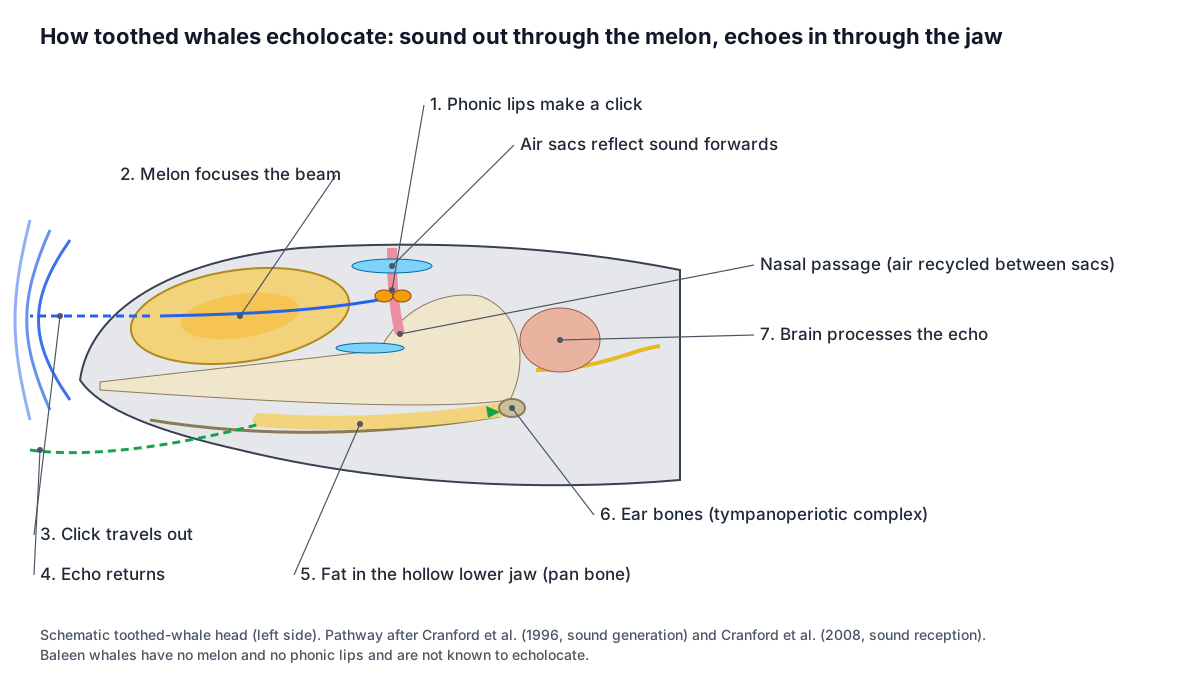
- Phonic lips: Pairs of fatty, lip-like tissues in the nasal passage below the blowhole, where echolocation clicks are made. Air pushed past the lips makes them slap together and produce a click. The sound passes forward into the melon.
- Melon: A rounded body of special fat in the forehead, in front of the blowhole. Focuses the clicks made at the phonic lips into a forward-pointing sound beam, like an acoustic lens.
- Nasal air sacs: Flattened air sacs branching off the nasal passage around the blowhole. Recycle air for sound production while the blowhole is shut, and reflect sound forward into the melon.
- Mandibular fat bodies: Channels of special fat inside and beside the hollow back of the lower jaw. Conduct returning echoes from the water to the middle and inner ear.
- Tympanoperiotic complex: The dense bony capsules of the middle and inner ear, hanging below the skull. Hear sound, including echolocation echoes. They are isolated from the skull by air sinuses so each ear hears independently.
Cranford et al. (1996) scanned and dissected 40 heads from 19 toothed-whale species and found the same sound generator in all of them: a pair of fatty bursae set in connective-tissue lips, with a cartilage blade, ligament and air sacs. Later work on Cuvier's beaked whale traced a lipid-rich channel from the water to the bony ear and showed that air sinuses isolate the ears from the skull (Cranford et al., 2008).
Whale flipper, fin, fluke and tail anatomy
A whale has three kinds of fin. The flippers are modified front legs with bones inside and are used for steering. The dorsal fin and the flukes have no bones: they are made of dense fibrous tissue under the skin. The flukes are horizontal and produce thrust as the tail stock moves up and down.
- Flippers: Broad, rounded, paddle-shaped front limbs, much larger in adult males. Steering, turning and braking. Thrust comes from the flukes, not the flippers.
- Humerus: A short, stout upper arm bone at the base of the flipper. Connects the flipper to the shoulder blade at a ball-and-socket joint.
- Radius and ulna: Two short, flattened forearm bones side by side, with the radius at the leading edge. Stiffen the front half of the flipper.
- Carpals: A mosaic of small, flat wrist bones embedded in cartilage. Link the forearm to the finger bones.
- Metacarpals and phalanges: Five fingers' worth of bones, with extra finger bones (phalanges) in the middle digits, a condition called hyperphalangy. Lengthen and stiffen the flipper blade.
- Dorsal fin: The tall fin in the middle of the back: up to about 1.8 m and triangular in adult males, about 0.9 m and curved (falcate) in females. Stabilises the whale against rolling and helps shed heat. Switch between Female and Male to compare its size.
- Flukes: The two horizontal tail blades, with a notch between them in the midline. Produce thrust on both the up- and downstroke. They work like a hydrofoil.
- Tail stock: The muscular, tapering, side-to-side flattened region between the anus and the flukes. Moves the flukes up and down. It is deep and narrow, so it slices through the water with little drag on each stroke.
- Epaxial muscles: The large muscles above the vertebral column (shown on the right side only). Lift the tail stock and flukes on the upstroke.
- Hypaxial muscles: The muscles below the vertebral column, largest in the tail stock (shown on the right side only). Pull the tail stock and flukes down on the downstroke.
Cetaceans are the only mammals with hyperphalangy, more than three bones per finger (Cooper et al., 2018). Toothed whales keep five digits, while most baleen whales have four (Cooper et al., 2007). The orca's flippers are broad and rounded; humpback flippers are long and narrow with bumps along the front edge.
Whale heart: how big is a blue whale's heart?
A whale's heart is a four-chambered mammalian heart, like ours, low in the chest between the flippers. The only blue whale heart ever preserved, at the Royal Ontario Museum in Toronto, is about 1.5 m tall and 1.2 m wide; Guinness World Records lists it at 199.5 kg (440 lb), while news reports quoted about 180 kg (400 lb). It came from a blue whale about 24 m long that died in sea ice off Newfoundland in 2014.
- Heart: A four-chambered mammalian heart, broad and somewhat flattened, low in the chest. Pumps blood around two circuits (lungs and body). During dives the heart rate slows (bradycardia) to save oxygen.
- Aorta: The main artery: it arches up from the heart and runs back under the spine to the tail. Carries oxygen-rich blood to the body.
- Posterior vena cava: The large vein returning blood from the abdomen and tail to the heart. Returns oxygen-poor blood to the heart.
- Thoracic rete mirabile: A dense mesh of small coiled arteries lining the roof of the thorax beside the spine. Supplies the brain and may buffer the pulse of blood pressure and store blood during dives.
- Counter-current heat exchangers: Arteries wrapped in veins in the flippers, dorsal fin and flukes. Warm arterial blood heats the cold blood returning in the veins, so little heat is lost. When the whale is hot, blood bypasses the exchangers and the fins dump heat.
During a dive the heart slows (bradycardia) and blood is redirected to the brain and heart, while muscles work on oxygen stored in their own myoglobin. Networks of small vessels called retia mirabilia line the chest and spinal canal, and counter-current heat exchangers in the fins control heat loss.
Whale lungs and breathing
Whales breathe with two long, unlobed lungs high in the chest. They breathe voluntarily, exchange most of their lung air in one breath, and let their lungs collapse during deep dives so that little nitrogen enters the blood. Cartilage keeps even the small airways open while the alveoli collapse.
Whale larynx and lungs: breathing without choking
In most land mammals the larynx sits level with the first three neck vertebrae. Reidenberg & Laitman (1987) dissected 17 toothed whales from nine genera and found the larynx far forward, extending above the foramen magnum, because it is elongated into a tube that projects past the soft palate into the nasopharynx, the neck is short, and the skull base lines up with the spine. This 'goosebeak' locks the airway into the nose, so food passes around it to the esophagus. (Reidenberg & Laitman (1987): position of the larynx in Odontoceti (toothed whales), Anat. Rec. 218.)
Lung size varies with diving style. Piscitelli et al. (2010) found that the lungs of deep-diving pygmy and dwarf sperm whales were half the mass and one fifth the volume of those of similar-sized bottlenose dolphins. Across families, deep divers (kogiids, sperm whales, beaked whales) had lung-to-body-mass ratios similar to land mammals, while dolphins and porpoises had relatively large lungs. Small lungs carry less nitrogen down, and the flexible ribcage lets the chest collapse under pressure. (Piscitelli et al. (2010): lung size and thoracic morphology in shallow- and deep-diving cetaceans, J. Morphol. 271.)
Whale stomach and digestive system
Whales have one stomach divided into chambers: in the orca, a muscular, non-glandular forestomach that crushes prey, a glandular main stomach that digests it, and a tubular pyloric stomach, followed by a swollen duodenal ampulla. Whales swallow prey whole and do not chew. The liver has no gallbladder.
- Esophagus: The muscular food tube from the throat to the forestomach. Carries swallowed prey to the stomach. Prey is swallowed whole or in large chunks.
- Forestomach: A large, muscular first stomach chamber lined with tough, skin-like epithelium and no digestive glands. Stores and mechanically crushes prey, a little like a bird's gizzard. Whales cannot chew.
- Main stomach: The second, glandular chamber where acid and enzymes digest food. Chemical digestion of prey with gastric acid and pepsin.
- Pyloric stomach: A narrow tube-like final stomach chamber, joined to the main stomach by a connecting channel. Continues digestion and releases food into the intestine through the pyloric sphincter.
- Duodenal ampulla: A swollen first part of the small intestine, easily mistaken for another stomach chamber. Receives bile and pancreatic juice, which enter through a shared duct.
- Liver: A large, two-lobed liver just behind the diaphragm. Whales have no gallbladder. Processes nutrients, makes bile, stores glycogen and helps clear lactate after dives.
- Pancreas: A long gland lying along the duodenum. Makes digestive enzymes and the hormones insulin and glucagon.
- Small intestine: A long, narrow, coiled intestine that fills much of the abdomen. Digests and absorbs food.
Whale stomach, liver and kidneys
A detailed dissection of 19 franciscana dolphins summarised several cetacean digestive features: the cetacean liver lacks a gallbladder, so bile flows straight to the duodenum; there is no clear boundary between small and large intestine because toothed whales have no caecum (the Ganges river dolphin is the exception); and stomachs are multi-chambered. Not all species have the same chambers: the franciscana has no forestomach, whereas orcas and baleen whales do. (Tostado-Marcos et al. (2024): digestive system of the franciscana dolphin, Animals 14 (PMC).)
Cetacean and pinniped kidneys are reniculate: each kidney is made of many small lobes (renculi), each with its own cortex, medulla and calyx. Ortiz (2001) notes this structure does not give them a greater concentrating ability than land mammals; whales get water mainly from food and metabolism and rarely drink sea water. (Ortiz (2001): osmoregulation in marine mammals, J. Exp. Biol. 204.)
Whale brain, eye and ear
Whales have large, highly folded brains; big male sperm whales and orcas have the largest brains of all toothed whales. Their eyes are small but work in water and air, and they hear mainly through the lower jaw rather than the pinhole ear canal. Toothed whales have no sense of smell; baleen whales keep a reduced one.
- Cerebrum: The large, heavily folded front part of the brain, wider than it is long. Processes hearing, vision, touch and movement; the auditory areas are especially large in toothed whales.
- Cerebellum: The rear, lower part of the brain that coordinates movement. Coordinates swimming, posture and probably processing of sound.
- Brainstem: The stalk that connects the brain to the spinal cord. Controls breathing, heart rate and the dive response. Whales breathe voluntarily: each breath is a conscious act.
- Eye: A small eye just above and behind the corner of the mouth, below the white eye patch. Sees both in water and in air. A reflective layer (tapetum lucidum) helps in dim light.
- Ear opening: A pinhole-sized opening behind the eye, with no outer ear flap (pinna). The external ear canal is extremely narrow and probably plays little part in hearing underwater; sound reaches the ear mainly through fat in the lower jaw.
- Tympanoperiotic complex: The dense bony capsules of the middle and inner ear, hanging below the skull. Hear sound, including echolocation echoes. They are isolated from the skull by air sinuses so each ear hears independently.
Be careful with claims about whale intelligence. Large spindle neurons (von Economo neurons) have been found in humpback, fin and large toothed whales, but their function is not known, and brain size alone does not measure intelligence.
Whale eye and brain
Peichl et al. (2001) stained the retinas of seven toothed-whale species and found no short-wavelength (blue) cones at all: whales have only long-wavelength cones and are essentially colour-blind. The same loss happened independently in seals, which suggests an advantage in the ocean's light environment. (Peichl, Behrmann & Kröger (2001): for whales and seals the ocean is not blue, Eur. J. Neurosci. 13.)
Whale mouth: baleen vs teeth
Toothed whales have a mouth full of simple, cone-shaped teeth for gripping prey, which they swallow whole. Baleen whales have no teeth as adults; instead, hundreds of baleen plates made of keratin (the protein in fingernails) hang from the upper jaw and sieve krill, copepods or small fish from the water.
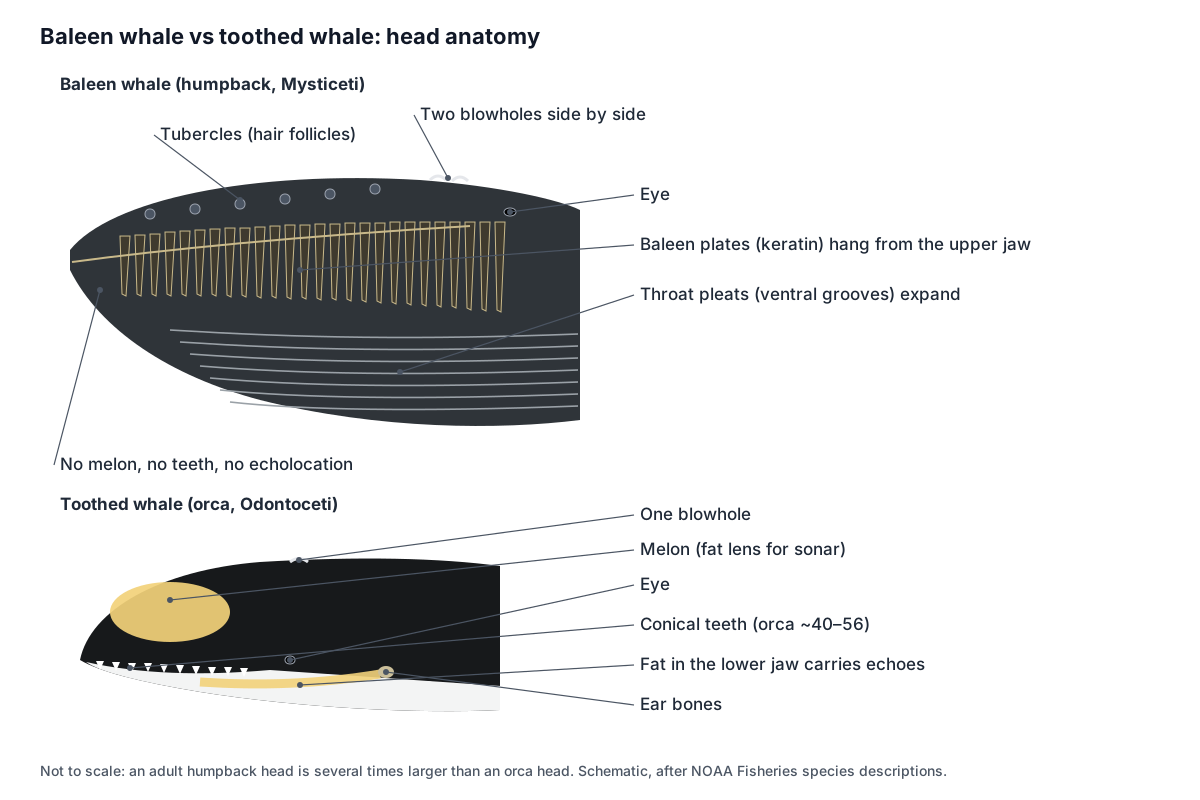
| Feature | Toothed whales (Odontoceti) | Baleen whales (Mysticeti) |
|---|---|---|
| Examples | Orca, sperm whale, beluga, pilot whales, dolphins | Blue, fin, humpback, gray, bowhead, right whales |
| Feeding | Teeth grip prey; swallowed whole | Baleen plates filter small prey |
| Blowholes | One | Two |
| Melon & echolocation | Yes | No melon; no echolocation known |
| Skull | Asymmetrical around the nares | Symmetrical; huge arched rostrum |
| Throat | Smooth (some have a few throat grooves) | Rorquals have many expandable throat pleats |
| Size | 1.5 m porpoises to 16 m sperm whales | Most are large; blue whale up to about 33 m |
| Flipper digits | Five | Usually four |
Whale reproductive anatomy: male vs female
Male and female whales both keep their reproductive organs inside the body for streamlining. Males have internal testes and a fibroelastic penis that stays folded inside the genital slit except during mating. Females have ovaries, a two-horned uterus, a vagina opening into the genital slit, and two mammary glands whose nipples sit in mammary slits. Use the Female/Male switch in the 3D model to compare them.
| Male whale | Female whale | |
|---|---|---|
| Gonads | Two internal testes behind the kidneys, cooled by blood from the fins and flukes | Two ovaries; each ovulation leaves a lifelong scar |
| Ducts & organs | Epididymis, ductus deferens, prostate; no seminal vesicles | Bicornuate uterus, cervix, vagina |
| External | Genital slit well in front of the anus | Genital slit close to the anus, with a mammary slit on each side |
| Pelvic bones | Larger; anchor the penis muscles | Smaller |
| Orca specifics | Taller dorsal fin (up to ~1.8 m), larger flippers and flukes | Pregnancy about 15–18 months, one calf |
- Testes: Two long, smooth testes kept permanently inside the abdomen; there is no scrotum. Make sperm and testosterone.
- Penis: A fibroelastic penis that lies folded in an S-shape inside the body and is extended through the genital slit only for mating. Transfers sperm. Retractor muscles pull it back into the body; muscles anchored on the pelvic bones control its movement.
- Ovaries: Two ovaries on the roof of the abdomen behind the kidneys. Release eggs and make sex hormones.
- Uterus: A uterus with two horns that join into a short body. Holds the fetus. Orca pregnancy lasts about 15–18 months and produces a single calf (NOAA).
- Mammary glands: Two long, flat milk glands under the belly blubber, one each side of the genital slit. Produce very fat-rich milk for the calf; the nipples sit in the mammary slits.
Whale species anatomy compared
Every whale shares the same basic plan, but species differ in size, feeding apparatus, fins and head shape. This table summarises the species most often searched for; the sections below give the details and sources.
| Species | Group | Maximum size (NOAA) | Distinctive anatomy |
|---|---|---|---|
| Orca (Orcinus orca) | Toothed | ≈9.8 m, 11 tons | Tall dorsal fin, eye and saddle patches, 40–56 conical teeth |
| Sperm whale (Physeter macrocephalus) | Toothed | ≈16 m (males), 45 tons | Head a third of body length, spermaceti organ, blowhole front-left |
| Beluga (Delphinapterus leucas) | Toothed | ≈4.9 m | White skin, no dorsal fin, flexible melon, unfused neck |
| Short-finned pilot whale (Globicephala macrorhynchus) | Toothed | ≈7.3 m | Bulbous melon, low wide dorsal fin, 7–9 teeth per row |
| Blue whale (Balaenoptera musculus) | Baleen | ≈33.5 m, 150 t | Largest animal; throat pleats; heart about 180–200 kg |
| Fin whale (B. physalus) | Baleen | ≈26 m, 80 tons | Right lower jaw white, left dark; 50–100 pleats |
| Humpback (Megaptera novaeangliae) | Baleen | ≈18 m, 40 tons | Very long flippers with tubercles; flukes up to 5.5 m wide |
| Gray whale (Eschrichtius robustus) | Baleen | ≈15 m | Dorsal hump and knuckles; short coarse baleen; bottom feeder |
| Bowhead (Balaena mysticetus) | Baleen | ≈19 m | Longest baleen, thickest blubber, ice-breaking skull, no dorsal fin |
| North Atlantic right whale (Eubalaena glacialis) | Baleen | ≈16 m | Callosities, no dorsal fin, V-shaped blow |
Killer whale (orca) anatomy
The orca or killer whale, Orcinus orca, is a toothed whale and the largest member of the dolphin family, Delphinidae. NOAA Fisheries gives a maximum of about 9.8 m (32 ft) and 11 tons. Adult males average about 8 m and females about 7 m (Animal Diversity Web). Adult males have disproportionately larger flippers, dorsal fins and flukes than females, and NOAA describes three North Pacific ecotypes that differ slightly in fin shape and saddle patch: residents with rounded fin tips, transients (Bigg's) with straighter fins and more solid grey saddles, and the smaller offshores. (NOAA Fisheries: killer whale (Orcinus orca).)
The male's dorsal fin is erect and triangular and can reach about 1.8 m; the female's is about 0.9 m and curved backwards. Both sexes have a white spot above and behind each eye, a grey saddle patch behind the fin, and white extending from the chin to just past the anus. The ear openings are small, sit behind the eyes and have no outer flap. (Animal Diversity Web: Orcinus orca.)
Orca teeth are large, cone-shaped and oval in cross-section. A report by the Orca Research Trust gives 10 to 12, occasionally up to 14, teeth in each quarter of the mouth, a total of 40 to 56, typically up to 10 cm long and interlocking when the jaws close. The Tokyo National Museum of Nature and Science lists 8 to 11 per tooth row, so counts vary between sources and individuals. Female orcas are pregnant for about 15 to 18 months and nurse a single calf for at least a year (NOAA). (Visser (2019), Orca Research Trust report on orca teeth (citing Jett et al. 2017).)
Sperm whale anatomy
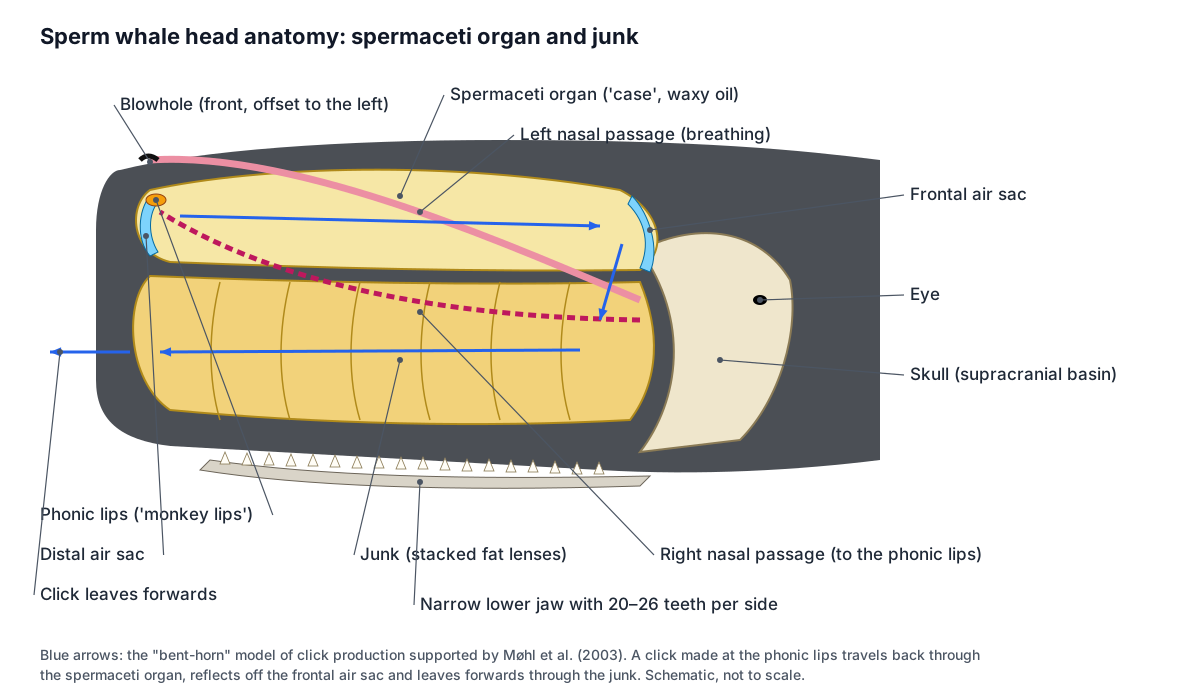
The sperm whale, Physeter macrocephalus, is the largest toothed whale: NOAA gives about 12 m (40 ft) for females and 16 m (52 ft) for males, and weights of 15 to 45 tons. Its huge, box-shaped head makes up about a third of its length. The single blowhole sits at the front of the head and is offset to the left, a feature no other living whale shares. The narrow lower jaw carries 20 to 26 large teeth on each side, and the upper teeth rarely break through the gums. Dives routinely reach about 600 m (2,000 ft) and last about 45 minutes. (NOAA Fisheries: sperm whale.)
Most of the head is a giant nose. The upper part is the spermaceti organ (the 'case'), filled with waxy oil; below it lies the junk, a stack of fatty lenses separated by connective tissue. The left nasal passage runs to the blowhole for breathing. The right nasal passage leads to a single pair of phonic lips (the 'museau de singe', or monkey's muzzle) at the front of the head. Air sacs sit at each end of the spermaceti organ: the distal sac at the front and the frontal sac against the bowl-shaped skull.
Sperm whale clicks are the loudest sounds recorded from any animal. Møhl et al. (2003) recorded on-axis clicks off Norway with source levels up to 236 dB re 1 µPa (rms), durations of about 100 microseconds and strong directionality. They concluded the nose works as a sound generator, supporting the 'bent-horn' model: a click made at the phonic lips travels back through the spermaceti organ, reflects off the frontal air sac and leaves forwards through the junk. (Møhl et al. (2003): the monopulsed nature of sperm whale clicks, J. Acoust. Soc. Am. 114.)
Big male sperm whales and killer whales share the record for the largest brains of all toothed whales. Yet the sperm whale cerebellum is only about 7% of brain mass, while the orca's is almost 14%, a difference the authors link to evolutionary history, diving and sensory ecology. (Ridgway & Hanson (2014): sperm whales and killer whales with the largest brains of all toothed whales show extreme differences in cerebellum, Brain Behav. Evol. 83.)
Blue whale anatomy
The blue whale, Balaenoptera musculus, is a baleen whale (a rorqual) and the largest animal known to have lived. NOAA Fisheries gives up to about 33.5 m (110 ft) and 150 tonnes (330,000 lb) for Antarctic blue whales; North Atlantic and North Pacific animals reach about 27 m (90 ft). Females are generally larger than males. Like other rorquals it feeds by lunging into swarms of krill, expanding its pleated throat and straining the water out through baleen plates. Its lifespan is estimated at 80 to 90 years from layers in the waxy earplug. (NOAA Fisheries: blue whale.)
The only blue whale heart ever preserved came from one of nine blue whales that died in sea ice off western Newfoundland in 2014. Royal Ontario Museum staff describe it as a '5 foot by 4 foot' (about 1.5 by 1.2 m) organ; they pumped six 189-litre drums of formalin into it and later plastinated it for display. (Royal Ontario Museum blog: Blue Whale Update — A Whole Lotta Heart.)
Guinness World Records lists the heart as weighing 199.5 kg (440 lb) and measuring about 1.5 m from the top of the aorta to the bottom of the lowest chamber, from a blue whale about 24 m long. Many news reports quoted about 180 kg (400 lb). Quote a range and say that the figure comes from one whale: claims that a blue whale heart is 'the size of a car' or weighs 600 kg or more are not supported by this measured specimen. (Guinness World Records: largest heart.)
Rorquals such as blue, fin and humpback whales have lower jaws whose two halves are not fused at the chin. Pyenson et al. (2012) found a sensory organ in the fibrous joint between them, with nerve endings that sense jaw rotation and throat expansion. It probably helps the whale time each lunge. (Pyenson et al. (2012): discovery of a sensory organ that coordinates lunge feeding in rorqual whales, Nature 485.)
Humpback whale anatomy
The humpback whale, Megaptera novaeangliae, grows to about 18 m (60 ft) and 40 tons. Its genus name means 'big-winged', after its very long flippers, which carry variable amounts of white. Its flukes can be up to about 5.5 m (18 ft) wide, with a serrated trailing edge and pointed tips; the black-and-white pattern under the flukes is unique and is used to identify individual whales. (NOAA Fisheries: humpback whale.)
Fish & Battle (1995) sectioned the flipper of a 9 m humpback and found a wing-like, high-aspect-ratio shape with a cross-section like an engineered aerofoil. Rounded tubercles along the leading edge probably act as lift-enhancing devices that keep flow attached at high angles of attack, giving the whale the tight turns it uses when feeding. (Fish & Battle (1995): hydrodynamic design of the humpback whale flipper, J. Morphol. 225.)
Humpbacks also have large spindle-shaped neurons (von Economo neurons) in the anterior cingulate, anterior insular and frontopolar cortex, similar to those described in great apes. Hof & Van der Gucht (2007) found them in the fin whale and the largest toothed whales too, but not in smaller species. They suggested parallel evolution; what these cells do is not yet known, so they are not proof of human-like emotions. (Hof & Van der Gucht (2007): structure of the cerebral cortex of the humpback whale, Anat. Rec. 290.)
Beluga whale anatomy (and the 'beluga knees' myth)
The beluga, Delphinapterus leucas, is a small toothed whale up to about 4.9 m (16 ft) long, averaging about 1,430 kg (3,150 lb). Calves are dark grey and turn white with age. Belugas have no beak and no dorsal fin; a tough dorsal ridge helps them swim under ice. Their round melon is flexible and can change shape as they vocalise. They have 16 to 20 teeth in each jaw, and blubber can make up as much as 40% of their body weight. (NOAA Fisheries: beluga whale.)
Unlike most whales, belugas have unfused neck vertebrae, so they can nod and turn their heads (NOAA). Viral videos call the bend behind a beluga's head its 'knees', but it is the neck and the soft fat around it. Belugas, like all living whales, have no hind limbs and no knees: only a pair of small pelvic bones buried in the muscle near the genital slit. (NOAA Fisheries: beluga whale.)
Fin, gray, bowhead and right whale anatomy
Fin whales (Balaenoptera physalus) reach about 23 to 26 m (75 to 85 ft) and 40 to 80 tons. Their colouring is asymmetrical: the lower jaw is dark on the left and white on the right, and the tongue has the reverse pattern. They have 50 to 100 throat pleats and 260 to 480 baleen plates. (NOAA Fisheries: fin whale.)
Gray whales (Eschrichtius robustus) grow to about 15 m (49 ft) and 41 tonnes (90,000 lb). They have no dorsal fin; instead there is a hump two-thirds of the way back followed by 6 to 12 small 'knuckles'. They feed mainly on the bottom, rolling onto their side to suck up sediment and filtering prey through 130 to 180 coarse baleen plates on each side of the upper jaw, leaving feeding pits on the seafloor. (NOAA Fisheries: gray whale.)
Bowhead whales (Balaena mysticetus) reach about 19 m (62 ft) and 91 tonnes (200,000 lb). They have the longest baleen of any whale and the thickest blubber, which NOAA gives as about 43 to 48 cm (17 to 19 in) and up to about 50 cm. The bow-shaped skull can be over 5 m (16.5 ft) long, about a third of body length, and is strong enough to break through sea ice about 20 cm thick. Bowheads have no dorsal fin and can live for well over 100 years, possibly over 200. (NOAA Fisheries: bowhead whale.)
North Atlantic right whales (Eubalaena glacialis) grow to about 16 m (52 ft) and 64 tonnes (140,000 lb). They are stocky, black and have no dorsal fin. Rough patches of skin called callosities on the head look white because they are covered by whale lice (cyamids); each pattern is unique. Their two blowholes produce a V-shaped blow, and their flippers are short, broad and paddle-shaped. (NOAA Fisheries: North Atlantic right whale.)
In the bowhead the stomach has four compartments: a large non-glandular forestomach lined with keratinised epithelium, a glandular fundic chamber, a narrow connecting channel and a tubular pyloric chamber, followed by a swollen duodenal ampulla. This is the same basic plan as in the orca. (Tarpley et al. (1987): anatomy of the stomach and duodenum of the bowhead whale, Am. J. Anat. 180.)
Pilot whale anatomy
Pilot whales are large oceanic dolphins (genus Globicephala), like the orca. Short-finned pilot whales are about 3.7 to 7.3 m (12 to 24 ft) long and 1,000 to 3,000 kg. They have a large, bulbous melon and no obvious beak, a low, wide-based dorsal fin set about a third of the way back, slender flippers, 7 to 9 teeth in each tooth row and a grey saddle and anchor-shaped chest patch. Adult males have larger heads and much bigger, hooked dorsal fins. (NOAA Fisheries: short-finned pilot whale.)
Pilot whales are a classic example in flipper-bone studies. Cooper et al. (2007) found that the first digit is reduced in most cetaceans, but not in Globicephala, and that hyperphalangy is greatest in digits II and III in toothed whales. (Cooper et al. (2007): evolution of hyperphalangy and digit reduction in the cetacean manus, Anat. Rec. 290.)
Whale vs fish: how to tell them apart
A whale is a mammal and a fish is not, and their anatomy shows it at a glance. Whales breathe air through a blowhole, and fish breathe water through gills. A whale's tail flukes are horizontal and move up and down; a fish's tail fin is vertical and moves side to side, because a mammal's spine bends most easily up and down.
| Feature | Whale (mammal) | Fish (including the whale shark) |
|---|---|---|
| Breathing | Lungs; blowhole on top of the head | Gills; gill slits or a gill cover |
| Tail | Horizontal flukes, up-and-down stroke, no bones in the blades | Vertical tail fin, side-to-side stroke, supported by fin rays |
| Skin | Smooth skin over blubber; no scales | Scales (or denticles in sharks) |
| Body temperature | Warm-blooded | Mostly cold-blooded |
| Front fins | Flippers containing arm and finger bones | Pectoral fins supported by fin rays or cartilage |
| Young | Live birth, fed with milk | Eggs or live young; no milk |
| Skeleton | Bone | Bone (bony fish) or cartilage (sharks, including the whale shark) |
Compare with our fish anatomy and shark anatomy pages.
Whale shark anatomy: why it is a fish, not a whale
The whale shark, Rhincodon typus, is a shark (class Elasmobranchii, order Orectolobiformes), not a whale. It breathes with gills through five very large gill openings, filters plankton with sieve-like modifications of its gill bars, and has a cartilage skeleton and a vertical tail fin. It reproduces by keeping eggs inside the mother: one female carried over 300 embryos that lived on yolk. FishBase gives a maximum of about 20 m but notes that the most reliably measured size is about 12 m. (FishBase: Rhincodon typus, whale shark.)
For the whale shark's internal anatomy and filter pads, see the whale shark section of our shark anatomy guide.
Is a dolphin a whale?
Yes, in the scientific sense. Dolphins are toothed whales: the family Delphinidae belongs to the Odontoceti alongside sperm whales, beaked whales, belugas and porpoises. The orca and the pilot whales are in fact the largest dolphins. In everyday English, "whale" usually means a large species and "dolphin" a small one, but the anatomy on this page, from the melon to the hyperphalangeal flipper, applies to a bottlenose dolphin almost unchanged.
How whales stay warm: blubber and counter-current heat exchange
Blubber insulates the body, but the flippers, dorsal fin and flukes are thin and have a large surface area. Scholander & Schevill (1955) described counter-current vascular heat exchangers in whale fins: each artery is surrounded by veins, so heat passes from outgoing warm blood to returning cold blood instead of being lost to the sea. (Scholander & Schevill (1955): counter-current vascular heat exchange in the fins of whales, J. Appl. Physiol. 8.)
Male whales and dolphins keep their testes inside the abdomen, where it would normally be too warm for sperm production. In bottlenose dolphins, spermatic arteries run beside veins carrying blood cooled at the surface of the dorsal fin and flukes; after vigorous swimming the temperature at this exchanger fell by up to 0.5 °C, suggesting it cools the testes more when the dolphin is working hardest (Pabst et al., 1995). (Pabst et al. (1995): thermoregulation of the intra-abdominal testes of the bottlenose dolphin, J. Exp. Biol. 198.)
Whale anatomy worksheet: test yourself
Use the 3D model or the diagrams above, then check your answers.
- How many blowholes does an orca have, and how many does a blue whale have?
- Which bones in the flipper are the same as the bones of your arm?
- Which two fins contain no bones?
- What structure focuses a toothed whale's echolocation clicks?
- Through which part of the head does a toothed whale hear?
- Name the chambers of an orca's stomach in order.
- What is left of a whale's hind limbs?
Answer key
- One in the orca (a toothed whale); two in the blue whale (a baleen whale).
- Humerus, radius, ulna, carpals, metacarpals and phalanges.
- The dorsal fin and the flukes.
- The melon, a body of special fat in the forehead.
- The lower jaw: fat in the hollow pan bone carries sound to the ear bones.
- Forestomach, main (fundic) stomach, pyloric stomach, then the duodenal ampulla.
- A pair of small pelvic bones (sometimes a tiny femur in baleen whales); no legs or knees.
Frequently asked questions
Is a whale a fish or a mammal?
A whale is a mammal. It breathes air with lungs, is warm-blooded, has a four-chambered heart, gives birth to live young and feeds them milk. Its tail flukes are horizontal and beat up and down, while a fish's tail fin is vertical and beats from side to side. The whale shark is not a whale but a fish.
How many blowholes does a whale have?
Toothed whales, such as orcas, dolphins, belugas and sperm whales, have one blowhole. Baleen whales, such as blue, humpback, fin, gray and right whales, have two blowholes side by side. The blowhole is the whale's nostril and connects to the lungs only, not to the mouth.
Do whales have bones in their tail or dorsal fin?
No. The flukes and dorsal fin have no bones. They are made of dense, fibrous connective tissue covered by skin and blubber. Only the last caudal vertebrae extend into the middle of the flukes. The flippers do contain bones: the same arm and hand bones as other mammals.
Do whales have legs or knees?
No. Living whales have no hind legs and no knees. All that remains is a pair of small pelvic bones floating in the muscle near the genital slit, sometimes with a tiny vestigial femur in baleen whales. The joint some people call a beluga's 'knee' is not a knee at all: belugas simply have flexible, unfused neck vertebrae.
How big is a blue whale's heart?
The only preserved blue whale heart, displayed at the Royal Ontario Museum in Toronto, measures about 1.5 m tall and 1.2 m wide. Guinness World Records lists it at 199.5 kg (440 lb); news reports quoted about 180 kg (400 lb). It came from a blue whale about 24 m long that died off Newfoundland in 2014.
How many teeth does an orca have?
An adult orca typically has 10 to 12, occasionally up to 14, cone-shaped teeth in each quarter of the mouth, about 40 to 56 in total. Teeth are up to about 10 cm long, and the upper and lower teeth interlock. Orcas do not chew; they tear prey and swallow pieces whole.
How many stomachs does a whale have?
Whales have one stomach divided into several chambers. In orcas and most dolphins these are a non-glandular forestomach that crushes food, a glandular main stomach and a tubular pyloric stomach, followed by a swollen duodenal ampulla. Baleen whales have a similar arrangement. It is not the same as a cow's four-chambered stomach.
How do whales hear underwater?
Toothed whales hear mainly through their lower jaw. Sound passes through fat-filled channels in the hollow back of the mandible to the ear bones, which are isolated from the skull by air sinuses. The tiny external ear opening plays little role underwater.
Is the whale shark a whale?
No. The whale shark (Rhincodon typus) is a shark, a cartilaginous fish. It breathes with gills, has a vertical tail fin and a cartilage skeleton. It is called a whale shark because of its size and its filter feeding. See our shark anatomy page for its anatomy.
References
- NOAA Fisheries: killer whale (Orcinus orca)
- Animal Diversity Web: Orcinus orca
- National Museum of Nature and Science, Tokyo: marine mammal database, Orcinus orca
- Visser (2019), Orca Research Trust report on orca teeth (citing Jett et al. 2017)
- Fabio Junior & Uemura: comparison of the vertebral column of the orca and the horse (literature review, FMU)
- NOAA Fisheries: blue whale
- Royal Ontario Museum blog: Blue Whale Update — A Whole Lotta Heart
- Guinness World Records: largest heart
- NOAA Fisheries: sperm whale
- NOAA Fisheries: humpback whale
- NOAA Fisheries: beluga whale
- NOAA Fisheries: fin whale
- NOAA Fisheries: gray whale
- NOAA Fisheries: bowhead whale
- NOAA Fisheries: North Atlantic right whale
- NOAA Fisheries: short-finned pilot whale
- FishBase: Rhincodon typus, whale shark
- Cranford, Amundin & Norris (1996): functional morphology and homology in the odontocete nasal complex, J. Morphol. 228
- Cranford et al. (2008): anatomic geometry of sound transmission and reception in Cuvier's beaked whale, Anat. Rec. 291
- Møhl et al. (2003): the monopulsed nature of sperm whale clicks, J. Acoust. Soc. Am. 114
- Reidenberg & Laitman (1987): position of the larynx in Odontoceti (toothed whales), Anat. Rec. 218
- Piscitelli et al. (2010): lung size and thoracic morphology in shallow- and deep-diving cetaceans, J. Morphol. 271
- Tarpley et al. (1987): anatomy of the stomach and duodenum of the bowhead whale, Am. J. Anat. 180
- Tostado-Marcos et al. (2024): digestive system of the franciscana dolphin, Animals 14 (PMC)
- Ortiz (2001): osmoregulation in marine mammals, J. Exp. Biol. 204
- Scholander & Schevill (1955): counter-current vascular heat exchange in the fins of whales, J. Appl. Physiol. 8
- Pabst et al. (1995): thermoregulation of the intra-abdominal testes of the bottlenose dolphin, J. Exp. Biol. 198
- Dines et al. (2014): sexual selection targets cetacean pelvic bones, Evolution 68 (PMC)
- Cooper et al. (2007): evolution of hyperphalangy and digit reduction in the cetacean manus, Anat. Rec. 290
- Cooper et al. (2018): flipper development and hyperphalangy in dolphins, Genesis 56
- Hof & Van der Gucht (2007): structure of the cerebral cortex of the humpback whale, Anat. Rec. 290
- Ridgway & Hanson (2014): sperm whales and killer whales with the largest brains of all toothed whales show extreme differences in cerebellum, Brain Behav. Evol. 83
- Peichl, Behrmann & Kröger (2001): for whales and seals the ocean is not blue, Eur. J. Neurosci. 13
- Roston & Roth (2019): cetacean skull telescoping brings evolution of cranial sutures into focus, Anat. Rec. 302 (PMC)
- Pyenson et al. (2012): discovery of a sensory organ that coordinates lunge feeding in rorqual whales, Nature 485
- Fish & Battle (1995): hydrodynamic design of the humpback whale flipper, J. Morphol. 225
More interactive anatomy models
- Human anatomy1,000+ bones, muscles, organs, vessels and nerves from real anatomical data.
- Octopus anatomyThree hearts, a ring-shaped brain, eight arms and a beak, in 3D.
- Squid anatomyPen, eight arms, two tentacles, giant axons and three hearts of the longfin squid.
- Squid dissectionStep-by-step guided squid dissection with every structure labeled.
- Fish anatomyExternal and internal anatomy of a bony fish: fins, gills, swim bladder, heart and brain.
- Perch dissectionGuided yellow perch (fish) dissection, from scales to the swim bladder.