

Flower anatomy at a glance
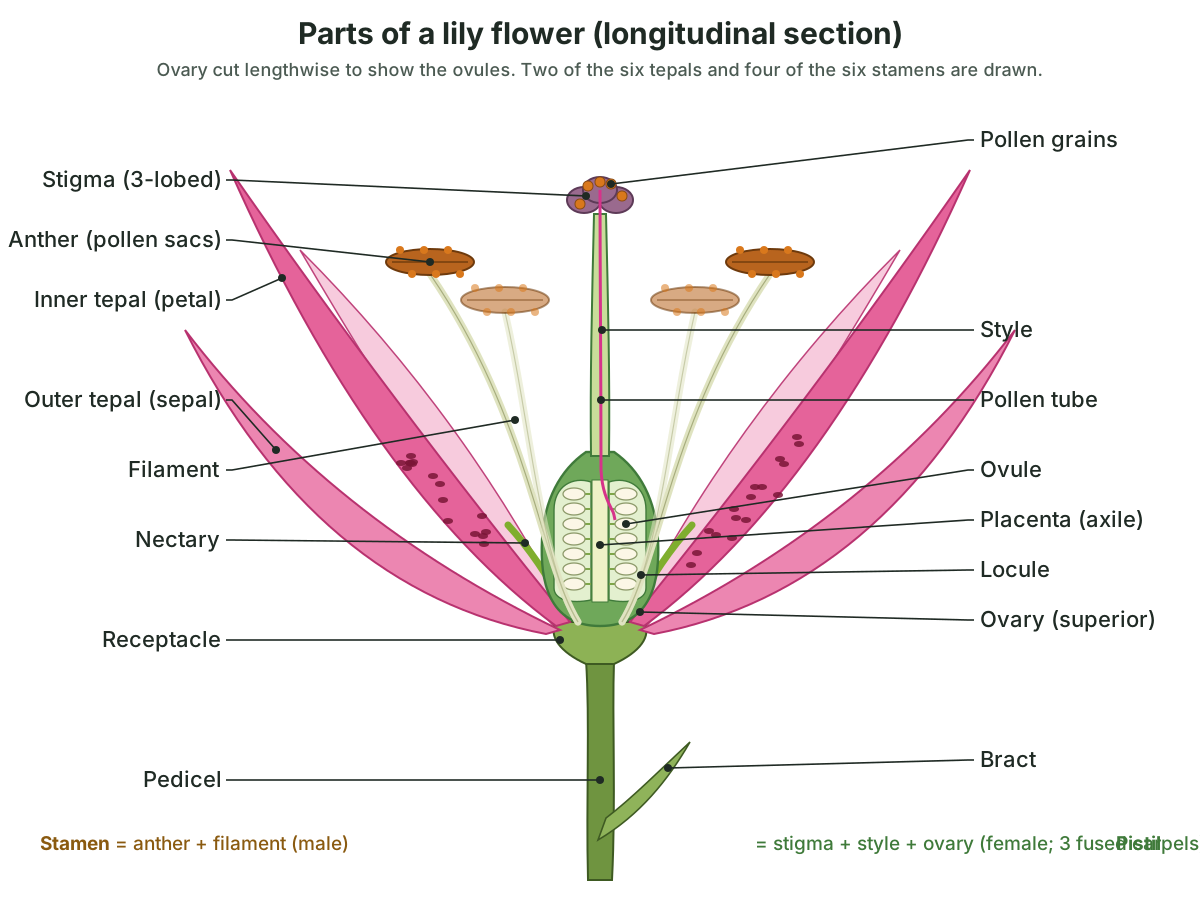
A flower is the reproductive shoot of a flowering plant: a short stem tip, the receptacle, carrying up to four rings (whorls) of modified leaves. From the outside in, they are the sepals (together the calyx), the petals (together the corolla), the stamens (the male parts, together the androecium) and the carpels (the female parts, together the gynoecium, which you see as one or more pistils). The flower sits on a stalk, the pedicel.
This page uses a lily as its reference flower because it is large, easy to dissect and has every part clearly separate: six tepals, six stamens and one pistil of three fused carpels with a superior ovary. Lilies are monocots, so their parts come in threes. Where other flowers differ, the species sections further down explain how, from hibiscus and orchids to sunflowers, cannabis and bananas.
Two useful words for directions: the base of a flower is the end attached to the stalk, and the apex is the far end of a part, such as the tip of a tepal. A whorl is a ring of parts attached at the same level.
Parts of a flower and their functions
The main parts of a flower are the sepals, which protect the bud; the petals, which attract pollinators; the stamens, which make pollen; and the pistil, which receives pollen and contains the ovules that become seeds. The receptacle holds them all, and nectaries make nectar as a reward for pollinators.
| Part | Group | Function |
|---|---|---|
| Sepal | Calyx (perianth) | Protects the flower bud; usually green |
| Petal | Corolla (perianth) | Attracts pollinators with colour, shape and scent |
| Tepal | Perianth | A sepal or petal when the two look alike, as in lilies |
| Nectary | Usually perianth or receptacle | Makes nectar to reward pollinators |
| Filament | Stamen (androecium) | Holds the anther up |
| Anther | Stamen (androecium) | Makes pollen in four pollen sacs |
| Pollen | Male gametophyte | Carries the sperm cells to the pistil |
| Stigma | Pistil (gynoecium) | Catches pollen; sticky surface |
| Style | Pistil (gynoecium) | Stalk between stigma and ovary; guides the pollen tube |
| Ovary | Pistil (gynoecium) | Holds the ovules; becomes the fruit |
| Ovule | Inside the ovary | Contains the egg; becomes the seed |
| Receptacle | Flower axis | Tip of the stalk that holds all the parts |
| Pedicel | Flower axis | Stalk of a single flower |
| Peduncle | Inflorescence axis | Stalk of a flower cluster |
Flower anatomy labeled: every part of the lily
This is the text version of the 3D model: all 27 labeled structures of the lily, grouped by whorl, with what each does. Use it as a study list or to check a labeled flower anatomy diagram.
Perianth
- Perianth (Calyx + corolla; in lilies, the six tepals)
- The non-reproductive outer parts of a flower: the sepals and petals together, or, in a lily, the six tepals. Protects the stamens and pistil in the bud, then advertises the open flower to pollinators with its colour, shape and scent.
- Outer tepals (Sepals; together the calyx)
- The three outer perianth segments. In a lily they are coloured like the petals, so they are called tepals rather than sepals. In the bud they wrap and protect the inner parts, as sepals do. In the open flower they add to the display that attracts pollinators.
- Inner tepals (Petals; together the corolla)
- The three inner perianth segments, broader than the outer ones. They correspond to the petals of a typical flower. Attract and guide pollinators. Their colour, spots and scent advertise nectar, and their broad surface gives insects a place to land.
- Nectaries (Nectar furrows, nectar glands)
- Grooves at the base of each tepal that secrete nectar, a sugary reward for pollinators. Make nectar, which rewards visiting insects and birds. To reach it, the visitor brushes past the anthers and stigma and carries pollen.
Male parts (androecium)
- Stamens (Androecium (all the stamens together))
- The male organs of the flower. Each stamen is a filament topped by an anther that makes pollen. Produce pollen, which carries the sperm cells to the female parts of the same or another flower.
- Filament
- The long, thin stalk of a stamen. Holds the anther out where pollinators will touch it, and carries water and nutrients to the developing anther through a single vein.
- Anther
- The pollen-making head of a stamen: two lobes (thecae), each with two pollen sacs, joined by a connective. Makes pollen by meiosis inside its pollen sacs, then splits open along a slit on each lobe to release it.
- Pollen sacs (Microsporangia, anther locules)
- The four chambers of an anther where pollen grains form. Microspore mother cells divide by meiosis to make four microspores each, which develop into pollen grains. A nourishing layer, the tapetum, feeds them.
- Connective
- The strip of tissue that joins the two anther lobes and links them to the filament. Holds the two lobes together and carries the vascular bundle from the filament into the anther.
- Pollen grains (Male gametophytes)
- Tiny grains, made in the anthers, that carry the male gametes. Lily pollen is orange-brown and sticky. Each grain is a male gametophyte. On a compatible stigma it grows a pollen tube that delivers two sperm cells to an ovule.
- Pollen tube
- A tube that grows from a pollen grain down through the style to an ovule, carrying the two sperm cells. Delivers the two sperm cells to the embryo sac, where double fertilization happens.
Female parts (gynoecium)
- Pistil (Gynoecium; in a lily, three fused carpels)
- The female organ of the flower: stigma, style and ovary. A lily pistil is made of three carpels fused together. Receives pollen, guides the pollen tubes to the ovules, and after fertilization becomes the fruit.
- Stigma
- The sticky tip of the pistil that catches pollen. A lily stigma has three lobes, one for each carpel. Captures pollen, checks that it is compatible, and lets it germinate. Its wet, sugary surface feeds the pollen tubes.
- Style
- The stalk that joins the stigma to the ovary. Raises the stigma to where pollinators will touch it and guides the pollen tubes down to the ovary.
- Ovary
- The swollen base of the pistil that holds the ovules. Here it is cut in half lengthwise to show the inside. Protects the ovules. After fertilization its wall grows into the fruit: in a lily, a dry capsule that splits into three.
- Locule (Ovary chamber)
- One of the hollow chambers inside the ovary where the ovules develop. Gives the ovules space to grow into seeds, protected inside the ovary wall.
- Septum (Partition, dissepiment)
- A wall between two locules, formed where the sides of two neighbouring carpels fused. Divides the ovary into chambers and carries the placentas to the centre of the ovary.
- Placenta (Axile placenta, central axis)
- The tissue the ovules are attached to. In a lily it runs up the central axis of the ovary. Anchors the ovules and supplies them with water and food through tiny stalks (funiculi).
- Ovules
- Small bodies inside the ovary, each containing an embryo sac with an egg. Each fertilized ovule becomes a seed. Make and protect the female gametophyte (embryo sac). After double fertilization the ovule grows into a seed.
- Funiculus (Ovule stalk (plural funiculi))
- The short stalk that attaches each ovule to the placenta. Carries water and nutrients from the placenta into the ovule. After the seed is shed it leaves a scar, the hilum.
Stalks, stem and leaves
- Receptacle (Torus, thalamus)
- The slightly swollen tip of the flower stalk, to which all the flower parts are attached. Holds the tepals, stamens and pistil in their whorls. Its short internodes are why flower parts are crowded together.
- Pedicel
- The stalk of one individual flower. Holds the flower out from the stem and positions it for pollinators; it carries water and sugars to the flower.
- Peduncle (Inflorescence stalk)
- The stalk that carries the whole inflorescence (flower cluster), or a single flower if the plant has only one. Supports the flowers and raises them above the leaves where pollinators can see them.
- Bracts
- Small, modified leaves at the base of each pedicel. Protect the young flower bud. In some plants they become large and colourful and do the job of petals.
- Flower bud
- An unopened flower. The tepals are still closed tightly over the stamens and pistil. Protects the developing flower parts until they are mature; the outer tepals act like the sepals of a typical bud.
- Stem
- The leafy main stem of the lily, which grows each year from an underground bulb. Holds the leaves up to the light and carries water up and sugars down in its vascular bundles.
- Leaves
- Narrow, lance-shaped leaves with parallel veins, typical of monocots. Photosynthesis: they make the sugars that feed the flowers and refill the bulb for next year.
Sepals, petals and tepals: what is the difference?
Sepals are the outer whorl of the perianth and are usually green and leaf-like; they enclose and protect the bud. Petals are the inner whorl and are usually coloured; they attract pollinators. When sepals and petals look the same, as in lilies, tulips, amaryllis and magnolias, both whorls are called tepals.
In a lily you can still tell the two whorls apart if you look closely. The three outer tepals, which correspond to sepals, are attached slightly lower and outside the inner three and are a little narrower. The three inner tepals, which correspond to petals, are broader. In the bud, the outer tepals wrap around the inner ones, doing the protective job of sepals; once the flower opens, all six join the display.
Tepals are not the only petal look-alikes. In iris, the falls are coloured sepals; in clematis and anemones, the showy parts are sepals and there are no petals; in dogwood, bougainvillea and poinsettia, the showy parts are bracts (modified leaves below the flowers); and in irises, part of the style itself is petal-like.
Male parts of a flower: the stamen
The male part of a flower is the stamen, a thin stalk called the filament topped by an anther. All the stamens of one flower together are the androecium (from Greek for "male house"). A lily has six stamens in two whorls of three.
An anther has two lobes (thecae) joined by a strip of tissue, the connective, and each lobe holds two pollen sacs (microsporangia). Inside the sacs, microspore mother cells divide by meiosis into four microspores each, fed by a lining layer called the tapetum. Each microspore develops into a pollen grain with two cells: a tube cell and a generative cell, which later divides to make two sperm cells. The tough outer wall of the grain, the exine, contains sporopollenin. When the pollen is ripe, the anther splits along a slit on each lobe.
Stamens vary between plants. In hibiscus, the filaments are fused into one tube; in daisies, the anthers are fused into a tube around the style; in tomatoes, the anthers form a cone; in orchids, the anther is part of a single column with the stigma. Florists often remove lily anthers because the pollen stains.
Female flower anatomy: pistil, carpels and ovary
The female part of a flower is the pistil, made of the stigma (which catches pollen), the style (a stalk) and the ovary (which holds the ovules). A pistil is built from one or more carpels: a pea pistil is a single carpel; a lily pistil is three carpels fused together. All the carpels of a flower are called the gynoecium ("female house").
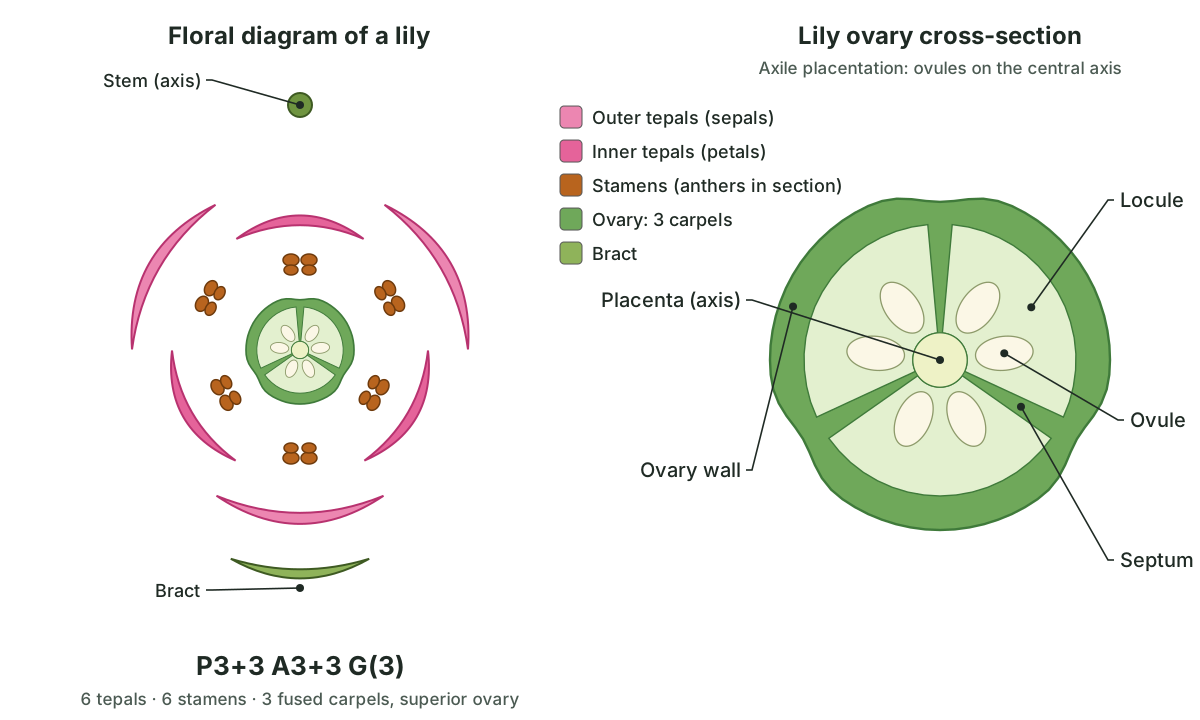
Inside the ovary, the ovules are attached to tissue called the placenta. How the placentas are arranged, the placentation, is used to identify plant families. A lily has axile placentation: the carpel walls (septa) meet in the middle and the ovules sit on the central axis, one locule per carpel. Other common types are parietal (ovules on the ovary wall, as in poppies and violets), free-central (ovules on a column with no septa, as in carnations and primroses), marginal (along one edge of a single carpel, as in peas) and basal (a single ovule at the bottom, as in sunflowers).
The ovary can sit in three positions. A superior ovary, like the lily's, is above the point where the other parts attach (the flower is hypogynous). An inferior ovary, as in iris, orchid, apple, banana and sunflower, is below the attachment of the perianth (epigynous). A half-inferior ovary is partly sunk in a floral cup. Some flowers have a cup-shaped hypanthium that carries the sepals, petals and stamens around a superior ovary, as in cherries and roses (perigynous).
"Female flower" can also mean a whole flower that has only female parts. Such a pistillate (carpellate) flower has a pistil but no working stamens. Squash, corn, holly, kiwifruit and cannabis all make pistillate flowers, as described in the next section.
Complete, perfect and imperfect flowers
A complete flower has all four whorls: sepals, petals, stamens and carpels. If any whorl is missing, the flower is incomplete. A perfect (bisexual) flower has both stamens and carpels, whatever else it lacks; an imperfect (unisexual) flower has only one: stamens in a staminate (male) flower, carpels in a pistillate (female) flower.
| Term | Meaning | Examples |
|---|---|---|
| Complete | Sepals, petals, stamens and carpels all present | Lily, rose, hibiscus, tomato, apple blossom |
| Incomplete | At least one whorl missing | Grasses and anemones (no petals), all unisexual flowers |
| Perfect (bisexual) | Stamens and carpels in the same flower | Lily, rose, tulip, tomato, Arabidopsis |
| Imperfect (unisexual) | Only stamens or only carpels | Corn, squash, cannabis, holly, willow |
| Staminate (male) | Stamens only | Corn tassel, squash male flowers, male cannabis plants |
| Pistillate (female) | Carpels only | Corn ear (silks are the styles), squash female flowers, female cannabis plants |
| Monoecious plant | Male and female flowers on the same plant | Corn, squash, oak, birch |
| Dioecious plant | Male and female flowers on separate plants | Cannabis, papaya, holly, kiwifruit, willow |
Every complete flower is perfect, but a perfect flower need not be complete: a grass floret has stamens and a pistil but no sepals or petals. Both terms come from OpenStax's description of the four whorls, and monoecious and dioecious describe the whole plant, not one flower.
Lily flower anatomy
A lily flower has six tepals in two whorls of three, six stamens in two whorls of three, and one pistil made of three fused carpels, with a superior ovary that has three chambers and many ovules on a central axis. Botanists write this as the floral formula P3+3 A3+3 G(3): P for perianth, A for androecium and G for gynoecium, with the brackets meaning the three carpels are fused. In printed formulas a line under the G marks a superior ovary. (Botany Brisbane: Liliaceae, Lilium.)
The tepals are free from each other, not joined into a tube, and many lilies have dark spots near the base of the inner face. At the base of each tepal is a nectary, a narrow furrow along the midline that secretes nectar. The six stamens are free of the perianth. Each long, slender filament carries a large anther attached near its middle, so it can pivot (botanists call this a versatile, dorsifixed anther). The anthers split open along a slit on each side to release sticky orange or brown pollen. (Botany Brisbane: Liliaceae, Lilium.)
In the centre, a single long style rises from the top of the ovary and ends in a three-lobed stigma, one lobe for each carpel. If you cut the ovary across, you see three chambers (locules) separated by three walls (septa) that meet in the middle, with the ovules attached to that central column. This is axile placentation, and the lily ovary is the standard microscope slide for it. After fertilization, the ovary becomes a dry capsule that usually splits down the middle of each chamber (loculicidal dehiscence) to release flat seeds. (Botany Brisbane: Liliaceae, Lilium.)
Lilies are also a classic example of a superior ovary: the ovary sits above the point where the tepals and stamens are attached, so if you pull off all the tepals and stamens, the whole ovary is left standing on the receptacle. In a flower with an inferior ovary, such as a fuchsia, an iris or a daffodil, the ovary is below the tepals and you can see it as a swelling under the flower. (OpenStax Biology 2e, 32.1 Reproductive Development and Structure.)
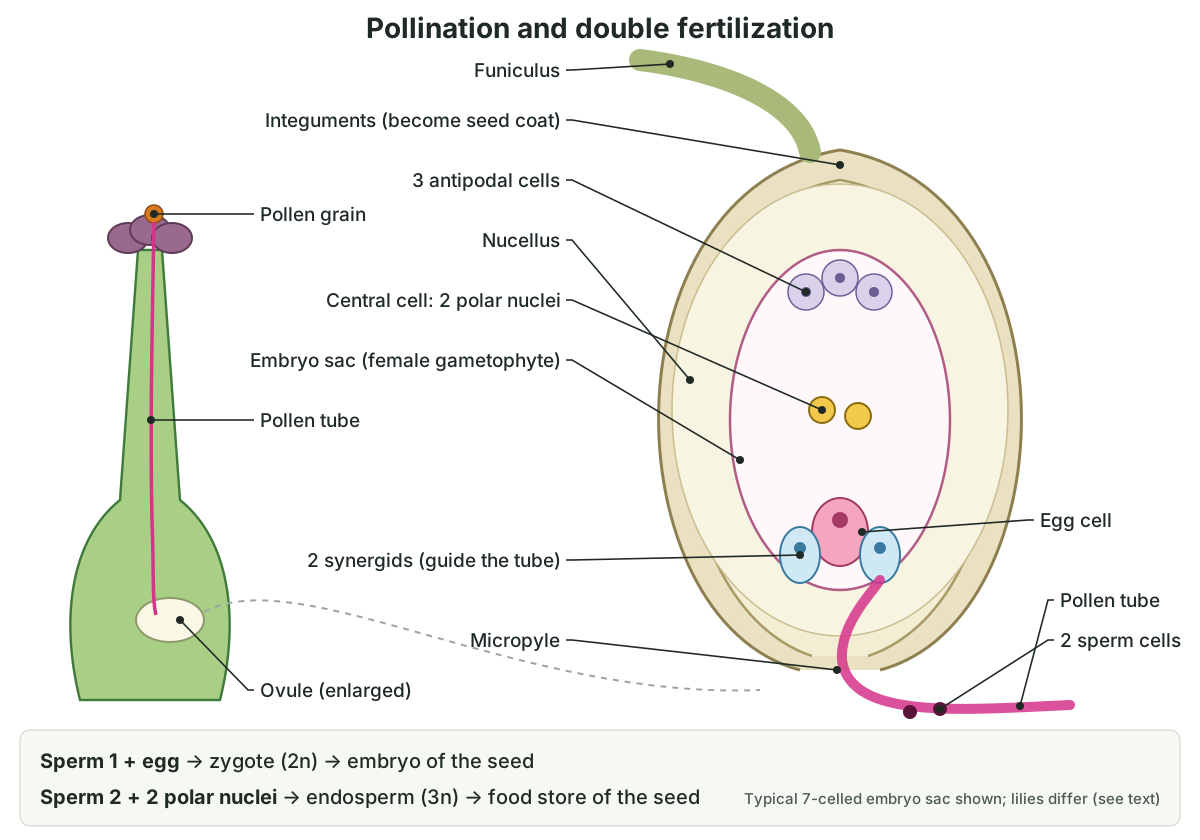
Lily embryology is unusual. In most flowering plants only one of the four megaspores made by meiosis survives and builds a seven-celled embryo sac. In Lilium all four megaspore nuclei take part (the Fritillaria type of embryo sac), so the nuclei at one end are triploid and the endosperm that forms after fertilization is usually described as pentaploid rather than triploid. That is why textbook drawings of lily embryo sacs look different from the standard diagram.
Many plants called lilies are not true lilies (Lilium). Daylilies (Hemerocallis), calla lilies (Zantedeschia, an aroid with a spathe and spadix), peace lilies (Spathiphyllum, another aroid), water lilies (Nymphaea, an early-diverging flowering plant), lilies of the valley and lily of the Nile (Agapanthus) belong to other families. One safety note: true lilies and daylilies are highly toxic to cats; even pollen licked from fur can cause kidney failure.
Monocot vs eudicot flowers
Monocot flowers, such as lilies, tulips, irises, orchids and bananas, have their parts in threes or multiples of three. Eudicot flowers, such as roses, buttercups, hibiscus, tomatoes and daisies, usually have parts in fours or fives. Count the petals or tepals: six tepals in two whorls of three is a monocot; five petals is almost always a eudicot.
| Feature | Monocots (lily, tulip, orchid) | Eudicots (rose, hibiscus, tomato) |
|---|---|---|
| Flower parts | In threes or multiples of three | In fours or fives, or multiples |
| Perianth | Often tepals (sepals and petals alike) | Usually distinct green sepals and coloured petals |
| Pollen | One furrow or pore (monosulcate) | Three furrows or pores (trisulcate or triporate) |
| Seed leaves | One cotyledon | Two cotyledons |
| Leaf veins | Parallel | Net-like (reticulate) |
| Stem vascular bundles | Scattered | In a ring |
| Roots | Fibrous | Usually a taproot |
Some early-diverging flowering plants fit neither pattern. Magnolias (magnoliids) have many tepals, stamens and carpels arranged in a spiral, and water lilies belong to an even older lineage. Magnolia tepals are a textbook example of undifferentiated sepals and petals.
Pollination and double fertilization
Pollination is the transfer of pollen from an anther to a stigma. If the pollen lands on the stigma of the same flower (or another flower of the same plant), it is self-pollination; if it comes from a different plant, it is cross-pollination. Cross-pollination mixes genes and produces more varied offspring, so many plants have ways to avoid selfing: anthers and stigmas that ripen at different times, styles of different lengths, separate male and female flowers, or separate male and female plants. (OpenStax Biology 2e, 32.2 Pollination and Fertilization.)
Flowers are shaped by who pollinates them. Bee flowers are often blue or yellow with nectar guides; butterfly flowers are bright and give a landing place; moth flowers are pale, scented and open at night; hummingbird flowers are red, tubular and scentless; bat flowers are large, pale and full of nectar; and wind-pollinated flowers such as grasses, maples and oaks are small, often lack petals, nectar and scent, and make huge amounts of light pollen. (OpenStax Biology 2e, 32.2 Pollination and Fertilization.)
Fertilization starts when a compatible pollen grain germinates on the stigma. The tube cell grows a pollen tube down through the style, and the generative cell, which divides into two sperm cells, travels inside it. Chemicals released by the synergids, two cells beside the egg, guide the tube to the ovule, and it enters through the micropyle, a small opening in the ovule's coats. (OpenStax Biology 2e, 32.2 Pollination and Fertilization.)
Flowering plants then perform double fertilization. One sperm fuses with the egg to make a diploid zygote, which grows into the embryo. The other sperm fuses with the two polar nuclei in the central cell to make a triploid cell that grows into the endosperm, the food store of the seed. Only angiosperms do this: two fertilizations, in one ovule, from one pollen tube. (OpenStax Biology 2e, 32.2 Pollination and Fertilization.)
From flower to fruit: what each part becomes
After fertilization, the fertilized ovule becomes the seed and the ovary becomes the fruit. Inside the seed, the zygote grows into an embryo with one or two seed leaves (cotyledons), an embryonic shoot and an embryonic root (radicle), and the ovule's coats harden into the seed coat. The tepals, stamens, style and stigma usually wither and fall. (OpenStax Biology 2e, 32.2 Pollination and Fertilization.)
The ovary wall becomes the fruit wall (pericarp), and how it matures decides the fruit type. A lily or tulip ovary dries and splits into a capsule; a tomato ovary becomes a juicy berry; a cherry's single carpel becomes a drupe with a stony inner layer; a pea's single carpel becomes a pod. Some fruits include other tissues: the flesh of an apple comes from the floral cup around an inferior ovary, and a strawberry's red flesh is a swollen receptacle with the true fruits (achenes) on its surface.
Flower parts and what they become
| Flower part | After fertilization |
|---|---|
| Ovary | Fruit (lily: capsule; tomato: berry; cherry: drupe; pea: pod) |
| Ovary wall | Fruit wall (pericarp) |
| Ovule | Seed |
| Integuments | Seed coat |
| Zygote | Embryo |
| Fertilized central cell | Endosperm |
| Funiculus | Seed stalk; leaves a scar, the hilum |
| Tepals, stamens, style, stigma | Usually wither and fall |
Hibiscus flower anatomy
The most striking part of a hibiscus flower is the staminal column, a pale tube that sticks out of the middle of the flower. Many stamens have their filaments fused into this single tube (botanists call the stamens monadelphous, from Greek for "one brotherhood"), with the anthers on short free tips along its upper part. The style runs up inside the tube and comes out at the top, where it splits into five branches, each ending in a round, fuzzy stigma. (Backyard Nature (Jim Conrad): hibiscus flowers.)
Below the column, a hibiscus flower has five large petals (the corolla), a green five-lobed calyx and, under the calyx, a ring of narrow bracts called the epicalyx, typical of the mallow family (Malvaceae). The superior ovary has five fused carpels and becomes a dry capsule. Because the stigmas sit above the anthers on the same column, a visiting bird or insect touches pollen and stigma in one movement. In some double cultivars, stamens on the column have turned into petal-like structures. (Backyard Nature (Jim Conrad): hibiscus flowers.)
Orchid flower anatomy
An orchid flower has three sepals, three petals and a column in the middle. One of the three petals, the labellum or lip, is larger and differently shaped and works as a landing platform for pollinators. The column is unique to orchids: it is a single structure that carries both the male parts (the anther) and the female parts (the stigma), so an orchid has no separate stamens and pistil to find. (Ray & Vendrame, Orchid Pollination Biology, UF/IFAS Extension EP521.)
Orchid pollen is not loose powder. It is packed into compact masses called pollinia, which sit under an anther cap at the tip of the column, attached to a sticky pad, the viscidium, that glues them onto a visiting insect. The stigma is a sticky hollow on the underside of the column, just behind the tip, and a flap of tissue called the rostellum usually separates it from the anther so the flower does not pollinate itself. After pollination the inferior ovary swells into a capsule holding hundreds of thousands to millions of dust-like seeds. (Ray & Vendrame, Orchid Pollination Biology, UF/IFAS Extension EP521.)
In most orchids the flower stalk and ovary twist through about 180 degrees as the bud opens, a process called resupination, so the lip ends up at the bottom of the flower. Orchid parts come in threes, like a lily's, because orchids are monocots too.
Iris flower anatomy
An iris flower has three drooping outer tepals called falls, three upright inner tepals called standards, and, between them, three petal-like style arms. The style arms look like small petals but are part of the pistil: the style splits into three flattened, petaloid branches, and each has a small flap near its tip, the stigmatic lip, that receives pollen. (Backyard Nature (Jim Conrad): iris flowers.)
Each style arm arches over one fall like a roof, and a single stamen is tucked under it. Bearded irises have a line of hairs, the beard, on each fall that leads a bee in under the style arm. As the bee pushes in, it brushes the stigmatic lip first (leaving pollen from the last flower) and then the anther, so each iris flower works as three separate pollination units. The ovary is inferior, below the tepals, and becomes a three-chambered capsule. (Backyard Nature (Jim Conrad): iris flowers.)
Lotus flower anatomy
A sacred lotus (Nelumbo nucifera) flower has many pink or white tepals, a ring of many stamens, and in the centre a flat-topped, spongy receptacle shaped like an upside-down cone. The carpels are sunk individually into pits on the top of this receptacle, which is why a ripe lotus seed head looks like a shower head with one nut-like fruit in each hole.
Lotus flowers make their own heat. For two to four days while the flower is open, it holds an internal temperature of about 30 to 35 °C even when the air is cooler, and imaging shows that the receptacle surface and carpels are among the warmest tissues. The petals open in the morning and close again around midday, forming an insulated chamber that keeps the warmth in, and the female organs mature before the male ones, which encourages cross-pollination. (Thermogenic tissues in lotus: insights from multiscale imaging and calcium dynamics (PMC).)
Despite the name and look, the lotus is not related to water lilies (Nymphaea). It is a eudicot in its own family, Nelumbonaceae; its closest living relatives are plane trees and proteas.
Tomato flower anatomy
A tomato flower is small, yellow and hangs downward. It has five (sometimes more) green sepals, five yellow petals joined at the base and bent back, and five or more stamens whose yellow anthers are joined side by side into a cone around the style. The stigma sits at or just inside the tip of the cone, and the superior ovary below it becomes the tomato fruit, a berry. (Purdue Vegetable Crops Hotline: pollination services in tomatoes.)
Tomato flowers are self-compatible, but their pollen is hidden inside the anther cone and does not fall out easily. Bumblebees release it by buzz pollination: they grab the flower and vibrate their flight muscles without flapping their wings, shaking pollen out of the anthers. Honeybees cannot do this, and tomatoes offer no nectar. Buzz-pollinated tomatoes set more fruit and heavier fruit, which is why greenhouse growers keep bumblebee hives or shake the flower clusters by hand. (Purdue Vegetable Crops Hotline: pollination services in tomatoes.)
Daisy, sunflower and other composite flower anatomy
A daisy or sunflower is not one flower but a head (capitulum) of hundreds of tiny flowers called florets, packed onto a shared receptacle and surrounded by rows of green bracts, the involucre (each bract is a phyllary). That is why the family is called Compositae or Asteraceae. When a head has two kinds of floret, the outer ones with one long strap-shaped petal are ray florets, and the inner tubular ones are disc florets. (VicFlora, Royal Botanic Gardens Victoria: family Asteraceae.)
Each tiny floret is a complete little flower with an inferior ovary holding a single ovule. Its five anthers are fused into a tube around the style, and the style pushes up through that tube like a piston, sweeping pollen out before its two stigma branches open. The calyx is reduced to a pappus of scales or bristles on top of the ovary, and the fruit is a one-seeded cypsela (often called an achene) crowned by that pappus. (VicFlora, Royal Botanic Gardens Victoria: family Asteraceae.)
The family varies the pattern. In sunflowers the ray florets are sterile and only the disc florets make seeds, arranged in spirals. Daisies and asters have female ray florets and bisexual disc florets. Dandelions have only strap-shaped florets, and their pappus becomes the parachute of each seed. Garden chrysanthemums, marigolds and zinnias are often doubled: breeders have turned many disc florets into ray-like ones, so the head looks like a ball of petals.
Anthurium and calla lily flower anatomy: spadix and spathe
The glossy red "flower" of an anthurium is a spathe, a single large bract, and the finger-like spike in front of it is the spadix, an inflorescence covered in hundreds of tiny true flowers. Each little bump on the spadix is one flower; after pollination they can form elongated, fleshy berries, though houseplants rarely set fruit. (NC State Extension Plant Toolbox: Anthurium andraeanum.)
Calla lilies (Zantedeschia) have the same plan, a white or coloured spathe wrapped around a yellow spadix, because both belong to the arum family (Araceae). In calla lilies the flowers are unisexual and have no perianth: female flowers crowd the lower part of the spadix and male flowers the upper part. Neither plant is a true lily.
Dogwood and bougainvillea: bracts that look like petals
The four white "petals" of a flowering dogwood (Cornus florida) are bracts, about 5 cm long and notched at the tip. The true flowers are the small greenish cluster in the middle; each is a tiny four-parted flower of its own, and together they form a dense head-like cyme. (NC State Extension Plant Toolbox: Cornus florida (flowering dogwood).)
Bougainvillea works the same way: the papery magenta, red or orange parts are bracts, usually in threes, and each bract shelters one small, white, tube-shaped true flower. Poinsettia's red "petals" are bracts too. In all three plants the bracts take over the job of attracting pollinators that petals do in other flowers.
Cannabis flower anatomy
Cannabis sativa is botanically interesting because it is normally dioecious: male (staminate) and female (pistillate) flowers grow on separate plants. Male flowers hang in loose clusters and have five small tepals and five stamens that shed wind-borne pollen. Female flowers have no showy parts at all; they are adapted to catch pollen from the air. (Spitzer-Rimon et al. (2019): Architecture and florogenesis in female Cannabis sativa plants, Frontiers in Plant Science.)
Each female flower is a single ovary wrapped in a small leaf-like bract, the perigonal bract, with two long thread-like stigmas that grow out (usually unevenly) from its tip. A perianth appears early in development but is reduced to a thin membrane around the ovary. Glandular trichomes, tiny stalked hairs with a secretory head, develop on the perigonal bract and on the small leaves around it before the stigmas lengthen. The female flowers are packed with these bracts into dense, branched inflorescences. A pollinated flower forms a single seed-like fruit (an achene). (Spitzer-Rimon et al. (2019): Architecture and florogenesis in female Cannabis sativa plants, Frontiers in Plant Science.)
Banana flower anatomy
A banana "flower" is a huge hanging inflorescence. Large boat-shaped purple bracts roll back one by one to reveal clusters (hands) of tubular flowers. The first clusters at the base are functionally female and grow into the bananas; the clusters near the tip are male and stay inside the purple bud at the end of the stalk. (TNAU Agritech Portal: banana botany.)
Each banana flower has six tepals: five are fused into a toothed tube and one is free. It has five fertile stamens (the sixth is missing or a sterile staminode) and an inferior ovary of three carpels with many ovules on axile placentation. In cultivated bananas the ovary develops into a seedless fruit without pollination, a process called parthenocarpy; the tiny black specks in a banana are undeveloped ovules. (TNAU Agritech Portal: banana botany.)
Arabidopsis flower anatomy and the ABC model
Arabidopsis thaliana, the model plant of genetics, has a small white flower of four whorls: four sepals, four white petals of about the same size and shape, six stamens (four long and two short) and a gynoecium of two fused carpels separated inside by a false septum. The pistil grows into a long, thin pod, the silique. (Alvarez-Buylla et al. (2010): Flower development, The Arabidopsis Book.)
Studies of Arabidopsis mutants produced the ABC model of flower development. A-class genes (APETALA1, APETALA2) acting alone make sepals; A plus B-class genes (APETALA3, PISTILLATA) make petals; B plus the C-class gene AGAMOUS make stamens; and C alone makes carpels. SEPALLATA genes are needed in all whorls: without them every organ turns into a sepal. Mutants that lack a class swap whole whorls, which is how double flowers full of extra petals can arise. (Alvarez-Buylla et al. (2010): Flower development, The Arabidopsis Book.)
Flower anatomy of other plants compared
Every flower is built from the same set of parts, but their number, shape and fusion vary. This table shows how popular garden, crop and lab flowers differ from the lily.
| Flower | Key anatomy | Ovary |
|---|---|---|
| Lily (Lilium) | 6 free tepals with basal nectaries, 6 stamens with versatile anthers, 3-lobed stigma | Superior, 3 carpels, axile; capsule |
| Tulip (Tulipa) | 6 tepals, 6 stamens, 3-lobed stigma sitting directly on the ovary (style very short or absent) | Superior, 3 carpels; capsule |
| Amaryllis (Hippeastrum) | 6 large tepals forming a trumpet, 6 stamens, long style with a 3-lobed stigma | Inferior, 3 carpels; capsule |
| Iris | 3 falls (outer tepals), 3 standards (inner tepals), 3 petal-like style arms each over one stamen | Inferior, 3 carpels; capsule |
| Orchid | 3 sepals, 2 petals plus a lip (labellum), column with anther cap, pollinia and stigma | Inferior, 3 carpels; capsule of dust-like seeds |
| Hibiscus | 5 petals, calyx and epicalyx, stamens fused into a staminal column around the style, 5 stigmas | Superior, 5 carpels; capsule |
| Rose (wild type) | 5 sepals, 5 petals, many stamens, many free carpels inside a cup-shaped hypanthium; garden roses have extra petals | Superior carpels in a hypanthium; hip |
| Cherry blossom | 5 sepals, 5 petals and 20 or more stamens on the rim of a floral cup | Superior, 1 carpel; drupe |
| Apple blossom | 5 sepals, 5 petals, about 20 stamens, 5 styles | Inferior, 5 carpels; pome (flesh from the floral cup) |
| Tomato | 5 sepals, 5 joined yellow petals, anthers joined in a cone around the style; buzz-pollinated | Superior, 2 or more locules; berry |
| Blueberry | Urn-shaped white corolla, 10 stamens with anthers that open by pores; buzz-pollinated | Inferior; berry crowned by the calyx |
| Daisy, aster, sunflower, marigold, zinnia, chrysanthemum | A head (capitulum) of ray and disc florets on one receptacle, ringed by bracts; anthers fused into a tube; pappus in place of a calyx | Inferior, 1 ovule per floret; cypsela |
| Dandelion | A head of strap-shaped (ray-type) florets only; pappus becomes the seed parachute; seeds often formed without fertilization | Inferior; cypsela |
| Lotus (Nelumbo) | Many tepals and stamens; carpels sunk in pits in a flat-topped receptacle; flower heats itself | Superior, many free carpels; nut-like fruits |
| Magnolia | Many tepals; many stamens and carpels spiralled on a cone-shaped receptacle; beetle-pollinated | Superior, many free carpels; cone of follicles |
| Peony | 5 sepals, 5 to 10 petals (single forms), many stamens, 2 to 5 large free carpels on a fleshy disc | Superior; follicles |
| Poppy (Papaver) | 2 sepals that drop as the flower opens, 4 petals, many stamens, a radiating stigma disc on top of the ovary (no style); no nectar | Superior, parietal placentation; capsule with pores |
| Anemone | No petals: 5 or more petal-like sepals, many stamens and carpels | Superior, many free carpels; achenes |
| Carnation (Dianthus) | Tubular calyx of 5 fused sepals with bracts at its base, 5 clawed fringed petals, 10 stamens, 2 styles | Superior, free-central placentation; capsule |
| Lilac (Syringa) | Tiny 4-lobed tubular corolla, 4-toothed calyx, only 2 stamens inside the tube, in large panicles | Superior, 2 carpels; capsule |
| Bleeding heart (Lamprocapnos) | 2 tiny sepals; 4 petals: 2 pink pouched outer petals (the heart) and 2 white inner petals joined at the tip over the stigma; 6 stamens in 2 bundles | Superior, 2 carpels; capsule |
| Adenium (desert rose) | 5 sepals, funnel-shaped 5-lobed corolla, 5 anthers joined in a cone around the style head | 2 carpels; paired follicles |
| Anthurium | Spadix of many tiny bisexual flowers, each with 4 tepals and 4 stamens, backed by a glossy spathe (bract) | Superior; berries |
| Calla lily (Zantedeschia) | Spadix with female flowers below and male flowers above, no perianth, wrapped in a white or coloured spathe | Superior; berries |
| Bird of paradise (Strelitzia) | Boat-shaped bract holds a series of flowers, each with 3 orange sepals and 3 blue petals, 2 petals forming an arrow that encloses the anthers and style; perching sunbirds release the pollen | Inferior, 3 carpels; capsule |
| Banana | Hands of tubular flowers under purple bracts: female at the base, male at the tip; 5 tepals fused, 1 free; 5 fertile stamens | Inferior, 3 carpels; seedless fruit in cultivated bananas |
| Cactus | Many tepals grading from sepal-like to petal-like, very many stamens, one style with several stigma lobes | Inferior, sunk in stem tissue that can bear spines or scales; berry |
| Dogwood (Cornus florida) | 4 large white bracts around a cluster of small green 4-parted true flowers | Inferior; red drupes |
| Bougainvillea | Usually 3 papery coloured bracts, each with 1 small white tubular true flower; no separate petals | Superior, 1 carpel; small dry fruit |
| Cannabis | Dioecious. Male: 5 tepals, 5 stamens. Female: an ovary wrapped in a trichome-covered bract with 2 long stigmas | Superior, 1 ovule; achene |
| Arabidopsis | 4 sepals, 4 white petals, 6 stamens (4 long, 2 short), 2 fused carpels; the model plant for the ABC genes | Superior, 2 carpels with a false septum; silique |
Two patterns run through the table. Flowers pollinated by animals invest in showy parts, nectar and scent, whether those are petals, tepals, bracts or even style arms. Flowers pollinated by wind, such as cannabis and grasses, reduce or lose them and instead make a lot of pollen and long, feathery or thread-like stigmas. For the next stage, the seed itself, see the seed anatomy page, and for the leaves that feed the flower, the leaf cross section.
Label the parts of a flower: worksheet and quiz
Test yourself with this flower anatomy worksheet. Print the diagram or open it on screen, write the name of each numbered part, then check your answers in the key. The quiz below the key has ten short questions, with answers you can reveal one by one.
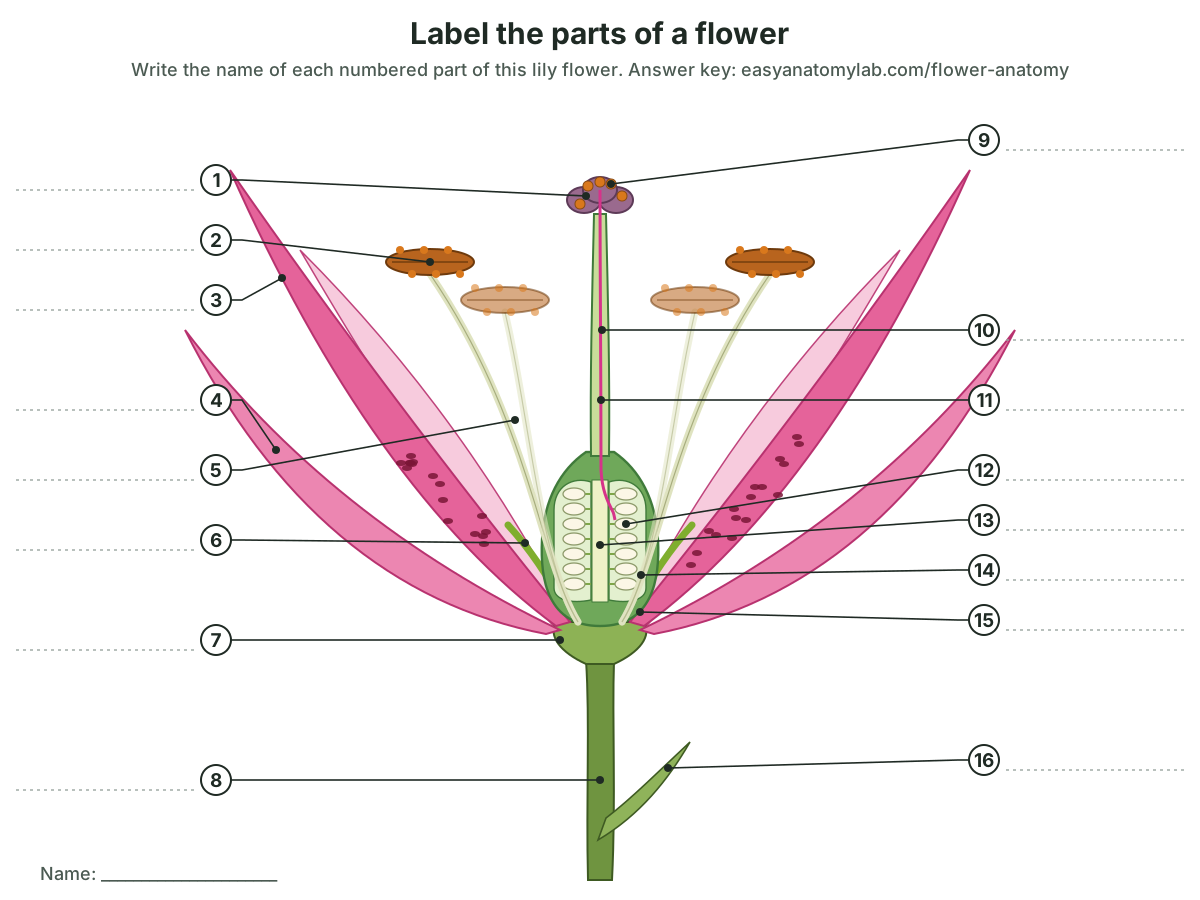
Worksheet answer key
- Stigma
- Anther (pollen sacs)
- Inner tepal (petal)
- Outer tepal (sepal)
- Filament
- Nectary
- Receptacle
- Pedicel
- Pollen grains
- Style
- Pollen tube
- Ovule
- Placenta
- Locule
- Ovary
- Bract
Flower anatomy quiz
- Which two parts make up a stamen?
Show answer
The filament (stalk) and the anther (pollen-producing head).
- Name the three parts of a pistil from top to bottom.
Show answer
Stigma, style, ovary.
- Why are a lily's sepals and petals called tepals?
Show answer
Because the two whorls look alike: the outer three are coloured like the inner three.
- How many carpels does a lily pistil have, and how can you tell?
Show answer
Three: there are three stigma lobes, three locules in the ovary and three valves in the capsule.
- Is a lily ovary superior or inferior?
Show answer
Superior: it sits above the attachment of the tepals and stamens.
- What does each ovule become after fertilization? And the ovary?
Show answer
Each ovule becomes a seed; the ovary becomes the fruit (in a lily, a capsule).
- What are the two products of double fertilization?
Show answer
A diploid zygote (sperm + egg), which becomes the embryo, and triploid endosperm (sperm + two polar nuclei), the seed's food store.
- A flower has stamens but no pistil. Is it complete? Is it perfect?
Show answer
Neither. It is incomplete (a whorl is missing) and imperfect (it is a staminate, male flower).
- Count the parts of a flower with 5 petals and 10 stamens. Monocot or eudicot?
Show answer
Eudicot: parts in fives. Monocots have parts in threes.
- Where is the nectar made in a lily?
Show answer
In the nectaries, grooves at the base of each tepal.
Activity idea: dissect a real lily or tulip. Pull off the six tepals and count them; cut the stamens off at the base and count them; slice the ovary across with a razor blade and look with a hand lens for three locules and rows of white ovules; then compare with a five-petalled eudicot flower such as a buttercup or a geranium.
Frequently asked questions
What are the parts of a flower and their functions?
A typical flower has four whorls on a receptacle at the tip of a stalk (pedicel). Sepals (the calyx) protect the bud; petals (the corolla) attract pollinators; stamens, each a filament and anther, make pollen; and the pistil, made of stigma, style and ovary, receives pollen and holds the ovules, which become seeds while the ovary becomes the fruit.
What is the difference between sepals, petals and tepals?
Sepals are the outer whorl, usually green, that protect the bud. Petals are the inner whorl, usually coloured, that attract pollinators. When the two whorls look the same, as in lilies, tulips and magnolias, all of them are called tepals.
What are the male and female parts of a flower?
The male parts are the stamens (filament and anther), together called the androecium. The female part is the pistil (stigma, style and ovary), made of one or more carpels and together called the gynoecium. A flower with both is perfect (bisexual); a flower with only one is imperfect.
What is the difference between a carpel and a pistil?
A carpel is one unit of the female part, with its own stigma, style and ovary. A pistil is what you see: either a single carpel (a pea) or several carpels fused together (a lily has three fused carpels in one pistil). The gynoecium is all the carpels of one flower.
Is a lily a complete flower?
Yes. A lily has all four whorls (the outer tepals in place of sepals, the inner tepals in place of petals, six stamens and a pistil), so it is complete, and because it has both stamens and a pistil it is also perfect.
What is double fertilization in flowers?
The pollen tube delivers two sperm cells into the ovule. One fertilizes the egg to make a diploid zygote, which grows into the embryo. The other fuses with the two polar nuclei of the central cell to make the triploid endosperm, the food store of the seed. This double event happens only in flowering plants.
What part of the flower becomes the fruit?
The ovary becomes the fruit, and the ovules inside it become the seeds. In some fruits other tissues join in: the swollen floral cup becomes the flesh of an apple, and the receptacle becomes the flesh of a strawberry.
How do you tell a monocot flower from a eudicot flower?
Count the parts. Monocot flowers, such as lilies, tulips and orchids, have parts in threes or multiples of three. Eudicot flowers, such as roses, buttercups and hibiscus, usually have parts in fours or fives. Monocot pollen has one furrow; most eudicot pollen has three.
Why do lilies have so much pollen?
Lily anthers are large and hang on long, swinging filaments, so they dust any large visitor, such as a moth or butterfly, with plenty of pollen. The pollen is sticky so it clings to the visitor, which is also why it stains clothes.
References
- OpenStax Biology 2e (2018, updated). 32.1 Reproductive Development and Structure. Rice University.
- OpenStax Biology 2e. 32.2 Pollination and Fertilization. Rice University.
- OpenStax Biology 2e. 26.3 Angiosperms. Rice University.
- Botany Brisbane. Liliaceae: Lilium (family and genus description).
- Conrad, J. Backyard Nature: hibiscus flowers (staminal column, style and stigmas).
- Ray, H. & Vendrame, W. Orchid Pollination Biology. University of Florida IFAS Extension, publication EP521.
- Conrad, J. Backyard Nature: iris flowers (falls, standards and style arms).
- VicFlora, Royal Botanic Gardens Victoria. Family Asteraceae.
- Spitzer-Rimon, B., Duchin, S., Bernstein, N. & Kamenetsky, R. (2019). Architecture and florogenesis in female Cannabis sativa plants. Frontiers in Plant Science 10: 350.
- Alvarez-Buylla, E. R. et al. (2010). Flower development. The Arabidopsis Book 8: e0127.
- Purdue University Vegetable Crops Hotline. Pollination services in tomatoes.
- NC State Extension Plant Toolbox. Cornus florida (flowering dogwood).
- NC State Extension Plant Toolbox. Anthurium andraeanum.
- Thermogenic tissues in lotus: insights from multiscale imaging and calcium dynamics. PubMed Central.
- Tamil Nadu Agricultural University Agritech Portal. Banana: botany.
More interactive anatomy models
- Leaf cross sectionLabeled leaf cross section: cuticle, epidermis, palisade and spongy mesophyll, veins.
- Stomata diagramGuard cells, stomatal pore and how stomata open and close, in 3D.
- Seed anatomyBean and corn seed anatomy: seed coat, cotyledons, endosperm and embryo.
- Chloroplast structureEnvelope, stroma, thylakoids, grana and lumen of a chloroplast, in 3D.
- Human anatomy1,000+ bones, muscles, organs, vessels and nerves from real anatomical data.
- Octopus anatomyThree hearts, a ring-shaped brain, eight arms and a beak, in 3D.