

Velociraptor skeleton at a glance
A Velociraptor skeleton is a small, lightly built theropod dinosaur skeleton about 1.5 to 2 m long, of which more than half is tail. It has a long, low skull with about 26 to 30 serrated teeth on each side, an S-curved neck, a short, deep rib cage with a wishbone and belly ribs, long arms with three clawed fingers, a hip with a backward-pointing pubis, and long legs that stood on two toes while a third toe held the famous sickle claw off the ground.
The reference species here is Velociraptor mongoliensis, named by Henry Fairfield Osborn in 1924 from a crushed skull and hand claw (AMNH 6515) found in 1923 at the Flaming Cliffs (Bayn Dzak) in Mongolia. It lived in the desert dunes of the Djadokhta Formation in the Campanian stage of the Late Cretaceous, about 75 to 71 million years ago. A second species, V. osmolskae, was named in 2008 from two upper jaws and a lacrimal found at Bayan Mandahu in Inner Mongolia, China; it differs mainly in the shape of the openings in the maxilla. (Turner, Makovicky & Norell (2012): dromaeosaurid systematics, Bulletin of the AMNH 371.)
| Region | Main bones | Count (sourced) |
|---|---|---|
| Skull | Premaxilla, maxilla, nasal, lacrimal, frontal, parietal, postorbital, jugal, squamosal, quadratojugal, quadrate, braincase, sclerotic ring | No separate prefrontal |
| Teeth (per side) | Premaxilla, maxilla, dentary | 4 + 11 upper; 14–15 lower |
| Neck | Cervical vertebrae with cervical ribs | About 10 |
| Back | Dorsal vertebrae, dorsal ribs, uncinate processes | 13 vertebrae, 13 rib pairs |
| Hips | Sacral vertebrae; ilium, pubis, ischium | 5–6 sacrals |
| Tail | Caudal vertebrae, chevrons, elongated prezygapophyses | At least 26 |
| Chest and belly | Furcula, paired sternal plates, sternal ribs, gastralia | 12 pairs of gastralia |
| Arm | Scapula, coracoid, humerus, radius, ulna, semilunate carpal, metacarpals I–III, phalanges | Fingers 2-3-4 |
| Leg | Femur, tibia, fibula, astragalus and calcaneum, distal tarsals, metatarsals I–V, phalanges | Toes 2-3-4-5 |
Directions: anterior means towards the snout, posterior towards the tail tip, dorsal towards the back and ventral towards the belly. Specimens are cited by their museum numbers; IGM, GIN and MPC-D are successive prefixes for the same Mongolian collection.
Velociraptor skeleton labeled diagram
The labeled Velociraptor skeleton below shows the animal from the right side, with every bone a school or museum worksheet usually asks for. The same labels are available in the 3D viewer above: switch on "All labels" or click any bone.
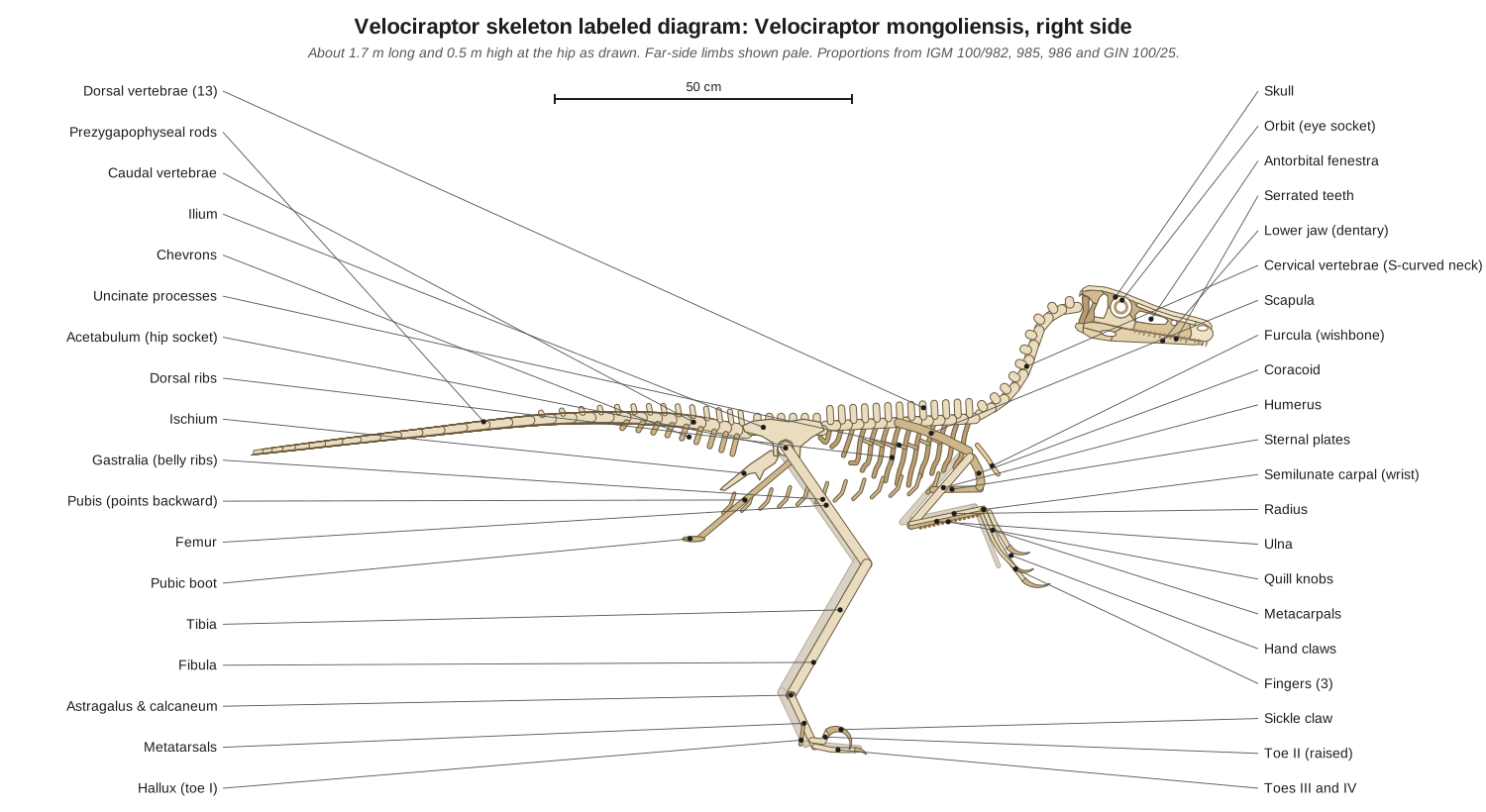
The bones most often asked for on a Velociraptor skeleton are:
- Maxilla: The main tooth-bearing bone of the upper jaw, with eleven teeth and the antorbital and maxillary openings.
- Dentary: The long, shallow tooth-bearing bone at the front of the lower jaw.
- Cervical vertebrae: About ten neck vertebrae arranged in an S-curve.
- Furcula: The boomerang-shaped wishbone formed by the fused collarbones.
- Scapula: A long, strap-like shoulder blade lying almost horizontally high on the rib cage.
- Humerus: The upper arm bone, with a large crest for the chest muscles.
- Ulna: The thicker, bowed forearm bone, where the secondary wing feathers attached.
- Semilunate carpal: A half-moon-shaped wrist bone over the first two metacarpals.
- Hand claws: Three sharp, strongly curved, side-to-side flattened finger claws; the thumb claw is the largest.
- Dorsal ribs: Thirteen pairs of mostly double-headed ribs forming a deep, narrow rib cage.
- Gastralia: A basket of thin, overlapping belly ribs in the abdominal wall.
- Ilium: The long, low upper hip bone fused to the sacrum.
- Pubis: The long front-lower hip bone, rotated backward (opisthopubic) as in birds.
- Ischium: The short, plate-like rear-lower hip bone with a pointed obturator process.
- Femur: The thigh bone, bowed forward, about 24 cm long in a large specimen.
- Tibia: The shin bone, slightly longer than the femur, with a cnemial crest at the knee.
- Metatarsals: Long upper foot bones: metatarsal III is longest, II shortest of the main three, and V a splint.
- Sickle claw: The enlarged, strongly curved claw on toe II, over 6.5 cm along its outer curve.
- Prezygapophyseal rods: Long bony rods projecting forward from each tail vertebra over its neighbours, stiffening the tail.
Velociraptor skull: bones, openings and teeth
A Velociraptor skull is long, low and narrow, up to about 23 cm long, with a snout that makes up 60% of its length and is only about a third as wide as the back of the skull. Barsbold and Osmólska measured the skull of the Fighting Dinosaurs specimen (GIN 100/25) at 230 mm, its lower jaw at 210 mm, and the deepest part of the skull at just 66 mm. (Barsbold & Osmólska (1999): the skull of Velociraptor, Acta Palaeontologica Polonica 44.)
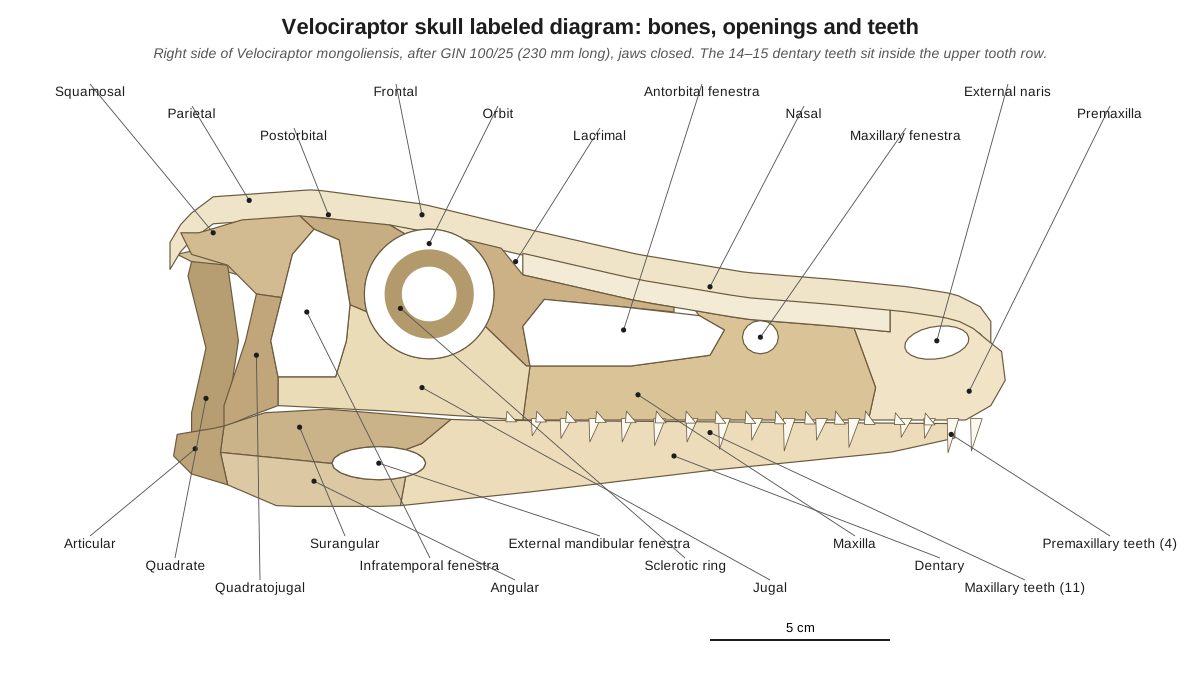
The side of the skull is a frame of bones around large openings. The large, oval external naris (nostril) sits near the tip. Behind it, the antorbital fenestra fills more than half of a long, shallow antorbital fossa, with a much smaller maxillary fenestra in front of it; these openings held air sinuses. The orbit is almost circular and held a ring of bony plates, the sclerotic ring. Behind the eye are the tall, narrow infratemporal fenestra on the side and an almost round supratemporal fenestra on the roof, which anchored the jaw muscles. Unusually, Velociraptor has no separate prefrontal bone; the lacrimal may include it. (Barsbold & Osmólska (1999): the skull of Velociraptor, Acta Palaeontologica Polonica 44.)
The snout of many Velociraptor skulls looks slightly dished or upturned. Barsbold and Osmólska treated this "depressed nasal" as a real feature, but Turner, Makovicky and Norell point out that the nasals are wider at the front, so side-to-side crushing, as in the holotype and Fighting Dinosaurs skulls, produces an exaggerated upturned look. The model and diagram keep only a gentle dip. (Turner, Makovicky & Norell (2012): dromaeosaurid systematics, Bulletin of the AMNH 371.)
Teeth. Each side of the upper jaw has 4 premaxillary and 11 maxillary teeth, and each dentary has 14 or 15, so a Velociraptor had roughly 26 to 30 teeth per side and 52 to 60 in all. The teeth are blade-like, curved backwards and serrated, with larger serrations (denticles) on the back edge than the front. Shed teeth from the type locality are mostly about 10 mm long. The lower jaw is very shallow, its depth only one-eighth to one-seventh of its length. (Barsbold & Osmólska (1999): the skull of Velociraptor, Acta Palaeontologica Polonica 44.)
A CT study of the braincase and inner ear found that Velociraptor could hear a wide, high range of frequencies (about 2,368 to 3,965 Hz) and had the balance organs of an agile animal, consistent with an active predator that also scavenged. (King et al. (2020): endocranium and trophic ecology of Velociraptor, Journal of Anatomy.)
Real Velociraptor skeleton size: next to a human
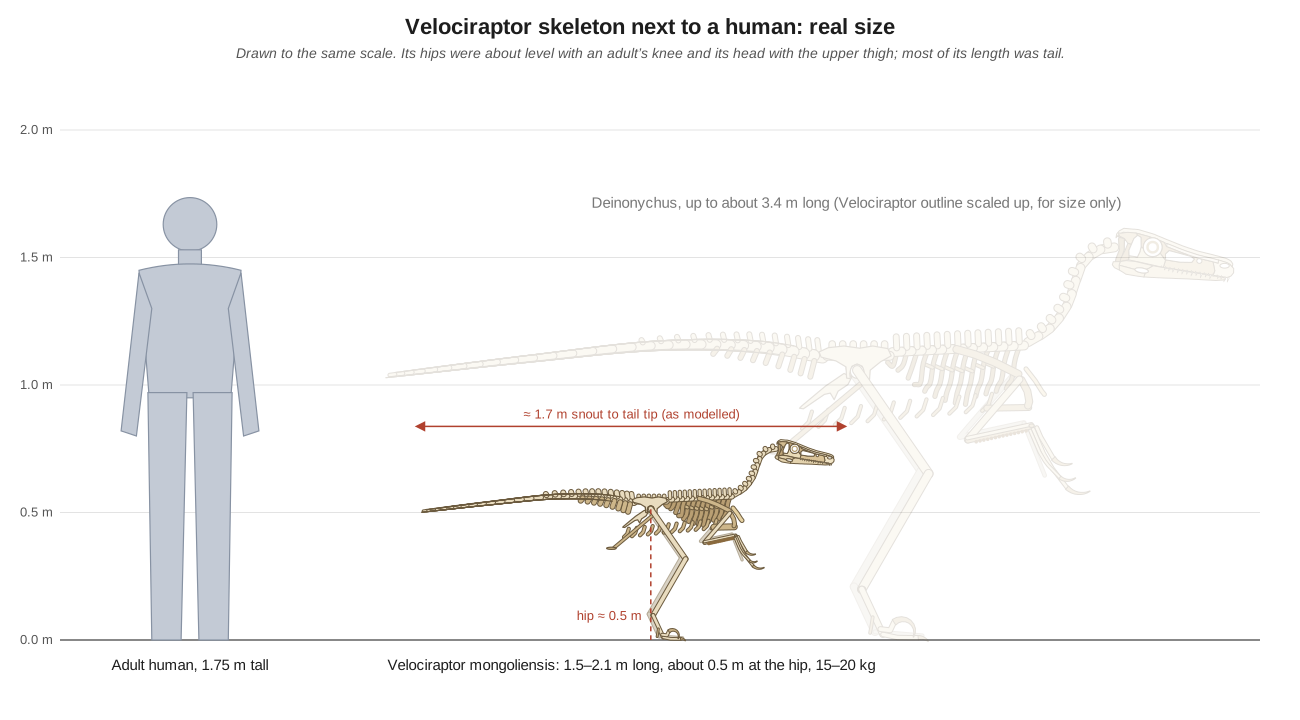
A real Velociraptor skeleton is about the length of an adult human's height but only knee-high at the hip. Adults were about 1.5 to 2.07 m long, about 0.5 m high at the hips and weighed roughly 14 to 20 kg; the skull was up to about 23 cm long. The Natural History Museum in London describes it as about the size of a Thanksgiving turkey, which is a fair description of its body without the tail. (Wikipedia: Velociraptor (specimen history and size estimates, with primary citations).) (Natural History Museum, London: Velociraptor facts.)
| Measurement | Velociraptor mongoliensis | Source specimen |
|---|---|---|
| Total length | 1.5–2.07 m (model: about 1.7 m) | Published estimates |
| Hip height | About 0.5 m | Published estimates |
| Body mass | About 14–20 kg | Published estimates |
| Skull length | 230 mm | GIN 100/25 |
| Femur (thigh bone) | 238 mm | IGM 100/986 |
| Tibia (shin bone) | 255 mm | IGM 100/986 |
| Metatarsal III | 86–99 mm | IGM 100/985, AMNH 6518 |
| Sickle claw (outer curve) | Over 6.5 cm | Bony core |
Bone measurements from Norell and Makovicky (1999) and Barsbold and Osmólska (1999). The keratin sheath that covered each claw in life would have made the claws longer than their bony cores. (Norell & Makovicky (1999): newly collected specimens of Velociraptor mongoliensis, American Museum Novitates 3282.)
How many Velociraptor skeletons have been found?
Velociraptor is one of the best-known dromaeosaurids, known from at least nine skeletons of varying completeness according to Turner, Makovicky and Norell (2012); other summaries say more than a dozen. The numbers differ because some finds are fragments or undescribed, and some specimens once called Velociraptor have since been given other names (for example MPC-D 100/980, named Shri devi in 2021). (Turner, Makovicky & Norell (2012): dromaeosaurid systematics, Bulletin of the AMNH 371.) (Wikipedia: Velociraptor (specimen history and size estimates, with primary citations).)
| Specimen | Found | What it preserves |
|---|---|---|
| AMNH 6515 (holotype) | 1923, Flaming Cliffs; Central Asiatic Expedition (Peter Kaisen) | Crushed but complete skull, a hand claw and phalanx |
| MPC-D 100/25 (Fighting Dinosaurs) | 1971, Tugrikin Shire; Polish-Mongolian expedition | Complete, articulated skeleton with skull, locked with a Protoceratops |
| GIN 100/2000 | Mongolian-Japanese expeditions | Complete skeleton of a young individual with its skull |
| GIN 100/24 | A Mongolian expedition | Almost complete but flattened skull with both jaws |
| IGM 100/976 | 1991, Tugrikin Shire; MAS-AMNH | Partial skull, neck, shoulder girdle and furcula |
| IGM 100/985 | 1993, Tugrikin Shire; MAS-AMNH | Sternal plates, 12 pairs of gastralia, pelvis, both feet |
| IGM 100/986 | 1993, Chimney Buttes; MAS-AMNH | Tail of 26 vertebrae, both legs and feet, pelvis |
| IGM 100/982 | 1995, Flaming Cliffs; MAS-AMNH | Well-preserved skull and torso with limbs and a fully articulated hand |
| V. osmolskae, IMM 99NM-BYM-3/3 | 1999, Bayan Mandahu, Inner Mongolia | Paired maxillae and a lacrimal |
Specimen details from Norell and Makovicky (1997, 1999), Barsbold and Osmólska (1999) and Turner et al. (2012). MAS-AMNH is the joint Mongolian Academy of Sciences and American Museum of Natural History expedition of the 1990s. IGM 100/982 has since been suggested to represent a separate species; that idea is still being tested. (Norell & Makovicky (1999): newly collected specimens of Velociraptor mongoliensis, American Museum Novitates 3282.)
The most complete Velociraptor skeleton
The most complete Velociraptor skeleton is the Velociraptor of the Fighting Dinosaurs (MPC-D 100/25). Barsbold and Osmólska describe it as complete and articulated, with the skull, closed jaws and the whole postcranial skeleton, although the snout and lower jaw are slightly crushed. A complete skeleton of a juvenile, GIN 100/2000, is the other full skeleton. (Barsbold & Osmólska (1999): the skull of Velociraptor, Acta Palaeontologica Polonica 44.)
For many details, though, scientists rely on the three-dimensional partial skeletons collected in the 1990s. Norell and Makovicky called them the largest assemblage of articulated dromaeosaurid postcrania then described. IGM 100/982 is preserved in near-perfect articulation from skull to the base of the tail, although scavengers removed the ends of many long bones. No single fossil preserves every bone undamaged, so a "full Velociraptor skeleton" in a museum, or this 3D model, is a composite of several specimens. (Norell & Makovicky (1999): newly collected specimens of Velociraptor mongoliensis, American Museum Novitates 3282.)
The real Velociraptor skeleton vs Jurassic Park
The Velociraptor skeletons and animals in the Jurassic Park films are not real Velociraptor. In 1988 the palaeoartist Gregory Paul placed the much larger North American Deinonychus antirrhopus in the genus Velociraptor, as V. antirrhopus. Michael Crichton, who had discussed the animals with Deinonychus expert John Ostrom, kept the name Velociraptor for his novel, and the film designers gave their raptors the proportions and snout of a large Deinonychus. (Wikipedia: Deinonychus (size, Paul 1988 and Jurassic Park).) Later work, including Barsbold and Osmólska's skull study, keeps Deinonychus and Velociraptor as separate genera. (Barsbold & Osmólska (1999): the skull of Velociraptor, Acta Palaeontologica Polonica 44.)
| Feature | Real Velociraptor mongoliensis | Film raptor (cultural reference) |
|---|---|---|
| Size | 1.5–2.1 m long, about 0.5 m at the hip, 15–20 kg | Deinonychus-sized or larger; Deinonychus reached about 3.4 m |
| Skull | Long, low, narrow snout (60% of the skull) | Deeper, boxier Deinonychus-like head |
| Feathers | Quill knobs on the ulna; feathered relatives | Scaly, featherless |
| Hands | Palms faced inward; could not pronate | Often shown palms-down |
| Wrist | Folded sideways on a semilunate carpal, like a bird wing | Not shown |
| Where and when | Mongolia and Inner Mongolia, about 75–71 million years ago | Mixed with Jurassic and Cretaceous species |
| Behaviour | Little evidence of pack hunting; also scavenged | Pack hunters with toe-tapping claws |
The Natural History Museum notes that there is no evidence for the films' claw-tapping behaviour and that trackways show, at most, groups moving together rather than cooperative hunting. Film references here are cultural context only; the skeleton on this page is built from the fossils. (Natural History Museum, London: Velociraptor facts.)
Velociraptor vs bird skeleton: how they are similar
A bird skeleton and a Velociraptor skeleton are similar because birds are living theropod dinosaurs, and dromaeosaurids such as Velociraptor are among their closest extinct relatives. The UC Museum of Paleontology lists more than twenty skeletal features birds share with maniraptoran dinosaurs, including a furcula formed by fused collarbones, hollow, thin-walled bones, a flexible wrist with a semilunate carpal, a pubis rotated backwards, long arms, an S-shaped neck and long metatarsals. (UC Museum of Paleontology: birds as avian dinosaurs.)
| Feature | Velociraptor | Pigeon (a flying bird) |
|---|---|---|
| Furcula (wishbone) | Yes, V-shaped | Yes, U-shaped and springy |
| Hollow, air-filled bones | Pneumatic vertebrae | Many pneumatic bones |
| Sternum | Two flat plates, no keel | One bone with a tall keel |
| Pubis | Points backward (opisthopubic) | Points backward |
| Wrist | Semilunate carpal; folding hand | Carpals fused into the carpometacarpus |
| Fingers | Three, long and clawed | Three, reduced and fused |
| Tail | Long bony tail, stiffened by rods | Short tail ending in a pygostyle |
| Teeth | Serrated teeth | Toothless beak |
| Foot | Separate metatarsals; toe II raised with a sickle claw | Fused tarsometatarsus; hallux reversed |
| Uncinate processes | Reported | Present |
Emu skeleton vs Velociraptor. An emu is a much bigger animal, standing 1.6 to 1.9 m tall, with greatly reduced wings and three forward-facing toes and no hind toe. Like Velociraptor it walks on its toes on long legs and has a backward-pointing pubis and an S-curved neck. The differences show what birds changed: as in all birds, the emu's foot bones are fused into one tarsometatarsus, its tail is short and its jaws are a toothless beak, and its arms have shrunk instead of carrying clawed hands. Like other flightless ratites it has a flat breastbone with no keel, closer to Velociraptor's keel-less plates than to a flying bird's. Velociraptor walked on two toes, holding toe II off the ground, while the emu walks on all three. (Australian Museum: emu.)
For the full bird side of the comparison, see the 3D bird skeleton page, which labels the keel, carpometacarpus, pygostyle and tarsometatarsus of a pigeon.
Velociraptor feathers: what the skeleton shows
Velociraptor had feathers, and the evidence is in its skeleton. In 2007 Alan Turner, Peter Makovicky and Mark Norell described a forearm bone (ulna IGM 100/981) with a row of quill knobs, the small bumps where the ligaments of large wing feathers anchor to the bone in living birds. Six knobs are preserved, and their spacing suggests about fourteen secondary feathers. The authors stress that this is a larger-bodied and clearly flightless animal. (Turner, Makovicky & Norell (2007): feather quill knobs in Velociraptor, Science 317.)
That ulna was later renumbered IGM 100/3503, and some authors have questioned whether it belongs to Velociraptor at all. Even so, Velociraptor's close relatives, such as Microraptor and Zhenyuanlong, are preserved with feathers, so a feathered Velociraptor is the mainstream view. No feathers, skin or colour have been preserved with a Velociraptor fossil. (Wikipedia: Velociraptor (specimen history and size estimates, with primary citations).)
In the 3D model, slide the Feathers control up to see a deliberately conservative outline: a short coat over the head, neck, body, arms and thighs, a small wing of vaned feathers along the ulna and second finger, and a frond of feathers along the end of the tail. The snout and the lower feet are left bare, the colour is a neutral brown, and feather lengths are guesses, so treat it as a silhouette rather than a portrait.
Velociraptor could not fly. Its arms were too short and its wing too small for flight or gliding. The Natural History Museum lists display, warmth and brooding eggs as possible uses of the feathers, and the 'raptor prey restraint' model adds flapping to stay balanced on top of struggling prey. (Natural History Museum, London: Velociraptor facts.)
The Velociraptor sickle claw and how it was used
The sickle claw is the enlarged, strongly curved claw on the second toe of each foot, more than 6.5 cm along its outer curve in bone and longer with its keratin sheath. Specialised joints in the toe, including a deep, rounded joint at the end of its second phalanx, let Velociraptor swing the claw up and back, so it was carried clear of the ground while the animal walked on toes III and IV. Norell and Makovicky describe the claw as strongly recurved, with a tall, narrow cross-section and a large flexor tubercle for the tendon that pulled it down. (Norell & Makovicky (1997): important features of the dromaeosaur skeleton, American Museum Novitates 3215.)
| Hypothesis | Idea | Evidence and status |
|---|---|---|
| Slashing (disembowelling) | The claw cut open prey like a blade | A robotic leg with a replica claw punctured but did not slice; now largely rejected (Manning et al. 2006) |
| Gripping and climbing | The claw hooked into the hide of large prey, like a climbing crampon | Proposed by Manning et al. (2006) from the robot test and comparisons with living claws |
| Prey restraint (RPR) | The predator pinned smaller prey under its body weight, the claw anchoring the grip, as hawks and eagles do with their enlarged inner talon | Fowler et al. (2011); the most widely cited model today |
| Throat strike | A stab at the neck of large prey | Suggested by the Fighting Dinosaurs pose, with the claw at the Protoceratops's throat |
Manning and colleagues concluded that the claw "did not function as a slashing weapon, but may have acted as an aid to prey capture". Fowler and colleagues found that the foot of Deinonychus groups with those of hawks and eagles in its proportions, and argued that dromaeosaurids pinned prey and began eating it alive, flapping their feathered arms for balance. (Manning et al. (2006): dinosaur killer claws or climbing crampons?, Biology Letters.) (Fowler et al. (2011): predatory ecology of Deinonychus and the origin of flapping, PLoS ONE.)
Velociraptor claw: hand claws and foot claws
Velociraptor had fourteen claws: three on each hand and four on each foot, including the two sickle claws. The hand claws are sharp, narrow, side-to-side flattened and strongly curved; the claw of digit I is the largest of the three and the claw of digit III the smallest. The famous sickle claw is on the foot, not the hand. The holotype AMNH 6515 includes a hand claw, from digit III, with its skull. (Norell & Makovicky (1999): newly collected specimens of Velociraptor mongoliensis, American Museum Novitates 3282.)
- Hand claws: Three sharp, strongly curved, side-to-side flattened finger claws; the thumb claw is the largest.
- Sickle claw: The enlarged, strongly curved claw on toe II, over 6.5 cm along its outer curve.
- Hallux: The small first toe, high on the inside of the foot and not reversed.
- Toe III: The middle, longest weight-bearing toe.
- Toe IV: The outer weight-bearing toe, nearly as long as toe III.
The Fighting Dinosaurs: Velociraptor vs Protoceratops skeleton
The Fighting Dinosaurs is a single block of sandstone holding a complete Velociraptor locked with a Protoceratops andrewsi, the sheep-sized horned dinosaur that is the most common large animal of the Djadokhta Formation. It was found on 3 August 1971 by a Polish-Mongolian expedition at Tugrikin Shire in the Gobi Desert. The Velociraptor is catalogued as MPC-D 100/25 (formerly GIN or IGM 100/25) and the Protoceratops as MPC-D 100/512. It is considered a national treasure of Mongolia. (Wikipedia: Fighting Dinosaurs (discovery and interpretations, with primary citations).)
One of the Velociraptor's arms is clamped in the Protoceratops's beak (the right hand, in Carpenter's description), and one foot is pressed against the Protoceratops's neck with the sickle claw at its throat. Both animals were buried very quickly, probably by a collapsing sand dune or a sandstorm, which explains why they are preserved in place. (Natural History Museum, London: Velociraptor facts.)
Scientists have read the scene in several ways. Kenneth Carpenter (1998) interpreted throat wounds from the claws that made the Protoceratops bleed to death while it held on to the predator's arm. Others proposed burial in a sandstorm mid-fight, or that the Velociraptor was scavenging. Barsbold (2016) noted that parts of the Protoceratops were missing or displaced, probably by scavengers after burial. None of these readings is settled, but the specimen is direct evidence that Velociraptor attacked prey about its own size. (Wikipedia: Fighting Dinosaurs (discovery and interpretations, with primary citations).)
Velociraptor also ate dead animals. Hone and colleagues described Velociraptor teeth next to tooth-marked Protoceratops bones (2010), and a Velociraptor skeleton (MPC-D 100/54) with a pterosaur bone in its gut (2012). The Natural History Museum notes that the pterosaur had a wingspan of around 3 m, larger than the Velociraptor, so it was more likely scavenged than killed. (Wikipedia: Velociraptor (specimen history and size estimates, with primary citations).)
Velociraptor hands and arms: wrist folding and no pronation
Velociraptor had long arms for a theropod, ending in large three-fingered hands. The shoulder blade (scapula) lies almost horizontally, high on the side of the rib cage, more like a bird's than in other non-avian theropods, and the L-shaped coracoid braces the shoulder against the paired sternal plates. A V-shaped furcula bridges the two shoulders in front. (Norell & Makovicky (1999): newly collected specimens of Velociraptor mongoliensis, American Museum Novitates 3282.)
The wrist has a half-moon-shaped semilunate carpal over the first two metacarpals. Its curved surface lets the hand fold sideways against the forearm, the same motion a bird uses to fold its wing. The hand has the theropod finger formula 2-3-4: digit I has two bones including the claw, digit II three, digit III four. Metacarpal II is the longest palm bone (about 51 mm in IGM 100/982) and finger II the longest finger. (Norell & Makovicky (1999): newly collected specimens of Velociraptor mongoliensis, American Museum Novitates 3282.)
No pronation. Velociraptor could not turn its palms to face the ground. In dromaeosaurids the radius is held firmly against the ulna and cannot roll around it, so the palms faced inward, towards each other, as if about to clap. Senter's range-of-motion study of its close relatives Deinonychus and Bambiraptor found the elbow could flex strongly but not straighten fully, and that bending the wrist back forced the palms to turn further upward (supination), never palm-down. (Senter (2006): forelimb function in Deinonychus and Bambiraptor, Journal of Vertebrate Paleontology.)
- Scapula: A long, strap-like shoulder blade lying almost horizontally high on the rib cage.
- Coracoid: The L-shaped bone below the scapula, fused to it and jointed to the sternal plates.
- Humerus: The upper arm bone, with a large crest for the chest muscles.
- Radius: The thinner of the two forearm bones.
- Ulna: The thicker, bowed forearm bone, where the secondary wing feathers attached.
- Quill knobs: A row of small bumps on the back of the ulna where the quills of wing feathers were tied by ligaments.
- Semilunate carpal: A half-moon-shaped wrist bone over the first two metacarpals.
- Metacarpals: Three palm bones; metacarpal II is the longest and metacarpal I short and robust.
- Fingers: Three fingers with the theropod phalangeal formula 2-3-4; finger II is the longest.
Velociraptor pelvis and the appendicular skeleton
The appendicular skeleton of Velociraptor is its limbs and limb girdles: the shoulder girdle and arms, and the pelvis and legs. The pelvis has three bones on each side that meet at an open hip socket (acetabulum), the hallmark of dinosaurs. The ilium is long and low, about 13 to 15 cm, with a sinuous upper edge and a reduced front shelf. The ischium is a short plate with a pointed obturator process. (Norell & Makovicky (1999): newly collected specimens of Velociraptor mongoliensis, American Museum Novitates 3282.)
The most bird-like feature is the pubis. In most dinosaurs it points forward and down; in Velociraptor it is swung backwards (opisthopubic). Norell and Makovicky measured an angle of 155° between the pubis and the long axis of the ilium in IGM 100/985, more backward than had been reconstructed for Deinonychus. The two pubes join at the bottom in an expanded pubic boot. (Norell & Makovicky (1997): important features of the dromaeosaur skeleton, American Museum Novitates 3215.)
The leg is built for speed. The femur (238 mm in IGM 100/986) is bowed forwards and is slightly shorter than the tibia (255 mm). The thin fibula runs down the outer side of the tibia. The astragalus and calcaneum are fused together and cap the tibia, with a tall ascending process up its front. Below them the long metatarsals hold the ankle well off the ground; metatarsal III is the longest, II the shortest of the main three, IV nearly as long as III, and V a thin splint. The small first toe (hallux) sits high on the inside and, unlike a perching bird's, is not reversed. (Norell & Makovicky (1999): newly collected specimens of Velociraptor mongoliensis, American Museum Novitates 3282.)
- Ilium: The long, low upper hip bone fused to the sacrum.
- Pubis: The long front-lower hip bone, rotated backward (opisthopubic) as in birds.
- Pubic boot: The expanded foot-like end of the fused pubes.
- Ischium: The short, plate-like rear-lower hip bone with a pointed obturator process.
- Acetabulum: The open hip socket where ilium, pubis and ischium meet.
- Femur: The thigh bone, bowed forward, about 24 cm long in a large specimen.
- Tibia: The shin bone, slightly longer than the femur, with a cnemial crest at the knee.
- Fibula: The very thin bone along the outer side of the tibia.
- Astragalus & calcaneum: The two upper ankle bones, fused to each other and capping the tibia, with a tall ascending process.
- Metatarsals: Long upper foot bones: metatarsal III is longest, II shortest of the main three, and V a splint.
Velociraptor spine, ribs and stiff tail
The Velociraptor backbone has four regions: a long, S-curved neck of about ten cervical vertebrae, thirteen dorsal (back) vertebrae carrying the ribs, a sacrum of five or six fused vertebrae locked between the hip bones, and a long tail. Norell and Makovicky number the dorsals from 1 to 13 in their measurements, and they describe the dorsal centra as pneumatic, with a honeycombed inside and openings where air sacs entered the bone, as in birds. (Norell & Makovicky (1999): newly collected specimens of Velociraptor mongoliensis, American Museum Novitates 3282.)
The sacrum grows with age. The partial skeleton IGM 100/985 has five sacral vertebrae, but in the larger IGM 100/986 the first tail vertebra has fused to the fifth sacral, giving six. The neural spines of the first five sacrals fuse into a continuous bony plate along the top of the hips. (Norell & Makovicky (1999): newly collected specimens of Velociraptor mongoliensis, American Museum Novitates 3282.)
The tail is the signature of the dromaeosaurid skeleton. IGM 100/986 preserves its first 26 tail vertebrae in a row; the total is unknown, and for comparison Ostrom estimated 36 to 40 in Deinonychus. From about the tenth tail vertebra backwards, each vertebra sends a pair of very long, thin rods (elongated prezygapophyses) forward over the vertebrae in front, and the chevrons underneath develop long forward and backward rods too. Together these bundles turn the back two-thirds of the tail into a stiff, light rod that worked as a counterbalance and a dynamic stabiliser. (Norell & Makovicky (1999): newly collected specimens of Velociraptor mongoliensis, American Museum Novitates 3282.)
Stiff does not mean rigid. One IGM 100/986 tail is preserved curved sideways without disturbing the rods, which suggests that the tail could still swing a good deal from side to side. The base of the tail stayed flexible, and it anchored the large caudofemoralis muscle that pulled each thigh backwards. (Norell & Makovicky (1999): newly collected specimens of Velociraptor mongoliensis, American Museum Novitates 3282.)
The rib cage is deep and narrow. The dorsal ribs are mostly double-headed and flat; the last is small and single-headed. Behind the sternum the belly was supported by gastralia: IGM 100/985 preserves twelve pairs, each pair made of two rods per side that overlap in a zigzag along the midline and could slide against each other, which may have helped breathing. (Norell & Makovicky (1997): important features of the dromaeosaur skeleton, American Museum Novitates 3215.)
Uncinate processes, the small backward-pointing spurs that brace the ribs of most living birds, have been reported in Velociraptor. Norell and Makovicky confirmed them on the Fighting Dinosaurs specimen in Ulaanbaatar, although they were not found in the skeletons collected by the American Museum expeditions. Codd and colleagues argued that, together with the sternum and gastralia, they gave maniraptoran dinosaurs bird-like breathing mechanics. (Codd et al. (2008): avian-like breathing mechanics in maniraptoran dinosaurs, Proc. R. Soc. B.)
How many bones does a Velociraptor skeleton have?
There is no published total bone count for Velociraptor, and this page does not invent one. Skulls are often crushed, the tip of the tail has never been found in sequence, and small bones such as gastralia, sclerotic plates and wrist bones are rarely all preserved. What can be stated from the fossils is a count by region:
| Region | Count | Source |
|---|---|---|
| Teeth (whole mouth) | About 52–60 (4 + 11 upper and 14–15 lower per side) | Barsbold & Osmólska 1999 |
| Cervical vertebrae | About 10 (scored as ten or fewer in dromaeosaurids) | Turner et al. 2012 |
| Dorsal vertebrae | 13 | Norell & Makovicky 1999 |
| Sacral vertebrae | 5–6, depending on age | Norell & Makovicky 1999 |
| Caudal vertebrae | At least 26; total unknown | Norell & Makovicky 1999 |
| Gastralia | 12 pairs of segments | Norell & Makovicky 1997 |
| Hand phalanges | 9 per hand (2 + 3 + 4) | Norell & Makovicky 1999 |
| Foot phalanges | 14 per foot (2 + 3 + 4 + 5) | Theropod formula |
For comparison, an adult human has about 206 bones. A Velociraptor certainly had more, mainly because of its long tail, gastralia and the many separate skull bones, but the exact number is not known.
Velociraptor fossils in museums, casts and replicas
Most real Velociraptor fossils are kept in Mongolian collections, because almost all specimens come from the Gobi Desert. The Fighting Dinosaurs are stored at the Mongolian Paleontological Center in Ulaanbaatar; they travelled to the American Museum of Natural History (AMNH) in New York for the 2000 exhibition "Fighting Dinosaurs: New Discoveries from Mongolia". The holotype skull AMNH 6515 is in the AMNH collection, collected in 1923 by the Central Asiatic Expeditions. The 1990s skeletons are catalogued in the Mongolian Academy of Sciences collection (IGM / MPC-D), and the V. osmolskae type is catalogued in Inner Mongolia, China. (Wikipedia: Fighting Dinosaurs (discovery and interpretations, with primary citations).)
What most museum visitors see are casts: resin or plaster copies of real bones, often combined from several specimens and mounted as a full skeleton. A cast of the Fighting Dinosaurs, for example, has been displayed at the Nagoya City Science Museum in Japan. Displays change, so check a museum's current exhibits before visiting to see a specific specimen. (Wikipedia: Fighting Dinosaurs (discovery and interpretations, with primary citations).)
Can you buy a real Velociraptor skeleton, and what is one worth? A real one is not legally for sale. Mongolian law since 1924 has declared dinosaur fossils property of the state and made their export a crime. In 2013, for example, a Tarbosaurus skeleton that had been smuggled out of Mongolia and auctioned in the United States was forfeited by a U.S. court and returned to Mongolia. The "Velociraptor skeletons" offered for sale, with prices that depend on size and finish, are casts and replicas, not fossils; this page does not recommend any vendor. (U.S. Attorney, S.D.N.Y. (2013): Tyrannosaurus bataar skeleton returned to Mongolia.)
Rotatable Velociraptor skeleton 3D model
The viewer at the top of this page is a rotatable Velociraptor skeleton 3D model. Drag to rotate, scroll or pinch to zoom, and click any bone to highlight it and read its name, position and function. The panel lists every structure by system; hide a system (for example the ribs) to see the bones behind it. "All labels" adds leader-line labels for printing or revision, and the Feathers slider fades in the reconstructed feather outline.
The model is built at a scale of 1 unit to 25 cm from published bone measurements: the femur, tibia, metatarsals, ilium, pubis, ischium and hand bones follow IGM 100/982, 100/985 and 100/986, and the skull follows GIN 100/25. It shows the animal standing with its sickle claws raised, its arms folded and its palms facing inward. It is a teaching model, not a scan of a single fossil.
Label the Velociraptor skeleton: worksheet and answer key
Test yourself on this unlabeled Velociraptor skeleton diagram. Write the name of each numbered bone, then check your answers in the key below. You can also use the 3D model: hide the labels, click a bone and say its name before you read it.
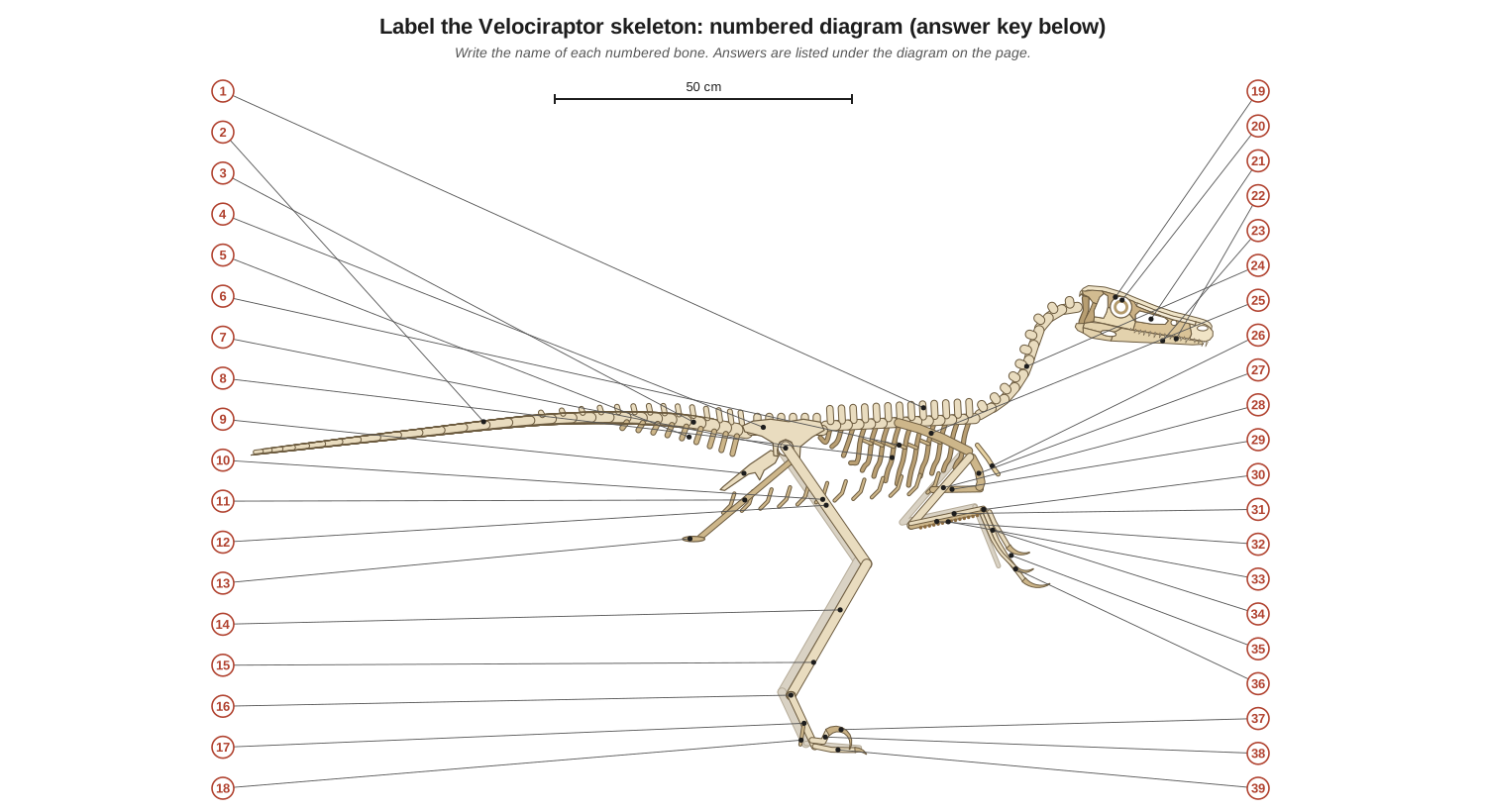
Answer key (39 bones)
- Dorsal vertebrae (13)
- Prezygapophyseal rods
- Caudal vertebrae
- Ilium
- Chevrons
- Uncinate processes
- Acetabulum (hip socket)
- Dorsal ribs
- Ischium
- Gastralia (belly ribs)
- Pubis (points backward)
- Femur
- Pubic boot
- Tibia
- Fibula
- Astragalus & calcaneum
- Metatarsals
- Hallux (toe I)
- Skull
- Orbit (eye socket)
- Antorbital fenestra
- Serrated teeth
- Lower jaw (dentary)
- Cervical vertebrae
- Scapula
- Furcula (wishbone)
- Coracoid
- Humerus
- Sternal plates
- Semilunate carpal (wrist)
- Radius
- Ulna
- Quill knobs
- Metacarpals
- Hand claws
- Fingers (3)
- Sickle claw
- Toe II (raised)
- Toes III and IV
Extra questions:
- Which bone shows that Velociraptor had wing feathers? (The ulna, with its quill knobs.)
- Which pelvic bone points backward, as in birds? (The pubis.)
- On which toes did Velociraptor walk? (Toes III and IV; toe II was held up.)
- Which wrist bone lets the hand fold sideways? (The semilunate carpal.)
Velociraptor skeleton parts: complete list
Every bone and opening in the 3D model, grouped by system. Click any name in the viewer's list to jump to it in 3D.
Feathers (reconstruction)
- Body plumage
- A conservative outline of the feathered body: a short coat over the head, neck, body and thighs. In living birds a feather coat insulates the body; in Velociraptor its exact extent and colour are unknown.
- Wing feathers (Secondaries and primaries)
- Long vaned feathers anchored to the back of the forearm and hand, forming a small wing. Velociraptor could not fly. The wings may have been used for display, shielding eggs, balance while running or pinning prey.
- Tail feathers
- A frond of vaned feathers along the sides of the end of the tail, as in feathered relatives. Probably display and balance. Inferred from relatives, not preserved in Velociraptor.
Skull
- Premaxilla
- The bone at the tip of the snout that carries the first four upper teeth and frames the nostril. Holds the front teeth; its long backward (maxillary) process braces the snout.
- Maxilla
- The main tooth-bearing bone of the upper jaw, with eleven teeth and the antorbital and maxillary openings. Carries most of the upper teeth and forms the side wall of the long, narrow snout.
- Nasal
- The long, narrow paired bone forming the top of the snout. Roofs the nasal cavity.
- Lacrimal
- The T-shaped bone between the antorbital fenestra and the orbit. Separates the antorbital cavity from the eye socket and forms part of the skull roof.
- Frontal
- The paired skull-roof bone above the orbits. Covers the front of the brain and rims the top of each orbit.
- Parietal
- The skull-roof bone at the back of the head, with a low midline crest. Roofs the back of the braincase and anchors jaw-closing muscles along its crests.
- Postorbital
- The three-pronged bone behind the orbit. Forms the back rim of the eye socket and part of the temporal arches.
- Jugal (Cheek bone)
- The long cheek bone under the orbit. Forms the lower rim of the eye socket and the lower temporal bar.
- Squamosal
- The bone at the upper back corner of the skull, above the quadrate. Holds the top of the quadrate and frames the temporal openings.
- Quadratojugal
- A small L-shaped bone joining the jugal to the quadrate. Braces the quadrate and closes the lower edge of the infratemporal fenestra.
- Quadrate
- The upright strut at the back of the skull that forms the upper half of the jaw joint. Carries the jaw joint. In living birds the equivalent bone also supports the eardrum.
- Braincase (Neurocranium, occiput)
- The bony box enclosing the brain and inner ears, at the back of the skull. Protects the brain; the occipital condyle at its base joins the skull to the first neck vertebra.
- Sclerotic ring (Scleral ring)
- A ring of small overlapping bony plates that stiffened the eyeball. Supports the large eye; its size relative to the orbit hints at how much light the eye gathered.
- External naris (Nostril opening)
- The large oval bony nostril near the snout tip. Opening of the nasal passage.
- Antorbital fenestra
- The largest skull opening, in front of the eye, inside a long shallow antorbital fossa. Housed an air sinus that lightened the skull, as in living birds and crocodilians.
- Maxillary fenestra
- A small round opening in the maxilla, in front of the antorbital fenestra. Led into the air-filled maxillary sinus.
- Orbit (Eye socket)
- The large, almost circular eye socket. Held the eye; the orbits face partly forward, giving some overlap of the visual fields.
- Temporal fenestrae (Infratemporal and supratemporal openings)
- The two openings behind each eye, one on the side and one on the roof, typical of diapsid reptiles. Make room for, and anchor, the jaw-closing muscles.
Lower jaw & teeth
- Dentary
- The long, shallow tooth-bearing bone at the front of the lower jaw. Carries the 14–15 lower teeth on each side.
- Surangular
- The upper bone of the back half of the lower jaw. Takes the pull of the jaw-closing muscles.
- Angular
- The lower bone of the back half of the lower jaw. Forms the lower edge of the rear jaw and the external mandibular fenestra.
- Articular
- The small bone at the back of the lower jaw that forms the lower half of the jaw joint. Hinges the lower jaw on the quadrate; its retroarticular process takes the jaw-opening muscle.
- External mandibular fenestra
- An oval opening in the side of the rear lower jaw. Lightens the jaw; typical of archosaurs.
- Upper teeth (Premaxillary and maxillary teeth)
- Fifteen serrated, backward-curved teeth on each side of the upper jaw: 4 in the premaxilla and 11 in the maxilla. Gripping and slicing flesh.
- Lower teeth (Dentary teeth)
- Fourteen or fifteen serrated teeth on each side of the lower jaw. Gripping and slicing, working against the upper teeth.
Vertebral column
- Cervical vertebrae (Neck vertebrae)
- About ten neck vertebrae arranged in an S-curve. Hold the head high and let the neck strike forward.
- Dorsal vertebrae (Back vertebrae)
- Thirteen back vertebrae carrying the ribs, with air-filled (pneumatic) centra. Support the rib cage and body.
- Sacrum (Sacral vertebrae)
- Five or six fused hip vertebrae locked between the two ilia. Transfers the body's weight to the hind legs.
- Caudal vertebrae (Tail vertebrae)
- The long tail of more than 26 vertebrae; the model draws 30. Counterbalance the front of the body and anchor the large leg-retracting muscle (caudofemoralis).
- Prezygapophyseal rods (Elongate prezygapophyses)
- Long bony rods projecting forward from each tail vertebra over its neighbours, stiffening the tail. Bundle the tail into a stiff but still flexible rod used for balance.
- Chevrons (Haemal arches)
- Bones under the tail vertebrae; from the 11th on they become flat plates with long forward and backward rods. Protect tail blood vessels and add to the stiffening rod system.
Ribs, sternum & gastralia
- Cervical ribs
- Short, slender ribs fused to the sides of the neck vertebrae. Anchor neck muscles.
- Dorsal ribs
- Thirteen pairs of mostly double-headed ribs forming a deep, narrow rib cage. Enclose the lungs and air sacs and help ventilate them.
- Uncinate processes
- Small, free bony spurs on the rear edge of the ribs, as in most living birds. Lever arms that help move the ribs and sternum when breathing.
- Sternal ribs
- Short ossified ribs linking the dorsal ribs to the sternal plates. Connect the rib cage to the breastbone.
- Sternal plates (Sternum, breastbone)
- A pair of flat breastbone plates without a keel, joined to the coracoids. Brace the shoulder girdle and form the front of the chest floor.
- Gastralia (Belly ribs)
- A basket of thin, overlapping belly ribs in the abdominal wall. Support the belly and probably helped breathing.
- Furcula (Wishbone)
- The boomerang-shaped wishbone formed by the fused collarbones. Braces the shoulders; in birds it also stores spring energy during flight.
Shoulder & arm
- Scapula (Shoulder blade)
- A long, strap-like shoulder blade lying almost horizontally high on the rib cage. Anchors shoulder muscles.
- Coracoid
- The L-shaped bone below the scapula, fused to it and jointed to the sternal plates. Forms part of the shoulder socket and braces it against the sternum.
- Humerus (Upper arm bone)
- The upper arm bone, with a large crest for the chest muscles. Moves the arm; the arms were long for a theropod.
- Radius
- The thinner of the two forearm bones. Tied firmly to the ulna, so the forearm could not twist the palm down.
- Ulna
- The thicker, bowed forearm bone, where the secondary wing feathers attached. Main forearm bone; anchor for the secondary feathers.
- Quill knobs (Ulnar papillae)
- A row of small bumps on the back of the ulna where the quills of wing feathers were tied by ligaments. Anchor points for secondary feathers: direct skeletal evidence of feathers.
- Semilunate carpal (Half-moon wrist bone)
- A half-moon-shaped wrist bone over the first two metacarpals. Lets the hand fold sideways against the forearm, like a bird folding its wing.
- Metacarpals (Palm bones)
- Three palm bones; metacarpal II is the longest and metacarpal I short and robust. Support the three fingers.
- Fingers (Manual digits I–III)
- Three fingers with the theropod phalangeal formula 2-3-4; finger II is the longest. Grasping and holding prey.
- Hand claws (Manual unguals)
- Three sharp, strongly curved, side-to-side flattened finger claws; the thumb claw is the largest. Hooking and holding prey.
Pelvis
- Ilium
- The long, low upper hip bone fused to the sacrum. Anchors thigh muscles and carries the body's weight to the legs.
- Pubis
- The long front-lower hip bone, rotated backward (opisthopubic) as in birds. Supports the belly and the gastralia; anchors leg muscles.
- Pubic boot
- The expanded foot-like end of the fused pubes. Support for the body when resting and attachment for belly muscles.
- Ischium
- The short, plate-like rear-lower hip bone with a pointed obturator process. Anchors muscles that pull the leg back.
- Acetabulum (Hip socket)
- The open hip socket where ilium, pubis and ischium meet. Holds the head of the femur. It is open in the middle, a dinosaur hallmark.
Hindlimb & foot
- Femur (Thigh bone)
- The thigh bone, bowed forward, about 24 cm long in a large specimen. Main weight-bearing bone of the leg.
- Tibia (Shin bone)
- The shin bone, slightly longer than the femur, with a cnemial crest at the knee. Carries the weight to the ankle; a longer tibia than femur suits a fast runner.
- Fibula
- The very thin bone along the outer side of the tibia. Muscle attachment; carries little weight.
- Astragalus & calcaneum (Upper ankle bones)
- The two upper ankle bones, fused to each other and capping the tibia, with a tall ascending process. Form the hinge-like ankle joint.
- Metatarsals (Foot bones)
- Long upper foot bones: metatarsal III is longest, II shortest of the main three, and V a splint. Lengthen the leg; the animal walked on its toes.
- Hallux (Pedal digit I)
- The small first toe, high on the inside of the foot and not reversed. Did not touch the ground in walking.
- Toe II (Pedal digit II)
- The second toe, specialised to hyperextend so its claw could be held up off the ground. Carries the sickle claw; held raised when walking.
- Sickle claw (Pedal ungual II)
- The enlarged, strongly curved claw on toe II, over 6.5 cm along its outer curve. Probably used to grip and pin prey rather than slash it.
- Toe III (Pedal digit III)
- The middle, longest weight-bearing toe. With toe IV, carries the weight: the foot is functionally two-toed.
- Toe IV (Pedal digit IV)
- The outer weight-bearing toe, nearly as long as toe III. Weight-bearing.
Frequently asked questions
How big was a Velociraptor skeleton?
An adult Velociraptor mongoliensis was about 1.5–2.1 m long, most of it tail, stood about 0.5 m high at the hips and weighed roughly 15–20 kg. Its skull was up to about 23 cm long. That is about the height of a large dog or a turkey, far smaller than the raptors in Jurassic Park.
Is there a complete Velociraptor skeleton?
Yes. The Velociraptor of the 1971 Fighting Dinosaurs specimen (MPC-D 100/25) is complete and articulated, and a young individual (GIN 100/2000) is also known from a complete skeleton with its skull. Several skeletons collected in the 1990s (IGM 100/982, 100/985, 100/986) are partial but beautifully preserved in three dimensions.
How many Velociraptor skeletons have been found?
Turner, Makovicky and Norell (2012) wrote that Velociraptor mongoliensis is known from at least nine skeletons of varying completeness. Other summaries say more than a dozen; counts differ because some specimens are fragmentary, some are undescribed, and some once referred to Velociraptor have been reassigned.
Did Velociraptor have feathers?
Yes. A forearm bone referred to Velociraptor has quill knobs, the bumps where wing feathers attach to the bone in living birds. Its close relatives are preserved with feathers. No Velociraptor skin or feathers have been found, so colour and exact feather length are unknown.
Was the Jurassic Park raptor a real Velociraptor?
No. The film's raptors were modelled on the much larger North American Deinonychus, which Gregory Paul had placed in the genus Velociraptor in 1988. The real Velociraptor was about half that length, feathered, and held its hands with the palms facing inward.
How many bones are in a Velociraptor skeleton?
There is no published total, and we do not invent one. The counts that are known include 4 + 11 upper and 14–15 lower teeth per side, about 10 neck, 13 back and 5–6 hip vertebrae, at least 26 tail vertebrae, 13 pairs of dorsal ribs, 12 pairs of gastralia, and the phalangeal formulae 2-3-4 (hand) and 2-3-4-5 (foot).
What was the Velociraptor sickle claw used for?
Probably for gripping and pinning prey. A robotic-leg test showed it could not slash open a carcass, and comparison with hawks and eagles suggests it worked like their enlarged inner talon. In the Fighting Dinosaurs fossil, one sickle claw lies at the throat of a Protoceratops.
How is a bird skeleton similar to a Velociraptor skeleton?
Both have a wishbone (furcula), hollow air-filled bones, a backward-pointing pubis, a half-moon wrist bone that folds the hand, uncinate processes on the ribs, three main fingers and a foot built on three main toes. Birds are living theropod dinosaurs, and dromaeosaurids like Velociraptor are among their closest relatives.
Can you buy a real Velociraptor skeleton?
Not legally. All known Velociraptor fossils come from Mongolia and Inner Mongolia, China. Mongolian law since 1924 makes dinosaur fossils state property and makes exporting them a crime. The skeletons offered for sale are resin or plaster casts and replicas.
References
- Norell, M. A. & Makovicky, P. J. (1997). Important features of the dromaeosaur skeleton: information from a new specimen. American Museum Novitates 3215.
- Norell, M. A. & Makovicky, P. J. (1999). Important features of the dromaeosaurid skeleton II: information from newly collected specimens of Velociraptor mongoliensis. American Museum Novitates 3282.
- Barsbold, R. & Osmólska, H. (1999). The skull of Velociraptor (Theropoda) from the Late Cretaceous of Mongolia. Acta Palaeontologica Polonica 44(2), 189–219.
- Turner, A. H., Makovicky, P. J. & Norell, M. A. (2012). A review of dromaeosaurid systematics and paravian phylogeny. Bulletin of the American Museum of Natural History 371.
- Turner, A. H., Makovicky, P. J. & Norell, M. A. (2007). Feather quill knobs in the dinosaur Velociraptor. Science 317, 1721. doi:10.1126/science.1145076
- Manning, P. L., Payne, D., Pennicott, J., Barrett, P. M. & Ennos, R. A. (2006). Dinosaur killer claws or climbing crampons? Biology Letters 2, 110–112. doi:10.1098/rsbl.2005.0395
- Fowler, D. W., Freedman, E. A., Scannella, J. B. & Kambic, R. E. (2011). The predatory ecology of Deinonychus and the origin of flapping in birds. PLoS ONE 6(12), e28964.
- Codd, J. R., Manning, P. L., Norell, M. A. & Perry, S. F. (2008). Avian-like breathing mechanics in maniraptoran dinosaurs. Proceedings of the Royal Society B 275, 157–161.
- King, J. L., Sipla, J. S., Georgi, J. A., Balanoff, A. M. & Neenan, J. M. (2020). The endocranium and trophic ecology of Velociraptor mongoliensis. Journal of Anatomy 237, 861–869.
- Senter, P. (2006). Comparison of forelimb function between Deinonychus and Bambiraptor (Theropoda: Dromaeosauridae). Journal of Vertebrate Paleontology 26(4), 897–906.
- Natural History Museum, London. Vicious Velociraptor: tales of a turkey-sized dinosaur.
- U.S. Attorney's Office, Southern District of New York (6 May 2013). Tyrannosaurus bataar skeleton returned to Mongolia.
- University of California Museum of Paleontology. Introduction to the Aves: birds as avian dinosaurs.
- Australian Museum. Emu (Dromaius novaehollandiae).
- Wikipedia. Velociraptor; Fighting Dinosaurs; Deinonychus (used as pointers to Osborn 1924, Paul 1988, Carpenter 1998, Godefroit et al. 2008, Hone et al. 2010 and 2012, Barsbold 2016 and Schmitz & Motani 2011).
More interactive anatomy models
- Pterodactyl skeletonPterodactylus skeleton in 3D: the fourth-finger wing, pteroid, hollow bones and crested skull.
- Human anatomy1,000+ bones, muscles, organs, vessels and nerves from real anatomical data.
- Octopus anatomyThree hearts, a ring-shaped brain, eight arms and a beak, in 3D.
- Squid anatomyPen, eight arms, two tentacles, giant axons and three hearts of the longfin squid.
- Squid dissectionStep-by-step guided squid dissection with every structure labeled.
- Fish anatomyExternal and internal anatomy of a bony fish: fins, gills, swim bladder, heart and brain.