

What does animal anatomy cover?
Animals are many-celled organisms whose cells have no walls. All of them are heterotrophs that must eat other organisms, most can move during at least part of their lives, and most are built from specialised tissues: epithelia that cover surfaces, connective tissue such as bone, muscle and nervous tissue. Biologists divide the kingdom into five clades: sponges (Porifera), Placozoa, Cnidaria, comb jellies (Ctenophora) and Bilateria, which holds every other animal. (OpenStax Biology 2e, 27.1 Features of the Animal Kingdom.)
The body plan is laid down in the embryo, and Hox genes, master control genes that encode transcription factors, help set it. Vertebrates have four or more sets of Hox genes, while invertebrates have one. (OpenStax Biology 2e, 27.1 Features of the Animal Kingdom.)
Vertebrate vs invertebrate anatomy
Nearly 97 percent of animal species are invertebrates, animals without a backbone, and perhaps millions of species have not yet been scientifically classified. (OpenStax Biology 2e, 28 Introduction (invertebrates).)
Estimates of that share depend on how species are counted. The Australian Museum puts invertebrates at well over 90 percent of animal species, with about 1.7 million invertebrate species documented so far and an estimated 5 to 30 million in total. (Australian Museum, Invertebrate biodiversity.)
Vertebrates belong to the chordates, which all have a notochord, a dorsal hollow nerve cord, pharyngeal slits and a post-anal tail at some stage of life. In vertebrates the notochord is replaced by the vertebral column that gives the group its name, and the nerve cord develops into the brain and spinal cord. With more than 62,000 living species, vertebrates are the largest group of chordates. (OpenStax Biology 2e, 29.1 Chordates.)
Arthropods dominate the invertebrates, with well over a million described species and an estimated 85 percent of all known species. They are coelomate animals with a tough exoskeleton made mainly of chitin and jointed appendages, which is what the name means: jointed feet. (OpenStax Biology 2e, 28.6 Superphylum Ecdysozoa: Arthropods.)
Animal body symmetry: asymmetrical, radial and bilateral
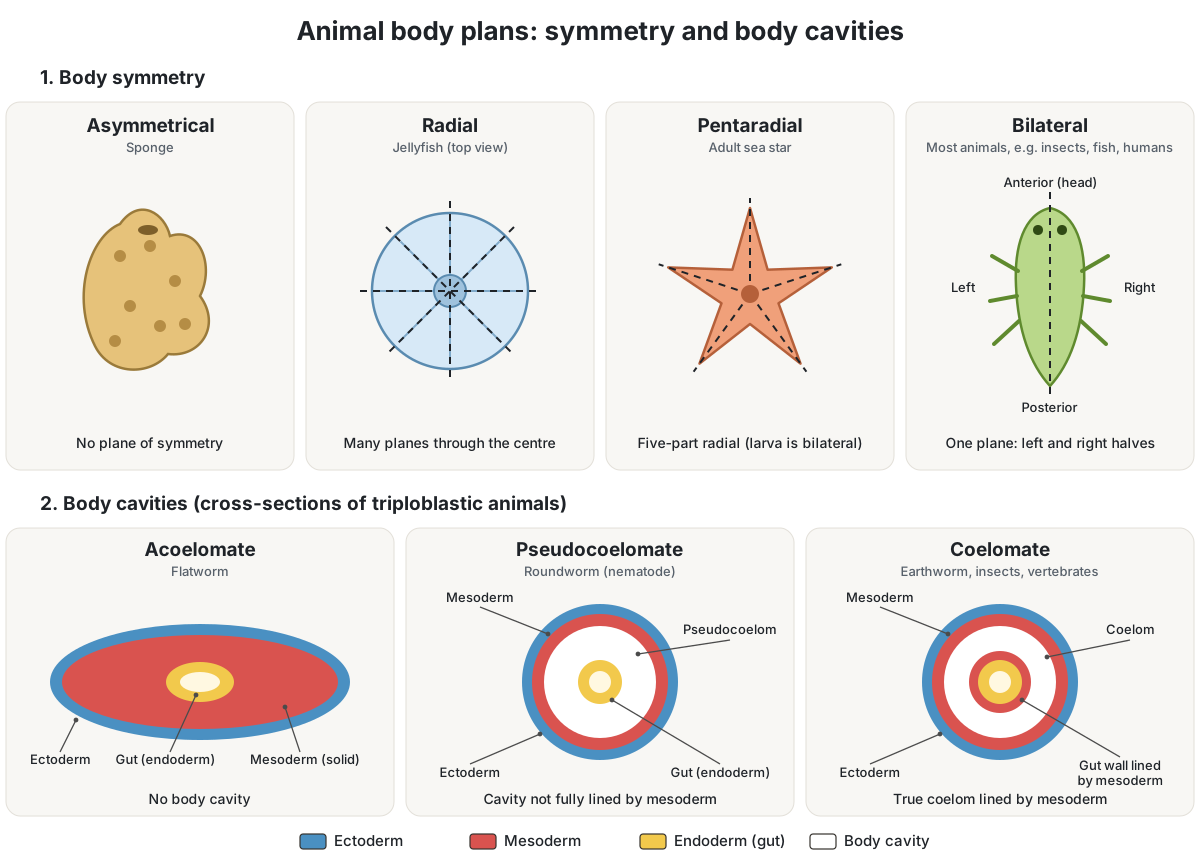
Sponges are asymmetrical. Jellyfish and sea anemones are radially symmetrical, with body parts arranged around a central axis, a plan best suited to animals that stay put or move little. Most animals are bilaterally symmetrical: one midsagittal plane divides them into left and right halves, they have a head and tail end (anterior and posterior) and a back and belly (dorsal and ventral), and bilateral symmetry allows streamlined, directional movement. (OpenStax Biology 2e, 27.2 Features Used to Classify Animals.)
Bilateral animals usually show cephalization, the gathering of an organised nervous system at the front end. Echinoderms are the famous exception that proves the rule: adult sea stars and sea urchins are radial, but their larvae start out bilateral, so echinoderms evolved from bilateral ancestors and are classified with them. (OpenStax Biology 2e, 27.2 Features Used to Classify Animals.)
Germ layers and body cavities: acoelomate, pseudocoelomate and coelomate
Embryos build the body from germ layers. Radially symmetrical animals such as cnidarians are diploblasts, with only ectoderm and endoderm and a non-living layer between them; bilateral animals are usually triploblasts, with mesoderm as a third, middle layer. (OpenStax Biology 2e, 27.2 Features Used to Classify Animals.)
Triploblasts differ in their body cavity. Flatworms are acoelomates, with no cavity between gut and body wall. Roundworms (nematodes) are pseudocoelomates, with a cavity lined partly by mesoderm and partly by endoderm. Annelids, molluscs, arthropods, echinoderms and chordates, vertebrates included, are eucoelomates, with a true coelom lined entirely by mesoderm. (OpenStax Biology 2e, 27.2 Features Used to Classify Animals.)
A coelom cushions the organs it encloses and absorbs shock, lets them grow and move freely, gives room for gases and nutrients to diffuse, and houses the major arteries and veins. (OpenStax Biology 2e, 27.2 Features Used to Classify Animals.)
Segmentation: repeated body units
In annelids such as the earthworm, many internal and external features repeat in every segment, a pattern called metamerism. A membranous septum closes off each segment and divides the coelom into compartments, and each segment carries its own pair of excretory metanephridia. Metamerism lets an animal grow bigger by adding compartments and makes its movement more efficient. (OpenStax Biology 2e, 28.4 Superphylum Lophotrochozoa: Mollusks and Annelids.)
Arthropods fuse groups of segments into body regions called tagmata: head, thorax and abdomen in insects, or a cephalothorax and abdomen in other groups. An insect's head alone is the fused remains of six ancestral segments, and the jointed appendages, often one pair per segment, are specialised for sensing, feeding, walking, jumping, digging or swimming. (OpenStax Biology 2e, 28.6 Superphylum Ecdysozoa: Arthropods.)
To see how the same organs differ across these body plans, from two-chambered fish hearts to bird air sacs and the vertebrate forelimb, read the comparative anatomy guide.
Mammal anatomy
Mammals are vertebrates with hair, made of the protein keratin, and mammary glands that make milk for the young. They hear through three middle-ear bones, the malleus, incus and stapes, two of which come from former jaw bones; most have heterodont teeth of different types and shapes; and they breathe with a muscular diaphragm, which birds lack. Like birds, they are endothermic and have a four-chambered heart, an example of convergent evolution. (OpenStax Biology 2e, 29.6 Mammals.)
The mammals on this site range from the domestic dog, cat and horse to farm animals, rodents, a whale and a bat. Bats are a large share of the class: the roughly 925 living species make up about 20 percent of all known mammal species, and most of a bat's wing is its hand. (Animal Diversity Web, Chiroptera.)
Compare a horse's single-toed leg with a bat's wing and a whale's flipper in the vertebrate forelimb diagram on the comparative anatomy page.
Bird anatomy
Birds are endothermic vertebrates covered in contour and down feathers. Their skeleton is built for flight: hollow pneumatic bones, some connected to air sacs in the body cavity, a blade-shaped keel on the sternum for the flight muscles, a furcula (wishbone) made of fused collarbones, and a light keratin beak instead of heavy jaws and teeth. Females of most species have only one working ovary, the left. Birds evolved from maniraptoran theropod dinosaurs about 150 million years ago. (OpenStax Biology 2e, 29.5 Birds.)
Reptile and amphibian anatomy
Reptiles lay amniotic eggs, in which the embryo is supported by four membranes (the yolk sac, amnion, chorion and allantois). Their skin holds keratin and waxy lipids that cut water loss, so they breathe only with lungs, and most are ectotherms that take their body heat from the environment. Squamates, the lizards and snakes, are the largest living group; a turtle's shell is part of its skeleton; and snakes, thought to descend from lizards more than 100 million years ago, still show vestigial hind limbs as pelvic spurs in boas and pythons. (OpenStax Biology 2e, 29.4 Reptiles.)
Amphibians are tetrapods with a moist, permeable skin kept wet by mucus glands; skin, lungs and the lining of the mouth all serve as breathing surfaces. The living species fall into three groups: salamanders, frogs and the legless caecilians. Frog tadpoles usually have gills, a lateral line and a long finned tail, and grow lungs and limbs at metamorphosis. (OpenStax Biology 2e, 29.3 Amphibians.)
Fish and shark anatomy
Fishes split into jawless fishes and the jawed fishes. Sharks, rays and skates are cartilaginous fishes, with a skeleton of cartilage, a lateral line that senses movement and vibration, electroreceptors called ampullae of Lorenzini and a very large, oil-rich liver. Bony fishes have a skeleton of bone, a protective muscular flap, the operculum, over the gills and, in many species, a gas-filled swim bladder that grows from the gut. Lobe-finned fishes have fin bones similar in type and arrangement to the limb bones of early tetrapods. (OpenStax Biology 2e, 29.2 Fishes.)
Marine invertebrate anatomy
Cnidarians such as jellyfish are radial and diploblastic, with a jelly-like mesoglea between two cell layers. Their defining cells are cnidocytes, stinging cells armed with nematocysts; they live as a stalk-like polyp or a bell-shaped medusa; their gastrovascular cavity has one opening that serves as both mouth and anus; and their nerve cells form a scattered net. (OpenStax Biology 2e, 28.2 Phylum Cnidaria.)
Molluscs, from clams to octopuses, share a muscular foot, a visceral mass holding most organs and a mantle over it, and all but bivalves feed with a toothed radula. Cephalopods such as squid and octopuses have a closed circulatory system, with blood kept entirely in vessels. (OpenStax Biology 2e, 28.4 Superphylum Lophotrochozoa: Mollusks and Annelids.)
Adult echinoderms such as sea stars have five-part (pentaradial) symmetry, an endoskeleton of small calcareous plates called ossicles, and a water vascular system, derived from the coelom, that works rows of tube feet on each arm. They have a nerve ring and radial nerves but no brain. (OpenStax Biology 2e, 28.7 Superphylum Deuterostomia.)
Insect, spider and other invertebrate anatomy
Living arthropods fall into four subphyla (a fifth, the trilobites, is extinct). Insects and other hexapods have six legs and three tagmata, head, thorax and abdomen, and most carry wings on the thorax. Chelicerates such as spiders have two tagmata, the prosoma and opisthosoma, and breathe with book lungs on land; crustaceans such as crayfish breathe with gills in water; insects and myriapods breathe through tracheae opened by spiracles. (OpenStax Biology 2e, 28.6 Superphylum Ecdysozoa: Arthropods.)
Annelids such as the earthworm are segmented worms whose body is a row of near-identical compartments, and most of them, the earthworm included, have a closed circulatory system of dorsal and ventral blood vessels. (OpenStax Biology 2e, 28.4 Superphylum Lophotrochozoa: Mollusks and Annelids.)
Organ dissections
Single organs from farm animals are a staple of anatomy labs. The cow eye, sheep brain and sheep heart guides below follow each dissection step by step and name every structure as it appears, so you can compare it with the same organ in the human anatomy guides.
Prehistoric animal skeletons
Pterosaurs were the first vertebrates to evolve true flight. Their wing was a membrane supported by a greatly elongated fourth finger, with a pteroid bone, unique to the group, pointing from the wrist towards the shoulder to support part of the membrane. (UC Museum of Paleontology, Pterosaur flight.)
These skeletons are reconstructed from fossils, so they show bones only. Set the pterosaur's fourth-finger wing beside a bat's and a bird's wing to see three separate solutions to flight built from the same forelimb bones.
How to study animal anatomy
Start with the body plan, then the systems. For any animal, ask four questions first: what symmetry it has, what body cavity, whether it is segmented, and whether it has a backbone. Then work through one organ system at a time and compare it with the same system in an animal you already know; the comparative anatomy guide does this for limbs, hearts, guts and lungs.
Use 3D models to learn where structures sit. Most models on this site can be rotated and taken apart layer by layer, and clicking a structure names it and explains what it does, which is the fastest way to learn positions before a practical exam.
Virtual and model-based dissection works. A 2021 systematic review of 50 studies found that humane teaching methods, such as models, simulations and virtual dissection, gave learning outcomes that were superior to harmful animal use in 30 percent of studies, equivalent in 60 percent and inferior in 10 percent. (Zemanova & Knight (2021), the educational efficacy of humane teaching methods, Animals 11: 114 (PMC).)
Virtual dissections on this site
Each dissection follows the usual lab sequence step by step, from external anatomy to the internal organs, and highlights each structure on a 3D model as you reach it:
Beyond animals: human, plant and cell anatomy
The same 3D approach covers the human body, plants, cells and microbes:
Human
Human tissues & physiology
Plants
Frequently asked questions
What is animal anatomy?
Animal anatomy is the study of the body structure of animals: their skeletons, muscles, organs and the way their bodies are organised. It covers everything from sponges and jellyfish to insects, fish, birds and mammals, and it compares how different groups solve the same problems, such as breathing, moving and digesting, with different body plans.
What is the difference between vertebrate and invertebrate anatomy?
Vertebrates have a backbone of vertebrae that replaces the embryonic notochord, a brain and spinal cord along the back and an internal skeleton. Invertebrates have no backbone; many, like insects and crabs, are supported by an external skeleton made mainly of chitin. Invertebrates make up roughly 96–97 percent of animal species.
What are the types of body symmetry in animals?
There are three main types. Asymmetrical animals, such as sponges, have no plane of symmetry. Radially symmetrical animals, such as jellyfish and sea anemones, have parts arranged around a central axis. Bilaterally symmetrical animals, including insects, fish and humans, have one plane that divides them into left and right halves, with a front end that usually carries the brain.
What is a coelom and which animals have one?
A coelom is a fluid-filled body cavity lined completely by mesoderm, which cushions the internal organs and lets them grow and move. Annelids, molluscs, arthropods, echinoderms and chordates, including all vertebrates, have a true coelom. Flatworms have no body cavity, and roundworms have a pseudocoelom, lined only partly by mesoderm.
What percentage of animals are invertebrates?
Roughly 95–97 percent. OpenStax Biology puts invertebrates at nearly 97 percent of animal species, the Sam Noble Museum at about 96 percent and the Australian Museum at well over 90 percent. Arthropods alone account for an estimated 85 percent of known species, while vertebrates number a little over 62,000 living species.
Which animals are dissected in biology class?
The virtual dissections on this site cover the frog, fetal pig, earthworm, crayfish, perch, squid, clam, starfish, grasshopper, pigeon, shark, rat and cat, plus three farm-animal organs: the cow eye, sheep brain and sheep heart. Each follows the usual lab order step by step and names every structure as it appears, so you can prepare before a lab or revise afterwards.
Is virtual dissection as good as real dissection?
For learning anatomy, usually yes. A 2021 systematic review of 50 studies found that humane methods, such as models, simulations and virtual dissection, gave equal or better learning outcomes than harmful animal use in 90 percent of the studies. Hands-on dissection still teaches practical skills, so many courses combine both.
References
- OpenStax. Biology 2e, section 27.1: Features of the Animal Kingdom. Rice University.
- OpenStax. Biology 2e, section 27.2: Features Used to Classify Animals.
- OpenStax. Biology 2e, chapter 28 introduction: Invertebrates.
- OpenStax. Biology 2e, section 28.2: Phylum Cnidaria.
- OpenStax. Biology 2e, section 28.4: Superphylum Lophotrochozoa: Mollusks and Annelids.
- OpenStax. Biology 2e, section 28.6: Superphylum Ecdysozoa: Arthropods.
- OpenStax. Biology 2e, section 28.7: Superphylum Deuterostomia.
- OpenStax. Biology 2e, section 29.1: Chordates.
- OpenStax. Biology 2e, section 29.2: Fishes.
- OpenStax. Biology 2e, section 29.3: Amphibians.
- OpenStax. Biology 2e, section 29.4: Reptiles.
- OpenStax. Biology 2e, section 29.5: Birds.
- OpenStax. Biology 2e, section 29.6: Mammals.
- Australian Museum. Invertebrate biodiversity.
- Sam Noble Oklahoma Museum of Natural History. Invertebrate fossils.
- Animal Diversity Web, University of Michigan. Chiroptera.
- University of California Museum of Paleontology. Vertebrate flight: pterosaur flight.
- Zemanova, M. A. & Knight, A. The educational efficacy of humane teaching methods: a systematic review of the evidence. Animals 11 (2021): 114.
More interactive anatomy models
- What is anatomy?What anatomy studies, its branches, how anatomists name and describe the body, and how to learn it.
- Anatomy and physiologyHow structure and function fit together, the levels of organisation and the organ systems, with study tips.
- Comparative anatomyHomologous, analogous and vestigial structures compared across vertebrates, with diagrams.
- Anatomy quizFree anatomy quizzes and games: find-the-structure quizzes on 3D models and labelling practice.
- Human anatomy1,000+ bones, muscles, organs, vessels and nerves from real anatomical data.
- Octopus anatomyThree hearts, a ring-shaped brain, eight arms and a beak, in 3D.