

Parts of a tree
In tree anatomy, a tree has three main parts: the roots, the trunk and the crown of branches and leaves. The roots anchor the tree and take up water and minerals; the trunk holds the crown up and carries water up and sugar down; the leaves make the tree's food by photosynthesis. Wood scientists group the trunk, branches and leaves as the shoot (Wood Handbook, ch. 3).
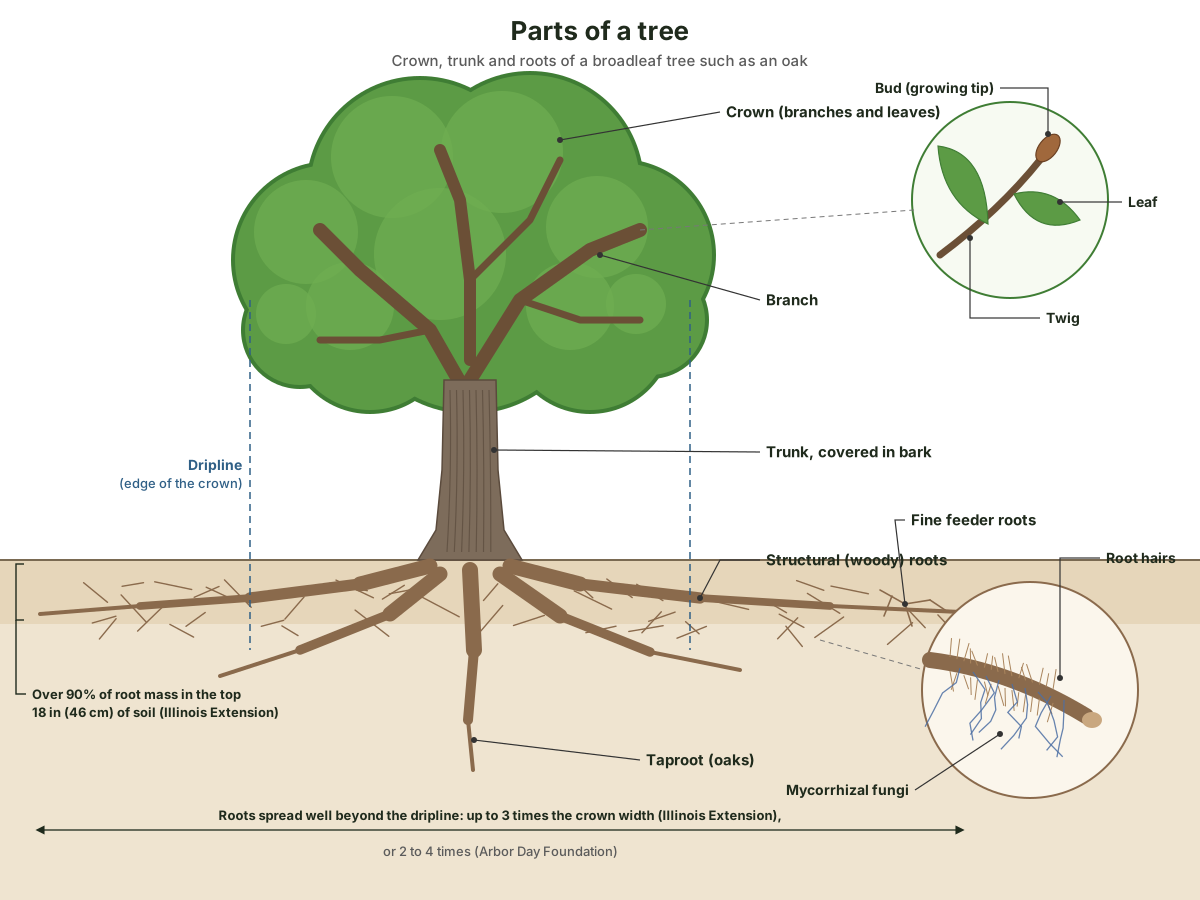
| Part | What it is | Main job |
|---|---|---|
| Roots | Large, long-lived woody roots and small, short-lived feeder roots | Anchor the tree, absorb water and minerals, store food for winter |
| Trunk (bole) | The woody stem: bark outside, wood inside | Holds up the crown; carries water up (xylem) and sugar down (phloem) |
| Branches and twigs | Side shoots that grow from the trunk | Support leaves, flowers and fruit; move materials between trunk and leaves |
| Leaves | Broad blades in oak; needles in pines and other conifers | Photosynthesis, which makes food and releases oxygen |
| Buds | Growing tips at the ends of twigs | Lengthen shoots; in spring they make the hormone (auxin) that restarts the cambium |
Table after the Arbor Day Foundation (Arbor Day Foundation). Inside a leaf, see the leaf cross section and stomata diagram; for the tissues all plants share, see plant anatomy.
What counts as a tree? Usually a woody plant with a single stem at least 2 m tall, or several stems with at least one 5 cm across at breast height. On that definition there are 60,065 tree species, about 20% of all seed plants (Beech et al. 2017); the Royal Forestry Society says more than 80,000 (Royal Forestry Society).
Layers of a tree trunk
A tree trunk has five main layers. From the outside in they are the outer bark, the inner bark (phloem), the vascular cambium, the sapwood and the heartwood, with a small, soft pith at the very centre (Wood Handbook, ch. 3). Everything outside the vascular cambium is bark; everything inside it is wood.
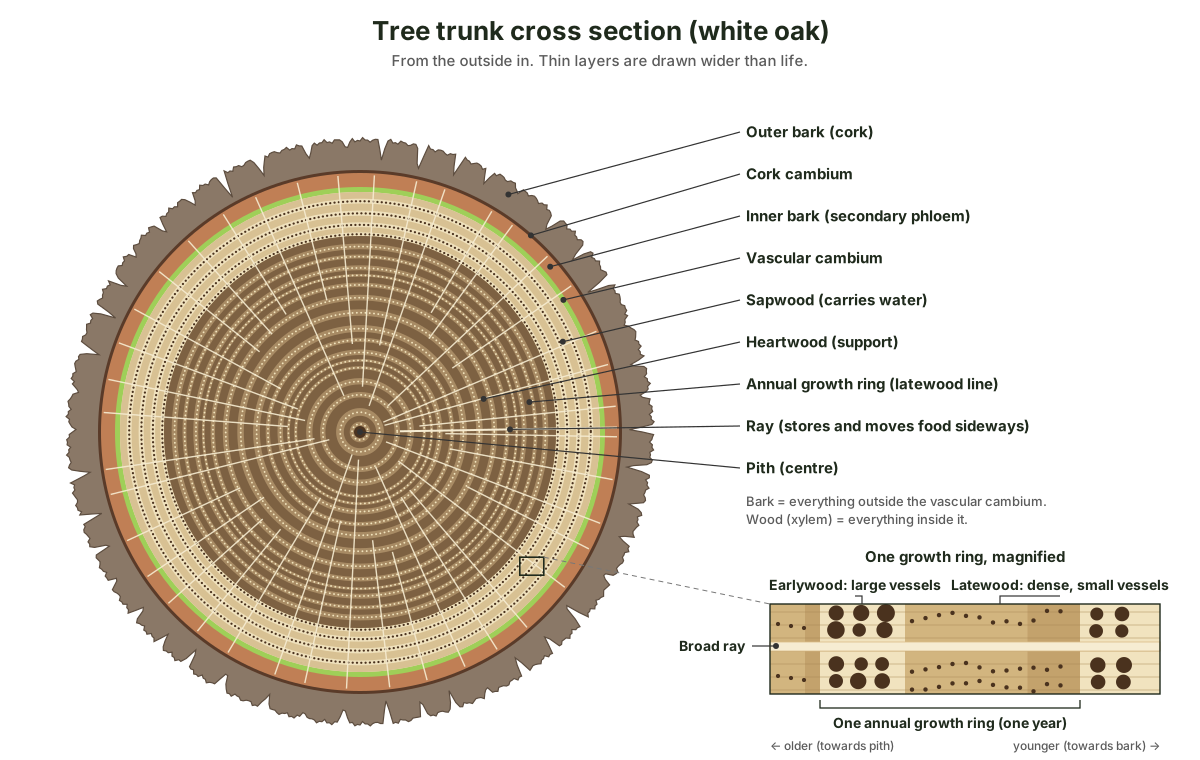
| Layer (outside → in) | What it is | Function | Alive? |
|---|---|---|---|
| Outer bark | Dead cork cells with waxy suberin in their walls | Protects the inner bark, limits water loss, insulates, keeps out insects | No; renewed from within |
| Cork cambium | Thin layer of dividing cells in the bark | Makes new cork | Yes |
| Inner bark (phloem) | Sugar-conducting tissue | Carries sugar from the leaves to the roots and growing parts | Yes, for a short time |
| Vascular cambium | Thin sheath of dividing cells | Makes new wood inside and new phloem outside | Yes |
| Sapwood | The youngest rings of wood (xylem) | Carries water and minerals up; stores starch | Partly: its parenchyma cells |
| Heartwood | Older wood with dark extractives | Central support; resists decay | No |
| Pith | Soft core at the centre | Remnant of the young shoot, before wood formed | — |
Table sources: the USDA Forest Service tree guide (USDA Forest Service), OpenStax (OpenStax 30.2) and the Wood Handbook.
Sapwood vs heartwood
Sapwood is the outer wood that still conducts water and has living parenchyma cells; heartwood is the darker wood inside it, which no longer conducts. Living cells at the boundary make the extractives that darken heartwood and protect it from decay fungi (Wood Handbook, ch. 3). In white oak the sapwood is nearly white and roughly 2 to 5 cm (1 to 2 in) wide, and the heartwood greyish brown (Wood Handbook, ch. 2), or light to medium brown in The Wood Database's description (The Wood Database).
Tree trunk cross section labeled: every structure in the model
This is the text version of the 3D model: every labeled structure, grouped as in the viewer, with what it does.
Bark (outer bark, cork cambium, inner bark)
- Outer bark (Cork, rhytidome)
- The rough, dead, corky outer layer of the trunk, in ridges and furrows on an old oak. Protects the softer inner bark from injury, limits water loss by evaporation, insulates against heat and cold and keeps out insects.
- Cork cambium (Phellogen)
- A thin layer of dividing cells in the bark that makes new cork. Produces the cork cells that renew the outer bark from within. Cork, the cork cambium and a thin layer called the phelloderm together form the periderm.
- Inner bark (secondary phloem) (Phloem, bast)
- The living layer of bark just outside the cambium, which carries sugar from the leaves. Translocates sugars made by photosynthesis from the leaves down to the roots and to other growing parts of the tree.
Vascular cambium
- Vascular cambium (Cambium)
- A thin sheath of dividing cells between the bark and the wood: the layer that makes the trunk grow thicker. Divides to make new wood (secondary xylem) to the inside and new inner bark (secondary phloem) to the outside, adding one growth ring of wood each year in a temperate tree.
Wood (secondary xylem)
- Sapwood (Alburnum)
- The pale outer band of wood, the youngest rings, which still carries water. Conducts water and dissolved minerals (sap) from the roots up to the leaves, and stores starch in its living parenchyma cells.
- Heartwood (Duramen)
- The darker central core of the trunk: old wood that no longer conducts water. Holds the tree up. It no longer conducts water, but chemicals called extractives darken it and help it resist decay.
- Pith (Medulla)
- A small, soft core at the very centre of the trunk. The remnant of the early growth of the trunk, before any wood was formed. In a young stem, pith is ground tissue that stores water and sugars.
- Annual growth rings (Tree rings, growth increments)
- Concentric bands in the wood, one added each growing season in a temperate tree. Record the tree's age, and their widths vary with each year's growing conditions, which is the basis of dendrochronology (tree-ring dating).
- Broad rays (Multiseriate rays, medullary rays)
- Ribbons of living cells that run from the pith towards the bark, crossing the growth rings. Store food and transport it sideways (horizontally) through the wood, between the inner bark and the inner rings.
- Vessels (pores) (Vessel elements, pores)
- Wide water-conducting tubes of hardwoods, seen as pores on the end grain. Carry water and dissolved minerals up the trunk.
- Tyloses (Singular tylosis)
- Bubble-like ingrowths that plug the vessels of white oak heartwood. Block the old vessels, which makes white oak heartwood almost impenetrable to liquids.
Branch and knot
- Branch (Limb)
- A side branch growing up and out of the trunk, cut lengthwise by the saw. Supports leaves, flowers and fruit, and transports materials between the trunk and the leaves (Arbor Day Foundation).
- Knot
- The base of the branch buried in the trunk, a cone of wood that widens from the pith to the bark. Anchors the branch to the trunk. In sawn wood it is a defect, because the grain bends around it.
- Branch collar
- The slightly swollen ring of tissue around the base of the branch, where it joins the trunk. A correct pruning cut is made just outside it, so the tree can seal the wound well and wood decay is less likely.
- Branch bark ridge
- A raised line of dark, rough bark in the angle between the top of the branch and the trunk. Marks where the branch and trunk tissues meet; pruning cuts start just outside it.
- Lenticels
- Small raised pores on young bark. Openings in the periderm that let the living cells inside exchange gases with the air.
Hand-lens view of one growth ring (magnified block)
- Earlywood (Springwood)
- The first part of each growth ring, made in spring, with rows of large vessels. Carries water up the trunk through its wide vessels.
- Latewood (Summerwood)
- The later, denser part of each growth ring, made of thick-walled fibres with small vessels. Adds strength. The abrupt change from one year's dense latewood to the next year's porous earlywood marks the ring boundary.
- Narrow rays (Uniseriate rays)
- Fine rays one cell wide, too small to see without a hand lens. Like the broad rays, store food and move it sideways through the wood.
How does a tree grow? Primary and secondary growth
A tree grows longer only at its tips and thicker along its whole length. Growth in length (primary growth) comes from apical meristems at the tips of shoots and roots. Growth in thickness (secondary growth) comes from two lateral meristems: the vascular cambium and the cork cambium (OpenStax 30.2).
The vascular cambium is a thin layer of cells between the inner bark and the wood. By repeated cell divisions it makes wood (secondary xylem) to the inside and secondary phloem to the outside. Its long fusiform initials make the vertical cells of the wood and its ray initials make the rays, and it divides sideways too, so that it keeps up with the growing girth of the trunk (Wood Handbook, ch. 3). Each spring it starts again in response to auxin, a hormone made by the opening buds at the branch tips that travels down through the phloem (Arbor Day Foundation).
The cork cambium makes cork cells whose walls contain suberin, a waxy, water-repelling substance. Cork, the cork cambium and a thin layer called the phelloderm together form the periderm, and openings in it called lenticels let the living cells inside exchange gases with the air. Herbaceous plants mostly show only primary growth (OpenStax 30.2).
Tree rings: how earlywood and latewood form
A tree ring is the wood made in one growing season. Early in the season the cambium makes earlywood, with large, thin-walled cells; later it makes latewood, which is denser, with thicker walls (OpenStax 30.2). The change from one year's latewood to the next year's earlywood is the line you count. The old names springwood and summerwood are no longer recommended, and many tropical trees form no visible rings at all (Wood Handbook, ch. 3).
| Ring type | What changes across the ring | Examples |
|---|---|---|
| Ring-porous hardwood | Abrupt: earlywood vessels are often ten or more times wider than latewood vessels | Temperate oaks, white ash, hickory, hackberry |
| Semi-ring-porous hardwood | Vessels shrink gradually across the ring | Black walnut |
| Diffuse-porous hardwood | Vessels about the same size all through the ring | Maple, birch, aspen, yellow-poplar; tropical oaks |
| Softwood, gradual change | Thin-walled earlywood tracheids grade into thick-walled latewood | Spruce, true fir, western redcedar |
| Softwood, abrupt change | Sharp step from earlywood to latewood | Southern yellow pine, larch, Douglas-fir, redwood |
All examples are from the Wood Handbook (Wood Handbook, ch. 3). The same genus can differ by climate: temperate oaks, ashes and hackberries are ring-porous, while their tropical relatives are diffuse-porous. Where the reference tree on this page sits: white oak is ring-porous, with very large earlywood pores in two to four rows and small latewood pores in radial groups (The Wood Database).
Dendrochronology: what tree rings tell us
Dendrochronology is the dating and study of annual rings in trees. Its basic technique, crossdating, matches patterns of wide and narrow rings across many samples from one area, so that every ring is assigned a single calendar year (Laboratory of Tree-Ring Research). Ring widths vary with the conditions in the year they formed, so a dated series of rings is also a record of past climate.
The astronomer A. E. Douglass collected his first tree-ring specimens in 1904 (LTRR history) and founded the Laboratory of Tree-Ring Research at the University of Arizona in 1937 (LTRR). One roof beam, HH-39, linked living trees to old timbers and dated many Puebloan ruins to the exact year.
Overlapping oak and pine timbers from central Europe now form a continuous record more than 12,400 years long. Its authors called it the 12,460-year Hohenheim chronology, absolutely dated back to 10,461 BC (Friedrich et al. 2004); a later popular account gives 12,468 years (wissenschaft.de).
The oldest known individual trees are Great Basin bristlecone pines. The tree called Prometheus, cut down in 1964, had 4,862 growth rings and was later put at almost 4,900 years old (NPS, Great Basin) (NPS, Bryce Canyon). Sources disagree on the oldest living one: the Bryce Canyon page gives the tree called Methuselah as 4,765 years old, while the Great Basin page gives 4,847 years for the oldest known living tree after Prometheus and adds that in 2012 another bristlecone from the same area proved to be 5,065 years old.
How to tell the age of a tree
Count the rings on a stump, or on a pencil-thin core taken with an increment borer at breast height, 4½ feet (1.4 m) up; the core must reach the centre (Northern Woodlands). Then add the years the tree took to reach that height: about 5 for aspen and softwoods and 10 for hardwoods (MSU Extension).
Ring counts are not always exact. A year that starts dry and turns very wet can make what looks like two rings, and in very dry years a tree can skip a ring altogether (NIST); bristlecones high in the mountains sometimes add no ring in a year (NPS, Great Basin). Crossdating many trees is how dendrochronologists catch these false and missing rings.
How does water move up a tree?
Water is pulled up a tree through the xylem of the sapwood. Water evaporating from the leaves (transpiration) creates a tension that draws a continuous column of water up from the roots; cohesion between water molecules and adhesion to the xylem walls hold the column together. This is the cohesion–tension theory (OpenStax 30.5).
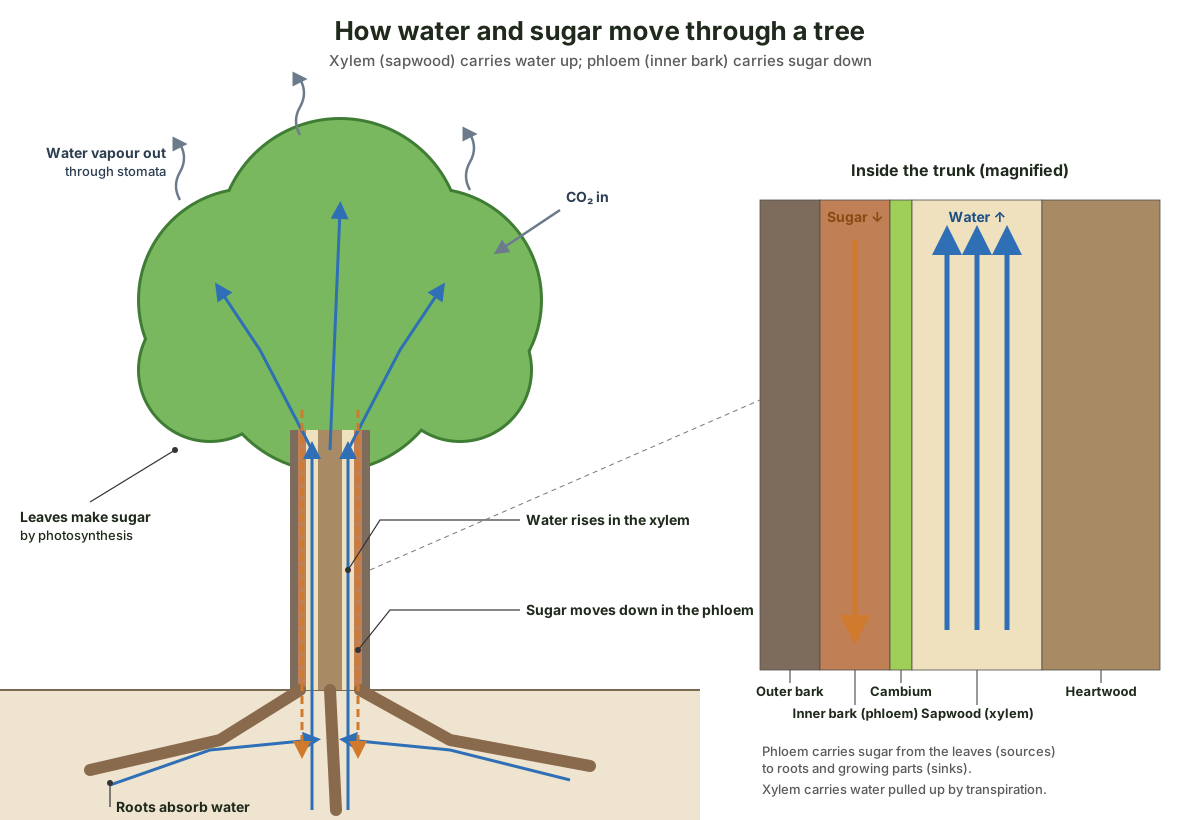
Water vapour leaves through the stomata, pores in the leaf surface that also let in carbon dioxide, so a tree trades water for carbon. Most of the water a tree takes up is lost this way, but sources give different shares: OpenStax says up to 90% of the water taken up by roots may be lost by transpiration (OpenStax 30.5), while South Dakota State University Extension says almost all the water absorbed on a summer day is lost, and only 1 to 2% is used for photosynthesis and other needs (SDSU Extension).
A large oak can transpire 40,000 gallons (151,000 litres) a year (USGS), and a mature elm more than 100 gallons (380 litres) on one hot summer day (SDSU Extension). The same pull lifts water to the top of a 116 m tree (OpenStax 30.5); the tallest known tree, the redwood Hyperion, is 115.61 m (Royal Forestry Society).
Sugar travels the other way, and to anywhere it is needed. Phloem sap flows by pressure from sources such as leaves to sinks such as roots, young shoots and developing seeds (OpenStax 30.5). That is why girdling, removing a complete band of bark, kills a tree: the phloem is cut, the roots starve and eventually stop sending water to the leaves. Removing a vertical strip less than a quarter of the way round harms but does not kill the tree (NMSU Extension).
Hardwood vs softwood trees
Hardwood and softwood are botanical groups, not measures of hardness. Hardwoods come from flowering trees (angiosperms) such as oak, maple and birch; softwoods come from gymnosperms, mostly conifers such as pine and spruce. The single most important difference in the wood is that hardwoods have vessels (pores) and softwoods do not (Wood Handbook, ch. 3).
| Feature | Hardwood (white oak) | Softwood (pine) |
|---|---|---|
| Plant group | Angiosperm (flowering plant) | Gymnosperm, mostly conifers |
| Leaves in northern temperate trees | Broad, usually deciduous | Needles, usually evergreen |
| Water-conducting cells | Vessels, seen as pores, plus fibres for support | Tracheids only, over 90% of the wood |
| Rays | Of two sizes in oak: one cell wide, and over eight cells wide | One or two cells wide |
| Resin canals | None | Present in some conifers, such as pines and Douglas-fir |
| Reaction wood in a leaning stem | Tension wood, on the upper side | Compression wood, on the underside |
Sources: Wood Handbook chapter 3 for all rows, with the 90% tracheid figure matched by The Wood Database (Softwood anatomy), which also notes that resin canals are unique to conifers. The names mislead: balsa, one of the lightest woods, is a hardwood (Wood Handbook, ch. 3). Reaction wood forms whenever a trunk or branch leans more than a degree or two from the vertical, so every sloping branch contains a lot of it.
Oak wood up close: vessels, rays and tyloses
Under a hand lens, white oak end grain shows large earlywood pores at the start of each ring, dense latewood with small pores in radial groups, and rays of two sizes (The Wood Database), as in the magnified block of the 3D model.
- Vessels are stacks of short cells joined end to end through holes called perforation plates; on the end grain they show as open pores (Wood Handbook, ch. 3).
- Rays run from pith to bark and continue into the inner bark. They carry substances sideways and do much of the wood's storage. Oak's broad rays are more than eight cells wide and several centimetres tall (Wood Handbook, ch. 3), which is why quartersawn oak shows broad, conspicuous ray flecks (Wood Handbook, ch. 2).
- Tyloses are bubble-like growths that fill the pores (The Wood Database). They plug most heartwood vessels of white oak, which makes it suitable for tight barrels, while red oak usually lacks them and leaks (Wood Handbook, ch. 2).
Tree roots and mycorrhizae
Most tree roots are shallow and wide. University of Illinois Extension says over 90% of tree root biomass lies in the top 18 inches (46 cm) of soil, almost half of it in the top 6 inches (15 cm), and that roots spread up to three times the width of the crown, up to five times in loose sandy soil and as little as half in heavy clay (Illinois Extension). The Arbor Day Foundation gives a deeper and wider picture: roots mostly in the top three feet (90 cm), spreading two to four times the width of the crown (Arbor Day Foundation). Both agree that roots reach well beyond the dripline, the edge of the crown.
Large perennial roots and small, short-lived feeder roots together absorb water and minerals, anchor the tree and store food for winter (Arbor Day Foundation); root hairs add surface for absorption (OpenStax 30.3). Oaks and hickories keep a taproot later in life (Illinois Extension).
Tree roots work with fungi. In a mycorrhiza, the fungus supplies the plant mainly with phosphate and other minerals, such as zinc and copper, and takes sugars from the root. Ectomycorrhizal fungi wrap the root in a dense sheath called a mantle; endomycorrhizal (arbuscular) fungi grow inside the root tissue and are found in more than 80% of land plants (OpenStax 31.3), or, in another count, about 80% of plant species and two-thirds of all land plants (Moore, World of Fungi). Oaks depend on ectomycorrhizal fungi for growth and survival: root tips from just five white oaks in Arkansas yielded at least 32 fungal taxa, most often species of Russula (Ben Hassine Ben Ali et al. 2018).
Knots, branches and the branch collar
A knot is the part of a branch that has become incorporated in the trunk. A knot cut across, as in a flatsawn board, is round; cut lengthwise, as on the radial face of the 3D model, it is a long "spike" knot. While the branch lives, the trunk's growth is continuous with it and the knot is intergrown; after it dies, the trunk grows around it and the knot is encased. Knots weaken wood because the fibres change direction around them (Wood Handbook, ch. 5).
Outside, the base of a branch has a branch collar, a slightly swollen ring of stem tissue, and in the angle between branch and trunk a branch bark ridge, a line of bark pushed up as branch and stem grew. A correct pruning cut starts just outside the branch bark ridge and avoids the collar; flush cuts injure the tree far more (University of Nebraska–Lincoln) (Iowa State Extension).
Frequently asked questions
What are the layers of a tree trunk in order?
From the outside in: outer bark (protection), inner bark or phloem (carries sugar down), the vascular cambium (the growth layer), sapwood (carries water up), heartwood (the dead, supporting core) and the pith at the centre. Many sources call the first five the five layers of a tree trunk and leave out the small pith.
Which part of a tree trunk is alive?
The living tissues are the inner bark, the cork cambium, the vascular cambium and the parenchyma cells of the sapwood. Most wood cells are dead when they start working, even in the sapwood, and the heartwood is dead. Heartwood still matters: it is the central pillar that holds the tree up.
What is the difference between sapwood and heartwood?
Sapwood is the pale outer wood that still conducts water and has living parenchyma cells. Heartwood is the darker inner wood that no longer conducts water. Living cells at the boundary fill it with extractives, chemicals that darken it and help it resist decay. In white oak the sapwood is roughly 2 to 5 cm wide.
How do you tell the age of a tree?
Count the annual rings on a stump, or on a pencil-thin core taken with an increment borer at breast height, 4.5 feet (1.4 m) above the ground. Then add the years the tree took to reach that height: Michigan State University Extension suggests about 5 for aspen and softwoods and 10 for hardwoods. Missing and false rings make single counts approximate.
Why does removing a ring of bark kill a tree?
Cutting a complete band of bark around the trunk (girdling) removes the phloem, which carries sugar from the leaves to the roots. The roots starve and eventually stop supplying water to the leaves, so the whole tree dies, often slowly. A vertical strip less than a quarter of the way round harms but does not kill the tree.
How deep do tree roots go?
Less deep than most people think. Illinois Extension says over 90% of tree root biomass is in the top 18 inches (46 cm) of soil, and roots can spread up to three times the width of the crown, more in sandy soil. The Arbor Day Foundation says most roots are in the top three feet and spread two to four times the crown.
What do tree rings tell scientists?
Ring widths vary with each year's growing conditions, so matched ring patterns from many trees (crossdating) assign every ring to an exact calendar year. That dates past climate and the year the timber in old buildings was cut. A central European oak and pine record built this way runs back more than 12,400 years.
Is a tree trunk xylem or phloem?
Both, in different layers. The wood (sapwood and heartwood) is secondary xylem, made by the vascular cambium on its inner side. The inner bark is secondary phloem, made on its outer side. So a trunk is mostly xylem, wrapped in a thin layer of phloem and covered by outer bark.
References
- Wiedenhoeft, A. (2010). Structure and function of wood. Wood Handbook, ch. 3, FPL-GTR-190. USDA Forest Service, Forest Products Laboratory.
- Wiemann, M. C. (2010). Characteristics and availability of commercially important woods (oaks). Wood Handbook, ch. 2, FPL-GTR-190.
- Kretschmann, D. E. (2010). Mechanical properties of wood (knots). Wood Handbook, ch. 5, FPL-GTR-190.
- Clark, M. A., Douglas, M. & Choi, J. (2018). Biology 2e, 30.1 The Plant Body. OpenStax.
- Clark, M. A., Douglas, M. & Choi, J. (2018). Biology 2e, 30.2 Stems. OpenStax.
- Clark, M. A., Douglas, M. & Choi, J. (2018). Biology 2e, 30.3 Roots. OpenStax.
- Clark, M. A., Douglas, M. & Choi, J. (2018). Biology 2e, 30.5 Transport of Water and Solutes in Plants. OpenStax.
- Clark, M. A., Douglas, M. & Choi, J. (2018). Biology 2e, 31.3 Nutritional Adaptations of Plants. OpenStax.
- Bellairs, S. Plant Anatomy and Physiology, 2.5 Secondary tissues. Biology LibreTexts.
- Arbor Day Foundation. Anatomy of a tree.
- USDA Forest Service. Anatomy of a tree.
- Royal Forestry Society. What is a tree?
- Beech, E., Rivers, M., Oldfield, S. & Smith, P. P. (2017). GlobalTreeSearch: the first complete global database of tree species and country distributions. Journal of Sustainable Forestry 36(5), 454–489.
- The Wood Database: White oak (Quercus alba).
- The Wood Database: Hardwood anatomy.
- The Wood Database: Softwood anatomy.
- Laboratory of Tree-Ring Research, University of Arizona. About tree rings.
- Laboratory of Tree-Ring Research, University of Arizona. Who are we?
- Grissino-Mayer, H. D. History of the Laboratory of Tree-Ring Research.
- Friedrich, M. et al. (2004). The 12,460-year Hohenheim oak and pine tree-ring chronology from Central Europe. Radiocarbon 46(3), 1111–1122.
- wissenschaft.de (16 July 2013). Gut zu wissen: Dendrochronologie.
- US National Park Service, Great Basin National Park. Identifying bristlecone pines.
- US National Park Service, Bryce Canyon National Park. Bristlecone pine.
- National Institute of Standards and Technology (2025). How do you measure the age of a tree?
- Michigan State University Extension. Increment borer use (teacher support document).
- McLeod, B. R. (2023). Aging trees with an increment borer. Northern Woodlands.
- US Geological Survey, Water Science School. Evapotranspiration and the water cycle.
- South Dakota State University Extension. Trees and drought stress.
- Thompson, M. Y. (2007). Southwest Yard & Garden, 8 September 2007 (girdling). New Mexico State University.
- Pankau, R. (2024). Clearing misconceptions around tree roots. University of Illinois Extension.
- Moore, D. World of Fungi: Arbuscular mycorrhizas.
- Ben Hassine Ben Ali, M. et al. (2018). Diversity of ectomycorrhizal fungi associated with Quercus alba in northwest Arkansas. Current Research in Environmental & Applied Mycology 8(4), 418–424.
- Nebraska Forest Service, University of Nebraska–Lincoln. Pruning trees.
- Iowa State University Extension and Outreach (2014). Pruning. Yard and Garden.
More interactive anatomy models
- Flower anatomyParts of a flower in 3D: petals, sepals, stamens, pistil, ovary and ovules of a lily.
- Leaf cross sectionLabeled leaf cross section: cuticle, epidermis, palisade and spongy mesophyll, veins.
- Stomata diagramGuard cells, stomatal pore and how stomata open and close, in 3D.
- Seed anatomyBean and corn seed anatomy: seed coat, cotyledons, endosperm and embryo.
- Chloroplast structureEnvelope, stroma, thylakoids, grana and lumen of a chloroplast, in 3D.
- Plant anatomyRoots, stems, leaves and flowers: plant tissues and organs, with 3D models.