

Anatomy of a bird's wing at a glance
In bird wing anatomy, the wing has three segments, like your arm: the upper arm (brachium) with the humerus, the forearm (antebrachium) with the radius and ulna, and the hand (manus) with two free wrist bones, the fused carpometacarpus and three short digits. Primary flight feathers grow from the hand, secondaries from the ulna and tertials from the humerus. (Feather Atlas)
This page uses the rock pigeon as its reference bird, the same species as the bird anatomy and bird skeleton pages, which cover the organs and the whole skeleton. A pigeon has ten primaries on each wing. (Mallet-Rodrigues, 2012) Where other birds differ, the text says so. Directions: the leading edge of the spread wing faces forward (cranial) and the trailing edge backward (caudal); proximal is towards the body and distal towards the wingtip.
| Wing segment | Bones | Feathers | Other parts |
|---|---|---|---|
| Upper arm | Humerus | Tertials | Pectoralis and supracoracoideus attach to the humerus |
| Forearm | Radius and ulna | Secondaries on the ulna; greater, median and lesser coverts | Propatagium (skin fold) in front, shoulder to wrist |
| Hand | Radiale, ulnare, carpometacarpus, alular, major and minor digits | Primaries, primary coverts, alula | Small hand muscles and tendons |
Bird wing bones labeled
The bones of a bird wing are the humerus, the radius and ulna, two free wrist bones (the radiale and ulnare), the carpometacarpus and the bones of three digits. Most birds have one phalanx in the alular digit, two in the major digit and one in the minor digit, so, counting the fused carpometacarpus as one bone, each wing has ten bones. (Baumel & Witmer, 1993)
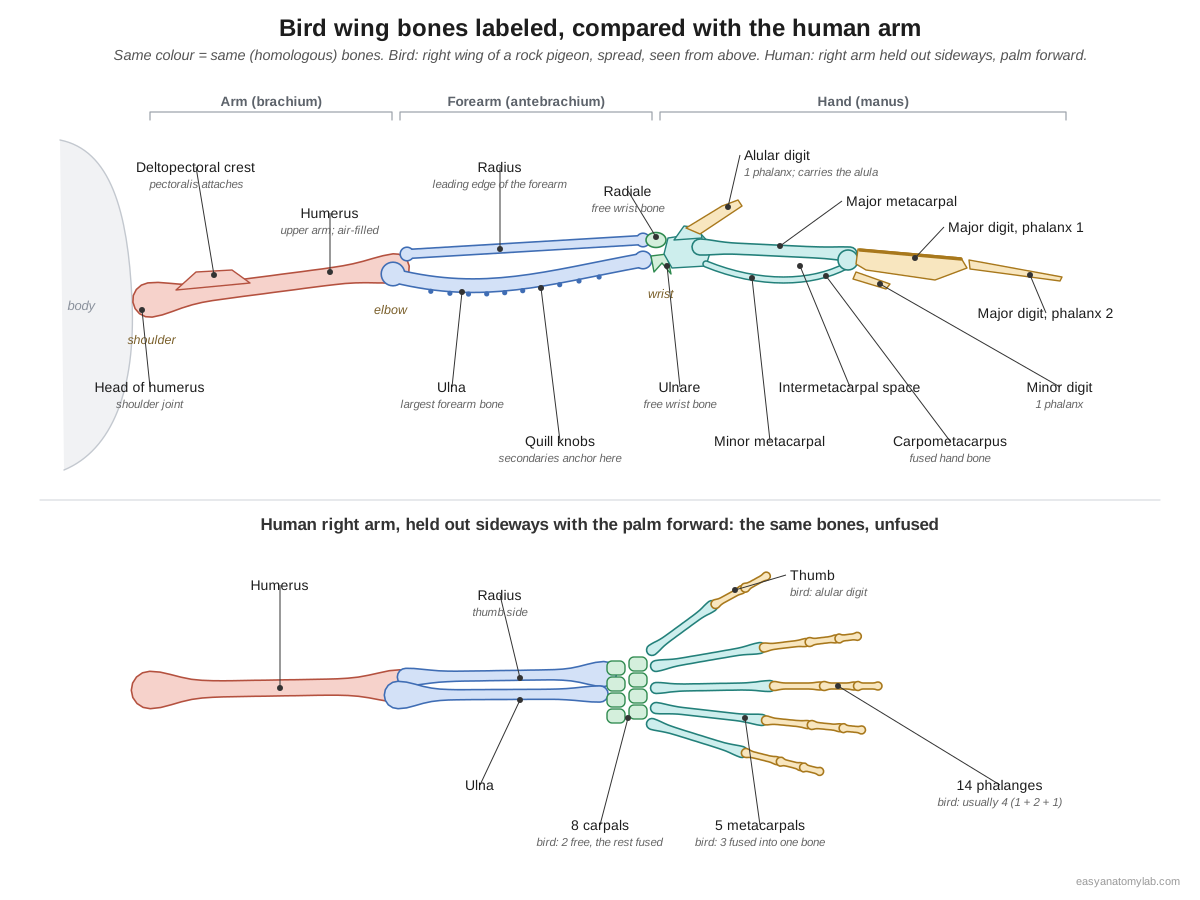
| Bone | Where | Detail |
|---|---|---|
| Humerus | Upper arm, shoulder to elbow | Hollow and air-filled in the fowl, through a connection with the clavicular air sac; the pectoralis attaches to its deltopectoral crest |
| Radius | Leading edge of the forearm | The thinner forearm bone; slides along the ulna as the elbow bends |
| Ulna | Trailing edge of the forearm | Thicker and longer than the radius; quill knobs anchor the ligaments of the secondary feather follicles |
| Radiale and ulnare | Wrist | The only free carpal bones in adults; the other carpals fuse with the metacarpals |
| Carpometacarpus | Hand | One bone formed from three metacarpals and carpals; the major and minor metacarpals join at both ends around an open space |
| Alular digit | Front of the wrist | Usually one phalanx; carries the alula |
| Major digit | Wingtip | Two phalanges; the first is broad with a thickened, reinforced leading edge |
| Minor digit | Behind the base of the major digit | One small phalanx |
Poultry Hub and Cavitt's ornithology notes give the same plan: two free carpals, three fused metacarpals, three digits and an ulna larger than the radius that supports the secondaries. (Poultry Hub) (Cavitt) The primaries are anchored to the major metacarpal and the phalanges of the major digit. (Kondo et al., 2018)
Not every bird follows the one-two-one pattern of phalanges. In several orders the alular digit has two phalanges, the last often with a claw, as in hoatzins and turacos; ducks and geese often have a third phalanx in the major digit; and the turkey's alular digit has two phalanges. Hollow humeri vary too: the air opening of the humerus is missing in penguins, petrels and shearwaters (but not albatrosses), loons, grebes, cormorants, many diving ducks, most shorebirds and gulls, rails and many songbirds. (Baumel & Witmer, 1993) Cavitt likewise lists divers and many small passerines as lacking pneumatic bones, while large soaring birds such as albatrosses, vultures and hawks have them. (Cavitt) For every other bone of the bird, see the bird skeleton page.
Bird wing vs human arm: the same bones
A bird wing and a human arm are built from the same bones in the same order: humerus, radius and ulna, wrist bones, hand bones and fingers. They are homologous structures, inherited from a common ancestor that had forelimbs. (Understanding Evolution) The bird's version has fewer wrist and hand bones and fuses its hand into one rigid bone that carries feathers.
| Part | Human arm | Bird wing |
|---|---|---|
| Upper arm | Humerus | Humerus, often air-filled |
| Forearm | Radius and ulna | Radius and ulna; the ulna is larger and carries the secondaries |
| Wrist | 8 carpal bones | 2 free carpals (radiale, ulnare); the rest fused into the carpometacarpus |
| Palm | 5 separate metacarpals | 3 metacarpals fused into the carpometacarpus |
| Fingers | 5 digits, 14 phalanges (thumb 2, fingers 3 each) | 3 digits, usually 4 phalanges (1 + 2 + 1) |
| Joints | Shoulder, elbow, wrist | The same three; elbow and wrist fold and unfold together |
The human figures come from standard anatomy: eight carpals, five metacarpals, two phalanges in the thumb and three in each finger. (TeachMeAnatomy) Which of our fingers the bird's three digits match is still unresolved: in theropod dinosaurs the fossil sequence points to digits I–III, while studies of chicken embryos found II–IV. Ornithologists therefore call them the alular, major and minor digits. (Nomina Anatomica Avium) For more on homologous and analogous structures, see comparative anatomy; for the bones, muscles and nerves of your own arm, see arm anatomy; and for a wing built from the same bones in a different way, see the bat wing vs bird wing comparison.
Bird wing feathers: primaries, secondaries, tertials, coverts and alula
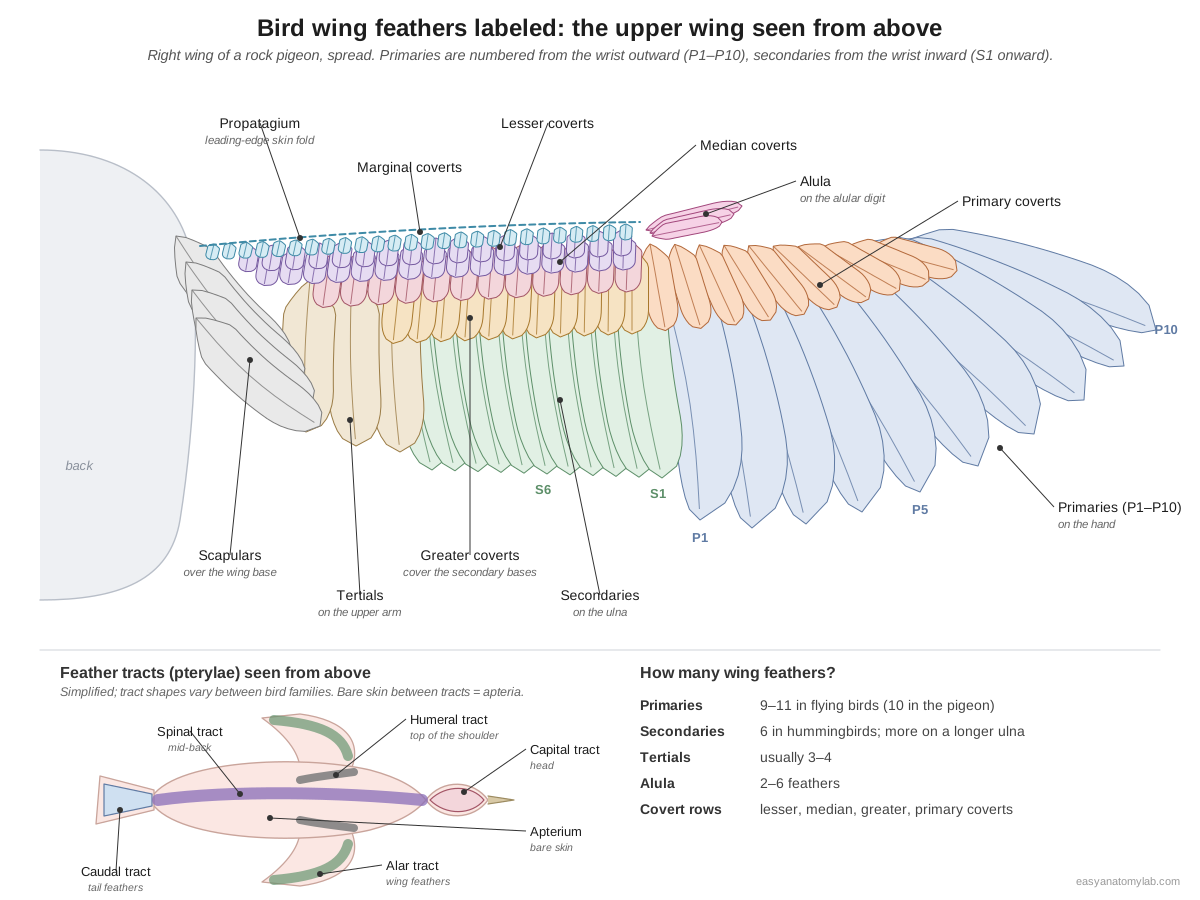
The feathers of a bird's wing are the flight feathers (remiges) and the coverts. Primaries grow from the hand, secondaries from the ulna and tertials from the humerus; (Feather Atlas) rows of coverts overlap their bases, and the alula sits at the wrist. (BTO) In a survey covering every living bird order, all flying species had 9–11 primaries. (Kiat & O'Connor, 2024)
| Feather group | Grows from | Typical number | Job |
|---|---|---|---|
| Primaries | Hand (carpometacarpus and major digit) | 9–11 in flying birds; 10 in the pigeon and the fowl | Long quills, strongly anchored; most of the flight power |
| Secondaries | Ulna | About 6 in hummingbirds; 9–25 in most species; up to 32 in albatrosses (one lab count) | The inner, lift-making wing surface |
| Tertials | Humerus | Usually 3–4 | The innermost flight feathers, next to the body |
| Greater coverts | Over the secondary bases | A row | Protect the bases of the secondaries |
| Primary coverts | Over the primary bases | A row | Protect the bases of the primaries |
| Median and lesser coverts | Towards the leading edge | Rows | Cover the front of the wing; lesser coverts hidden at rest |
| Alula | Alular digit at the wrist | 2–6 feathers | Keeps airflow attached at slow speed |
Sources differ on secondaries because their number grows with the length of the ulna: Kiat and O'Connor found only six in a hummingbird, the Feather Atlas gives 9–25 depending on the species, and an ornithology lab handout counts up to 32 in albatrosses. (Kiat & O'Connor) (Feather Atlas) (lab handout) Primary counts are steadier. Most groups have ten; (Feather Atlas) only birds that lost flight long ago depart from 9–11, with 16 or more in ostriches, rheas and penguins and few or none in emus, cassowaries and kiwis. (Kiat & O'Connor)
Primaries are numbered from the wrist outward (P1 to P10) and secondaries from the wrist inward, so the outermost secondary borders the innermost primary. (BTO) In captive pigeons a single primary took 21–37 days to grow, the outer ones longest. (Mallet-Rodrigues) Flight feathers are asymmetric: the trailing vane is broader than the leading one, (Poultry Hub) an asymmetry that gives the wing its curved (cambered) profile. (Kiat & O'Connor) In soaring birds such as many birds of prey, notches in the vanes of the outer primaries (emarginations) let the wingtip spread into separate fingers. (Feather Atlas)
Feathers grow only from tracts called pterylae, with bare skin (apteria) between them. (Tseng et al., 2024) The flight feathers and their coverts form the alar tract; the humeral tract covers the top of the shoulder, from the leading edge of the wing to its trailing edge, where the scapulars lie over the wing base. (lab handout) On a perched bird the lesser coverts and the alula are usually hidden under the body feathers and scapulars. (BTO) For the parts of a single feather, see feather anatomy.
Wing molt: how birds replace flight feathers and keep flying
Flight feathers wear out: abrasion and ultraviolet light badly degrade even sturdy wing quills after about two years, so most birds under about 1 kg replace all their flight feathers every year. Because growing feathers leave gaps that reduce flight performance, most birds do not molt while breeding. In the simplest pattern, molt starts at the innermost primary, P1, and moves outward to P9 or P10 in a single wave. Large birds that must keep flying run several waves through the primaries at once, while loons, grebes, ducks, geese and many rails drop all their flight feathers together and spend a flightless period on the water; a mute swan needs about two months to regrow its longest primary. (Rohwer et al. (2009): allometry of the duration of flight feather molt in birds, PLoS Biology (PMC).)
Pigeons follow the inner-to-outer rule only loosely. In captive rock pigeons the inner primaries (P1–P5) were replaced mostly from September to December and the outer ones (P6–P10) from January to August, and only 30% of complete wing molts followed a perfect outward sequence. An old primary usually dropped when its neighbour was about three-quarters grown. (Mallet-Rodrigues (2012): replacement and growth of primary feathers in captive rock pigeons, Zoologia.)
Molt is also symmetrical. Matching feather tracts on the left and right wings molt in step, which matters for a flying bird; in the domestic fowl the inner flight feathers molt first. (Poultry Hub: integument (feathers, pterylae and moult).)
Bird flight muscles: pectoralis, supracoracoideus and the triosseal pulley
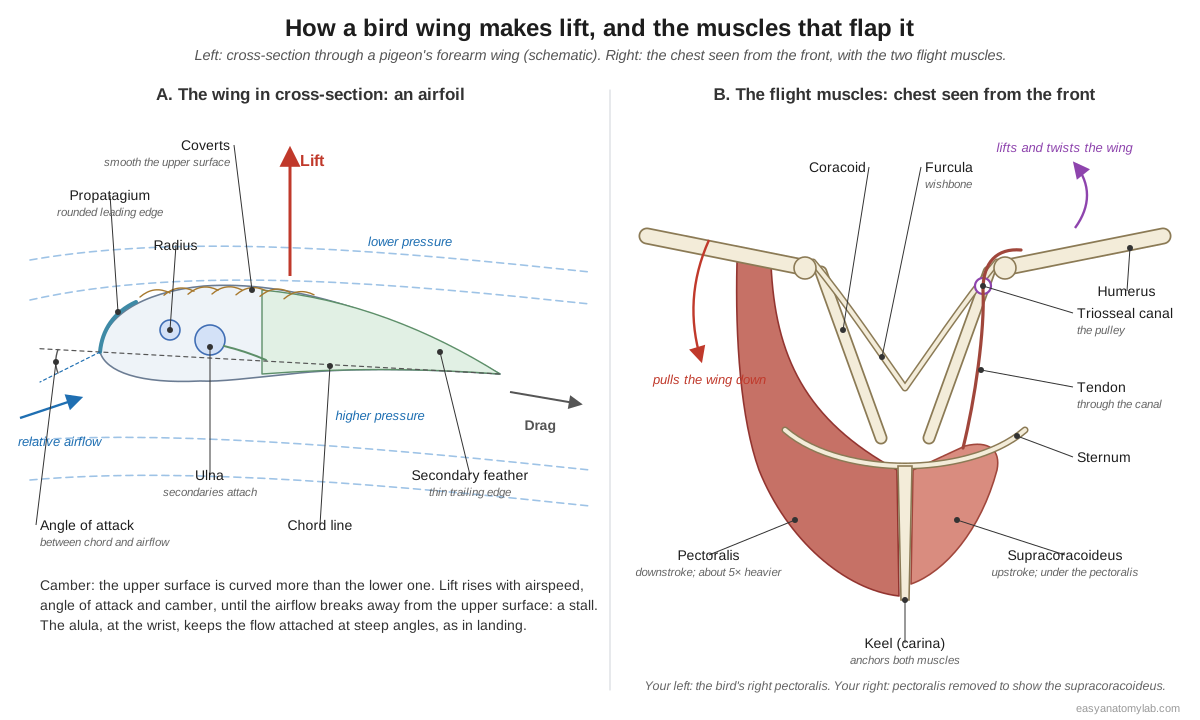
A bird flaps its wing with two breast muscles anchored on the keel of the sternum. The large pectoralis pulls the wing down in the power stroke. The smaller supracoracoideus lies under it, yet lifts the wing: its tendon runs up through the triosseal canal at the shoulder and pulls on the top of the humerus like a rope over a pulley. (Cavitt) (Biewener, 2011)
| Muscle | From | To | Action | Size |
|---|---|---|---|---|
| Pectoralis | Keel and sternum | Underside of the humerus (deltopectoral crest) | Downstroke | About 8–11% of body mass; 53 g per side in pigeons |
| Supracoracoideus | Keel and sternum, under the pectoralis | Top of the humerus, via the triosseal canal | Upstroke: raises and twists the wing | About one-fifth of the pectoralis; 10 g per side in pigeons |
What is the patagium on a bird wing?
The patagium is the fold of skin that turns a bird's arm into part of the wing surface. Its main part, the propatagium, stretches between the shoulder and the wrist and forms the wing's leading edge. Along its front edge runs the propatagial muscle, which in some species is tendinous for most of its length and is then called the propatagial tendon. (Uno & Hirasawa (2023): origin of the propatagium in non-avian dinosaurs, Zoological Letters (PMC).)
The propatagium links the joints of the wing. When the elbow straightens, the propatagial muscle and tendon straighten the wrist at the same time; when the elbow bends, the radius slides along the ulna and folds the wrist. With the elbow and wrist moving together, a bird controls its wingbeat with only small muscles in the outer wing. Ratites, the flightless ostrich group, lack the propatagial structure. (Uno & Hirasawa (2023): origin of the propatagium in non-avian dinosaurs, Zoological Letters (PMC).)
The propatagial muscle has no counterpart in other living four-limbed animals. In chicken embryos it forms from cell masses split off the deltoid, pectoralis, biceps and extensor carpi radialis; it moves the wing joints and fine-tunes the wing's profile in flight, and some flightless birds have lost it. (Uno & Hirasawa (2025): multiple developmental origins of the avian propatagial muscle, Journal of Anatomy (PMC).)
How a muscle below the wing lifts it: the supracoracoideus
The supracoracoideus is about one-fifth of the mass of the pectoralis. Its tendon passes over the shoulder through the triosseal foramen, which acts as a pulley, so the muscle raises the wing and rotates it (supination) during the upstroke. It is the main wing elevator at slow to moderate speeds and in hovering; at higher speeds the wing is probably lifted mainly by aerodynamic forces. (Biewener (2011): muscle function in avian flight, achieving power and control, Phil. Trans. R. Soc. B (PMC).)
Measurements in pigeons fit these proportions. Tobalske and Biewener weighed single muscles of birds averaging about 562 g: each pectoralis averaged 53 g and each supracoracoideus 10 g. Their recordings support the idea that the supracoracoideus mainly twists (supinates) the humerus, although it also helps to raise the wing. (Tobalske & Biewener (2008): contractile properties of the pigeon supracoracoideus during different modes of flight, J. Exp. Biol..)
The pulley itself varies. Its name means three-bone canal, after the coracoid, scapula and furcula that meet around it, but in some birds only the coracoid and scapula form it, and in birds with a bony bridge on the coracoid, including the rock pigeon, hummingbirds, turacos, bee-eaters, hoopoes and hornbills, the coracoid alone may enclose it. (Baumel & Witmer (1993): Osteologia, in Handbook of Avian Anatomy: Nomina Anatomica Avium, 2nd ed. (PDF).)
How does a bird wing make lift?
A bird wing makes lift because it is an airfoil: a curved surface with a thick, rounded leading edge that tapers to a thin trailing edge. Air flowing over the curved upper surface exerts less pressure than air below the wing, and the difference pushes the wing up. Lift grows with airspeed, with the angle of attack and with camber. (Cavitt)
The anatomy builds that shape. In cross-section the forearm wing has the propatagium, radius, ulna and coverts at the front and the vane of a secondary feather at the back (panel A above). Tilting the wing up raises lift only to a point; at too steep an angle the air breaks away from the upper surface and the wing stalls. Birds delay stalling with slots: the alula at the wrist and gaps between the outer primaries. (Cavitt) (Ehrlich et al.) The inner wing, which moves least, makes most of the lift; the hand sweeps through a wide arc and makes most of the thrust, each primary working as a small airfoil of its own. (Cavitt)
Two numbers describe a wing. Wing loading is the bird's weight per area of wing; (Suryan et al., 2008) heavy divers such as loons have much higher wing loading than small songbirds. (Cavitt) Aspect ratio is wing length divided by width. Long, narrow wings cut the drag made by wingtip vortices and lower the energy cost of flight, which is why albatrosses and other long-distance soarers have high aspect ratios, while short, broad wings turn faster. (Walters et al., 2026) (Cavitt)
The alula: a small feather group that prevents stalls
The alula is a small structure at the joint between the hand-wing and the arm-wing, made of a digit bone and two to six feathers, and it is present in all living flying birds. It has long been compared to the leading-edge slat of an aircraft wing, which keeps lift high at steep angles. (Lee et al. (2015): the function of the alula in avian flight, Scientific Reports (PMC).)
Lee and colleagues tested this in Eurasian magpies. With a full alula, the birds descended more steeply, finished their descent sooner and changed body orientation more than the same birds while the alula was molting. In a wind tunnel, magpie wings with the alula made more lift at high angles of attack (by 1.3–12.7% in one wing tested) and often stalled later. The tip of the alula sheds a small swirling vortex that pushes air down onto the wing's upper surface and stops the airflow from separating from it. (Lee et al. (2015): the function of the alula in avian flight, Scientific Reports (PMC).)
Types of bird wings: shapes and flight styles
Bird wings come in a few basic shapes, each matched to a way of flying: short, rounded wings for quick take-offs and turns, long pointed wings for speed, broad slotted wings for soaring over land, and very long, narrow wings for soaring over the sea. (Ehrlich et al.)
| Wing type | Shape | Examples | Good for |
|---|---|---|---|
| Elliptical | Short, tapered, low aspect ratio, often with slotted tips | Most songbirds, doves, woodpeckers, game birds | Fast take-off and agile flight among obstacles |
| High-speed | Flat, long and pointed, no slots | Falcons, swallows, plovers | Fast, sustained flight |
| Slotted soaring | Broad, cambered, low aspect ratio, deep slots between primaries | Vultures and other soaring land birds | Circling slowly in thermals |
| High aspect ratio | Very long and narrow | Albatrosses and other ocean soarers | Gliding over the sea on wind deflected by waves |
Within one group the shape follows habitat. Hawks that soar over open country have low-aspect-ratio wings, and woodland hunters such as the sharp-shinned hawk, like owls, have even lower ratios, which helps them turn quickly among trees. (Ehrlich et al.) Narrow thermals favour lower aspect ratios that keep a bird inside the rising column. (Cavitt)
Frequently asked questions
What are the parts of a bird's wing?
A bird wing has three segments like a human arm: the upper arm with the humerus, the forearm with the radius and ulna, and the hand with two wrist bones, the fused carpometacarpus and three digits. Flight feathers (primaries, secondaries and tertials) grow along it, coverts overlap their bases, the alula sits at the wrist, and a skin fold, the propatagium, forms the leading edge.
How many bones are in a bird wing?
In most birds, ten in each wing if the fused carpometacarpus counts as one bone: humerus, radius, ulna, two free wrist bones (radiale and ulnare), the carpometacarpus and four phalanges, one in the alular digit, two in the major digit and one in the minor digit. Some birds have extra phalanges, such as a second alular phalanx in turkeys, hoatzins and turacos.
Is a bird wing the same as a human arm?
It has the same bones in the same order, so the two are homologous: both come from the forelimb of a shared ancestor. The bird version has only two free wrist bones instead of eight, three metacarpals fused into one bone instead of five separate ones, and three short digits with usually four phalanges instead of five fingers with fourteen.
What is the alula on a bird?
The alula, or bastard wing, is a small group of two to six stiff feathers on the alular digit, the bird's 'thumb', at the front of the wrist. Birds raise it at slow speeds and steep angles, such as when landing. Wind-tunnel tests show it raises lift and delays stalling by creating a small vortex that keeps air flowing smoothly over the wing.
How many flight feathers does a bird have?
Flying birds have 9 to 11 primaries on each wing; most have 10, as the pigeon and the chicken do. The number of secondaries depends mainly on the length of the ulna, from about 6 in hummingbirds to well over 20 in long-winged seabirds. Most birds also have 3–4 tertials and 10–12 tail feathers.
Which muscle raises a bird's wing?
The supracoracoideus. It lies on the breast under the pectoralis, which pulls the wing down, but its tendon runs up through the triosseal canal at the shoulder and attaches to the top of the humerus, so it lifts and twists the wing like a rope over a pulley. It is about one-fifth the mass of the pectoralis.
References
- Baumel & Witmer (1993): Osteologia, in Handbook of Avian Anatomy: Nomina Anatomica Avium, 2nd ed. (PDF)
- Nomina Anatomica Avium online (Weber State University): Osteologia, nomenclature of the wing digits
- Poultry Hub (Australia): skeletal system of the fowl
- Poultry Hub: integument (feathers, pterylae and moult)
- Cavitt, Weber State University: Ornithology lecture 5, avian flight (PDF)
- TeachMeAnatomy: bones of the hand (carpals, metacarpals and phalanges)
- Understanding Evolution (UC Berkeley): homologies and analogies
- U.S. Fish and Wildlife Service Feather Atlas: glossary
- U.S. Fish and Wildlife Service Feather Atlas: identifying feather position
- Kiat & O'Connor (2024): functional constraints on the number and shape of flight feathers, PNAS (PMC)
- Mallet-Rodrigues (2012): replacement and growth of primary feathers in captive rock pigeons, Zoologia
- Donelan, British Trust for Ornithology (2024): Field Craft, applied bird topography (BTO News, PDF)
- Tseng et al. (2024): gap junctions in Turing-type periodic feather pattern formation, PLOS Biology (PMC)
- Ornithology Lab 2: feathers, feather tracts and molt (lab handout, citing Chaplin & Faaborg and Stettenheim)
- Kondo et al. (2018): flight feather development, its early specialization during embryogenesis, Zoological Letters (PMC)
- Lee et al. (2015): the function of the alula in avian flight, Scientific Reports (PMC)
- Biewener (2011): muscle function in avian flight, achieving power and control, Phil. Trans. R. Soc. B (PMC)
- Tobalske & Biewener (2008): contractile properties of the pigeon supracoracoideus during different modes of flight, J. Exp. Biol.
- Uno & Hirasawa (2023): origin of the propatagium in non-avian dinosaurs, Zoological Letters (PMC)
- Uno & Hirasawa (2025): multiple developmental origins of the avian propatagial muscle, Journal of Anatomy (PMC)
- Ehrlich, Dobkin & Wheye (1988): wing shapes and flight, Stanford Birds essays
- Walters et al. (2026): theoretical morphospace of the avian wing planform for flight style, Nature Communications (PMC)
- Suryan et al. (2008): wind, waves and wing loading in albatrosses, PLoS ONE (PMC)
- Rohwer et al. (2009): allometry of the duration of flight feather molt in birds, PLoS Biology (PMC)
More interactive anatomy models
- Bird skeletonHollow bones, keeled sternum, wishbone and fused wing bones of a bird.
- Bird anatomyBird digestive system, air sacs, heart and feather anatomy in 3D.
- Chicken anatomyCrop, gizzard, reproductive tract, skeleton and external parts of the chicken.
- Pigeon dissectionGuided pigeon dissection: flight muscles, crop, gizzard, air sacs and heart.
- Human anatomy1,000+ bones, muscles, organs, vessels and nerves from real anatomical data.
- Octopus anatomyThree hearts, a ring-shaped brain, eight arms and a beak, in 3D.