

Label the diagram: heart and animal labelling worksheets
Labelling practice tests recall without the hints a multiple-choice question gives you. Choose a name for each number and press Check, or print the worksheet with its answer key on a separate page. The heart diagram is a frontal section seen from the front, so the heart's right side is on your left.
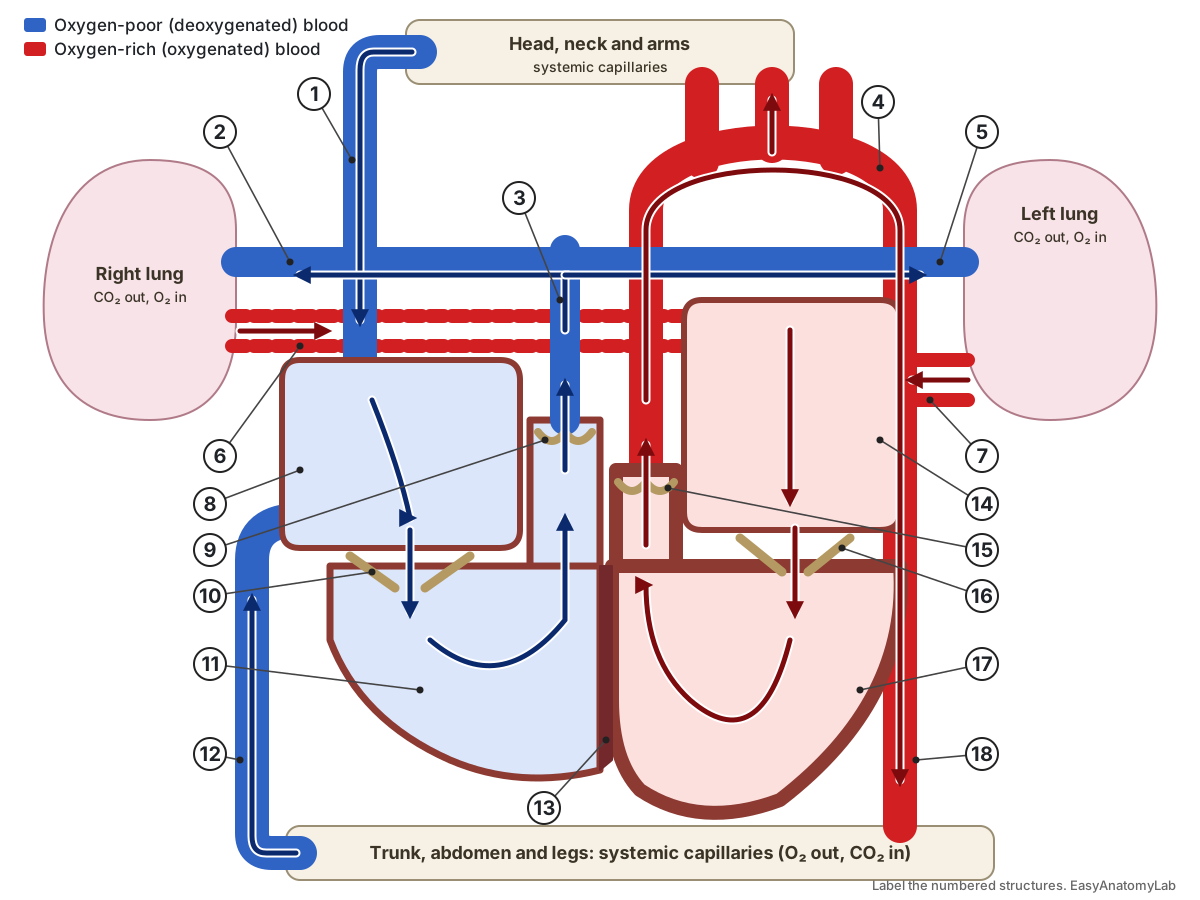
The labelled diagram and every structure are explained on blood flow through the heart.
Every anatomy quiz on EasyAnatomyLab
This page holds 100 multiple-choice questions, 6 interactive labelling worksheets and a 3D find-the-structure game on 5 models. Across the site, 68 more quizzes, labelling worksheets and lab question sets with answer keys sit on 58 model and diagram pages, listed below by group.
Topic quizzes on this page
| Quiz | Questions | What it tests | Study first |
|---|---|---|---|
| Bones | 12 | Bone counts, the skull, spine and ribs, limb bones, bone types and bony landmarks. | Skeletal system, Skull bones |
| Muscles | 12 | Muscle tissue types, origin and insertion, muscle roles, how muscles are named and the main muscle groups. | Muscular system |
| Organs | 12 | Where the main organs lie in the chest, abdomen and pelvis, their sizes and the membranes around them. | Organs of the body |
| Heart | 12 | The chambers, valves, great vessels, heart wall, coronary arteries and conduction system. | Heart anatomy |
| Directional terms | 12 | The anatomical position, directional term pairs, body planes, prone and supine, and left and right. | Directional terms, Anatomical planes |
| Frog | 8 | The facts and lab skills taught on the frog anatomy page. | Frog anatomy |
| Frog dissection | 8 | The facts and lab skills taught on the frog dissection page. | Frog dissection |
| Dog | 8 | The facts and lab skills taught on the dog anatomy page. | Dog anatomy |
| Cat skeleton | 8 | The facts and lab skills taught on the cat skeleton page. | Cat skeleton |
| Fetal pig | 8 | The facts and lab skills taught on the fetal pig dissection page. | Fetal pig dissection |
3D find-the-structure quizzes
Each round asks for 10 structures picked at random from those shown when the model opens, so no two games are the same. Play them in the 3D game above.
- Human heart (Human tissues & physiology): 10 of 54 heart structures, from chambers & septa, valves & supports, oxygen-poor vessels, oxygen-rich vessels, coronary vessels, conduction system, fetal remnants. Learn them on the blood flow through the heart page.
- Frog (Reptiles & amphibians): 10 of 113 frog structures, from external, mouth, skeletal, muscular, nervous, digestive, respiratory, circulatory, urogenital. Learn them on the frog anatomy page.
- Dog (Mammals): 10 of 158 dog structures, from external, skeletal, nervous, sense organs, digestive, respiratory, cardiovascular, lymphatic & endocrine, urinary, reproductive. Learn them on the dog anatomy page.
- Cat skeleton (Mammals): 10 of 45 bones of the cat skeleton, from skeletal. Learn them on the cat skeleton page.
- Fetal pig (Mammals): 10 of 114 fetal pig structures, from external, mouth & oral cavity, digestive, respiratory, circulatory (fetal), glands & lymphoid organs, urinary, reproductive, nervous, skeletal, muscular. Learn them on the fetal pig dissection page.
Quizzes, worksheets and lab questions on other pages
Most 3D model pages end with a self-test: a numbered diagram to label, a short quiz, or the questions a dissection lab asks, each with an answer key.
Mammals
- Dog anatomy: Dog anatomy worksheet: test yourself
- Dog skeleton: Dog skeleton worksheet
- Cat dissection: Cat dissection lab questions and answer key
- Cat skeleton: Cat skeleton quiz with answer key
- Horse anatomy: Horse anatomy quiz
- Horse skeleton: Horse skeleton quiz
- Fetal pig dissection: Fetal pig dissection worksheet: lab questions and answer key · Fetal pig quiz: identify the structure
- Pig anatomy: Pig anatomy quiz: test yourself
- Cow digestive system: Cow digestive system worksheet with answer key
- Rabbit anatomy: Rabbit anatomy worksheet: test yourself
- Rat dissection: Rat dissection labeling worksheet and answer key · Rat dissection lab questions and answer key
- Whale anatomy: Whale anatomy worksheet: test yourself
- Bat skeleton: Bat skeleton worksheet: test yourself
Birds
Prehistoric animals
Reptiles & amphibians
Fish & sharks
Marine invertebrates
Insects, spiders & other invertebrates
- Spider anatomy: Spider anatomy worksheet: test yourself
- Ant anatomy: Label the ant: worksheet with answers
- Grasshopper dissection: Grasshopper dissection lab questions and answer key
- Honeybee anatomy: Honeybee anatomy worksheet with answers
- Insect body parts: Label the insect body parts worksheet (printable)
- Crayfish anatomy: Crayfish anatomy worksheet: test yourself
- Crayfish dissection: Crayfish dissection lab questions and answer key · Worksheet answers: the questions students ask most
- Earthworm anatomy: Earthworm anatomy quiz
- Earthworm dissection: Earthworm dissection worksheet and answer key
Organ dissections
- Cow eye dissection: Cow eye dissection lab questions and answer key · Cow eye dissection worksheet
- Sheep brain dissection: Sheep brain dissection worksheet and answer key · Sheep brain dissection pre-lab questions
- Sheep heart dissection: Pre-lab questions and answers · Sheep heart dissection lab questions and answer key
Human tissues & physiology
- Action potential diagram: Label the action potential: unlabeled diagram and answer key
- Blood flow through the heart: Label the heart blood flow diagram yourself
- Nephron anatomy: Label the nephron: unlabeled diagram and answer key · Nephron anatomy quiz
- Sarcomere diagram: Label the sarcomere: unlabeled diagram and quiz
- Skin layers: Label it yourself: blank skin layers diagram and quiz
Plants
- Chloroplast structure: Chloroplast structure diagram: label it yourself (worksheet and answers)
- Flower anatomy: Label the parts of a flower: worksheet and quiz
- Leaf cross section: Label the cross section of a leaf: worksheet and answer key
- Seed anatomy: Seed anatomy worksheet: label it yourself
- Stomata diagram: Stomata diagram worksheet: label it yourself (with answers)
Cells & microbes
- Cellular respiration diagram: Label it yourself: blank cellular respiration diagram
- Amoeba diagram: Label the amoeba: unlabeled diagram and answer key
- Bacterial cell diagram: Label the bacterial cell: unlabeled diagram and answer key
- Bacteriophage diagram: Label the bacteriophage diagram yourself
- Euglena diagram: Label the Euglena: unlabeled diagram and answer key
- Virus structure: Label the diagram showing the structure of an enveloped virus
For the human body, each region guide on the 3D human anatomy page has labelled diagrams to cover and recite, and every structure in the model has its own page.
How to study anatomy effectively
Anatomy is a lot of names, places and relationships, and the methods that make it stick are the ones that make you work: recalling an answer before you see it, coming back to a topic after a gap, and turning diagrams into tests. The quizzes on this page are built around those three ideas.
Does quizzing yourself help you learn anatomy?
Yes. Recalling facts from memory, called retrieval practice or self-testing, helps you keep anatomy for longer than reading it again. In a university anatomy and physiology course, students who read a passage, recalled as much as they could and then reread it scored higher a week later than students who read it three times or reread it while taking notes. (Dobson JL, Linderholm T. Self-testing promotes superior retention of anatomy and physiology information. Adv Health Sci Educ. 2015.)
The effect shows up in human anatomy courses too. Future medical and dental students who answered the same nervous system questions three times scored almost 9% higher on the second attempt, half an hour later, with nothing in between but seeing the correct answers. On the third attempt, a week later, they scored 29% higher than on the first. (Logan JM, Thompson AJ, Marshak DW. Testing to enhance retention in human anatomy. Anat Sci Educ. 2011.)
It does not take long. In one anatomy and physiology course, ten very brief retrieval quizzes, about two hours in total over the semester, left students remembering 41% more of the tested material at the end of term than a control group. (Dobson JL. Retrieval practice is an efficient method of enhancing the retention of anatomy and physiology information. Adv Physiol Educ. 2013.)
University learning centres give the same advice: rereading leads to quick forgetting, while quizzing yourself is a highly effective study technique. Use the quiz above before you feel ready; the explanation after each answer turns a wrong guess into a fact you are more likely to remember. (The Learning Center, University of North Carolina at Chapel Hill: Studying 101: Study Smarter Not Harder.)
Spaced repetition: how often should you review anatomy?
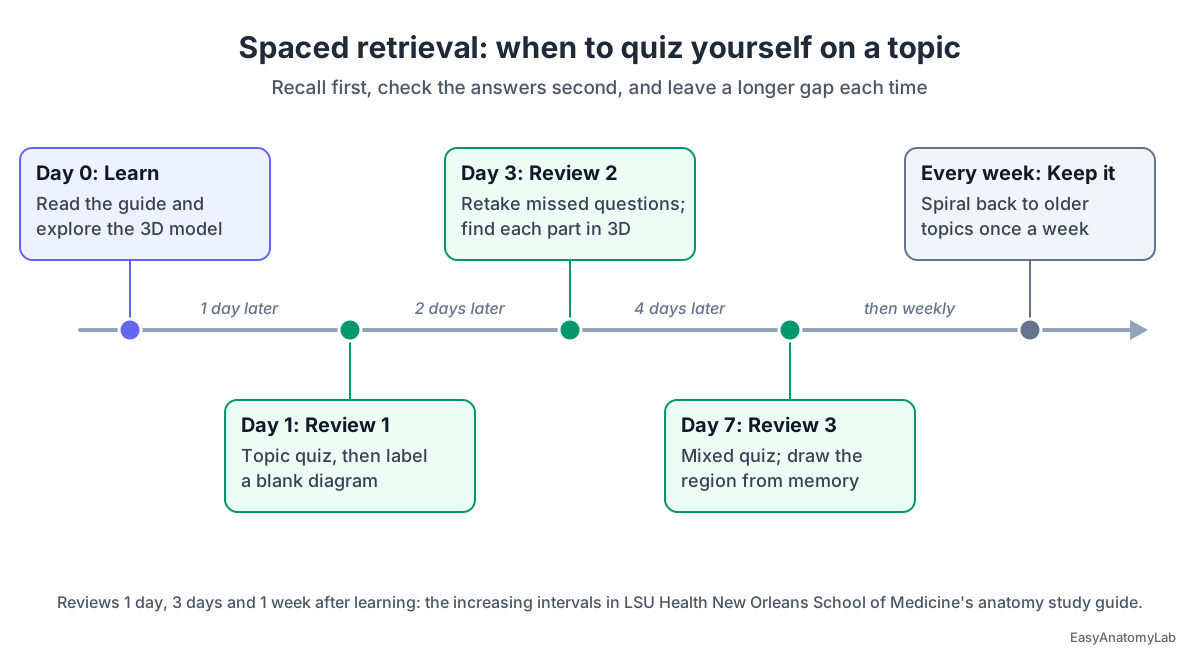
Review the same material several times with growing gaps instead of in one long session. LSU Health New Orleans School of Medicine suggests reviewing at increasing intervals, such as after 1 day, 3 days and 1 week, studying a little every day (even 20 to 30 minutes), and spiralling back to older material each week rather than cramming. (LSU Health New Orleans School of Medicine: How to Study Anatomy in Your First Year of Medical School.)
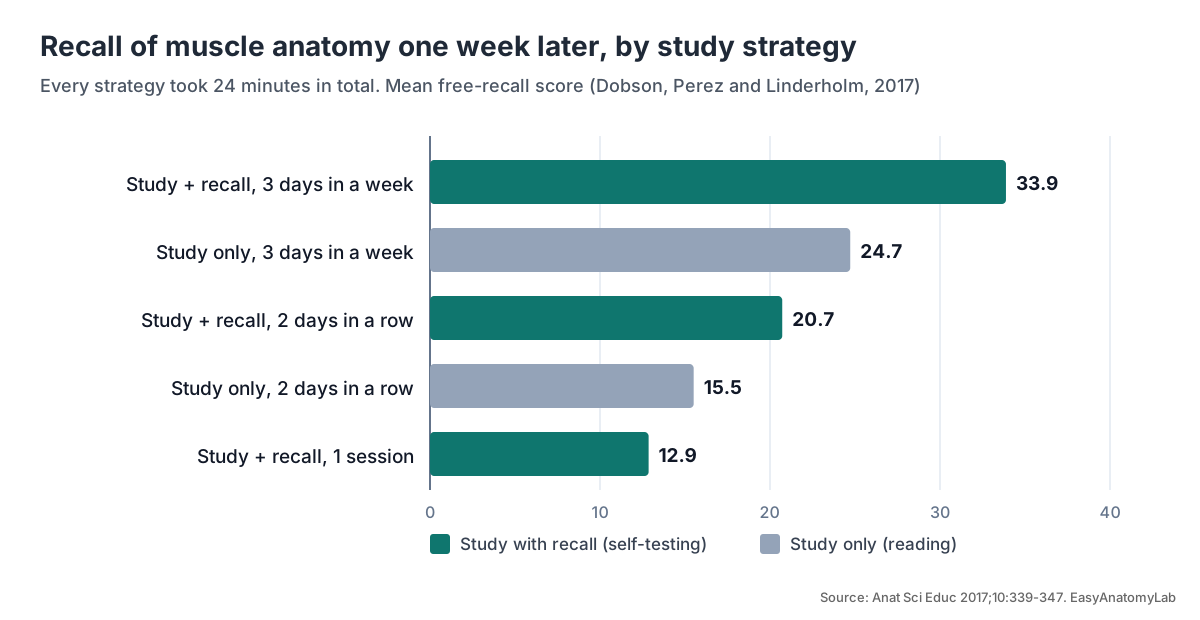
Spacing and self-testing work best together. Students who learned sets of skeletal muscles in 24 minutes of study spread over three days in a week, with recall built in, scored 33.9 on a free-recall test a week later. Spreading the same time without recall gave 24.7, and doing all the recall in one sitting gave only 12.9. (Dobson JL, Perez J, Linderholm T. Distributed retrieval practice promotes superior recall of anatomy information. Anat Sci Educ. 2017.)
A longer first gap can help. In two physiology courses, students who did their first online homework 5 days after a class did no better on a quiz a week later than those who did it after 1 day, but they scored higher on that topic in the final exam weeks later. (Cadaret CN, Yates DT. Retrieval practice in the form of online homework improved information retention more when spaced 5 days rather than 1 day after class. Adv Physiol Educ. 2018.)
A 2024 systematic review of health professions education found 56 studies with 63 experiments on spacing and retrieval practice; 43 showed a significant benefit for grades over the comparison groups. (Trumble E, Lodge J, Mandrusiak A, Forbes R. Systematic review of distributed practice and retrieval practice in health professions education. Adv Health Sci Educ. 2024.)
Flashcard apps such as Anki automate the schedule. At one medical school, the 78 first-year students who used Anki scored higher on their course exams and on the Comprehensive Basic Science Exam than the 52 who did not, though a cohort study like this shows an association, not proof that the app caused the gain. (Gilbert MM et al. A cohort study assessing the impact of Anki as a spaced repetition tool on academic performance in medical school. Med Sci Educ. 2023.)
Another medical school found daily Anki use linked to higher USMLE Step 1 scores but not Step 2 scores, and concluded that a variety of study methods can reach similar results. (Wothe JK et al. Academic and wellness outcomes associated with use of Anki spaced repetition software in medical school. J Med Educ Curric Dev. 2023.)
Labelling and drawing: how to practise with diagrams
Turn every labelled diagram into a test. Cover the labels and name each structure, label blank diagrams repeatedly, sketch structures from memory and explain them out loud as you draw: all four are on LSU Health's list of anatomy study methods. (LSU Health New Orleans School of Medicine: How to Study Anatomy in Your First Year of Medical School.)
Drawing has been tested in a randomised study. Of 416 second-year medical students, those asked to draw the anatomical region before or after their dissection session scored significantly higher on memory tests 1 and 7 weeks later than those who did not draw. It did not matter whether they drew before or after. (Alsaid B, Bertrand M. Students' memorization of anatomy, influence of drawing. Morphologie. 2016.)
A blank-page exercise, in which first-year anatomy students drew diagrams or built plasticine models from recall with every cue removed, was designed to make them aware of what they had and had not yet learned. Feedback from 282 students described it as a positive learning experience. (Naug HL, Colson NJ, Donner DG. Promoting metacognition in first year anatomy laboratories using plasticine modeling and drawing activities: the blank page technique. Anat Sci Educ. 2011.)
Do 3D models and anatomy games help you learn?
3D models help most with spatial knowledge: where structures lie in relation to each other. A meta-analysis of 36 studies with 2,226 participants found that 3D visualisation tools improved factual anatomy knowledge slightly (effect size d = 0.30) and spatial knowledge more clearly (d = 0.50) compared with other teaching methods. (Yammine K, Violato C. A meta-analysis of the educational effectiveness of three-dimensional visualization technologies in teaching anatomy. Anat Sci Educ. 2015.)
Games mainly help engagement. In a pilot with 16 second-year medical students playing a team-based anatomy quiz game, 89% found it engaging and 74% wanted to play again, and players said it showed them their strengths and gaps. The study measured engagement, not exam results. (Janssen A et al. A little healthy competition: a team-based digital game for medical student engagement with anatomy and histology. BMC Med Educ. 2015.)
The find-the-structure quiz on this page combines the two: you have to recall where a structure is and find it in 3D, and each answer is highlighted on the model with its description, so a miss becomes a quick lesson.
A daily anatomy study plan
LSU Health New Orleans School of Medicine gives first-year medical students this quick daily structure. The last column shows where to do each step here. (LSU Health New Orleans School of Medicine: How to Study Anatomy in Your First Year of Medical School.)
| When | What to do | On EasyAnatomyLab |
|---|---|---|
| Before the lecture or lab | Preview the structures (5 to 10 minutes) | Explore the 3D model and the guide for the topic |
| After the lecture or lab | Review actively: self-test and diagrams | Take the topic quiz; label a blank diagram |
| Later the same day | Spaced repetition with flashcards | Retake missed questions; play the 3D find-the-structure quiz |
| End of the week | Practice questions, clinical links, teaching others | Mixed quizzes on older topics; quiz a friend with the share link |
Anatomy quiz FAQ
Is this anatomy quiz free?
Yes. Every quiz, 3D game and worksheet on EasyAnatomyLab is free to use, with no account or sign-up. There is no score history in an account: the 3D quiz keeps your best score in your own browser, and the worksheets print with their answer keys.
What is the best way to study anatomy?
Test yourself instead of rereading, and spread your reviews over days: a 2024 systematic review found that retrieval practice and spaced practice improve grades in health professions education. Combine them with labelling blank diagrams, drawing from memory and a 3D model for spatial relationships, and review a little every day rather than cramming.
How do you memorize anatomy fast?
Learn the code in the names first: muscle names tell you shape, size, location, number of heads and action, so a name like flexor carpi radialis explains itself. Then quiz yourself on one region at a time, revisit it after about 1 day, 3 days and 1 week, and label a blank diagram from memory before checking the key.
How often should I review anatomy?
Little and often. LSU Health's medical school advises daily review of 20 to 30 minutes, reviews at growing gaps such as 1 day, 3 days and 1 week, and a weekly return to older topics. In one study, muscle anatomy studied with recall over three days in a week was remembered far better than the same time spent in one session.
Are anatomy games good for learning?
They help most when they make you recall answers, not just click around. In a pilot study, most medical students found an anatomy quiz game engaging and wanted to play again, and 3D tools improve spatial anatomy knowledge in a meta-analysis of 36 studies. Use games as one form of self-testing, alongside quizzes and diagrams.
How do I study for an anatomy lab practical?
Follow the routine LSU Health's medical school gives for the cadaver lab: preview the structures before the session, engage actively during it and review straight after, and teach structures to a lab partner. Between sessions, cover the labels on diagrams, play the find-the-structure quiz on a 3D model and work through the lab questions and answer keys on the dissection pages.
Which topics does the anatomy quiz cover?
The human quizzes cover bones, muscles, organs, the heart and directional terms, with 12 questions each. Animal quizzes cover the frog, dog, cat skeleton and fetal pig, and the 3D quiz uses the human heart and four animal models. The directory below lists every other quiz and worksheet on the site.
References
- Logan JM, Thompson AJ, Marshak DW. Testing to enhance retention in human anatomy. Anat Sci Educ. 2011
- Dobson JL. Retrieval practice is an efficient method of enhancing the retention of anatomy and physiology information. Adv Physiol Educ. 2013
- Dobson JL, Linderholm T. Self-testing promotes superior retention of anatomy and physiology information. Adv Health Sci Educ. 2015
- Dobson JL, Perez J, Linderholm T. Distributed retrieval practice promotes superior recall of anatomy information. Anat Sci Educ. 2017
- Cadaret CN, Yates DT. Retrieval practice in the form of online homework improved information retention more when spaced 5 days rather than 1 day after class. Adv Physiol Educ. 2018
- Trumble E, Lodge J, Mandrusiak A, Forbes R. Systematic review of distributed practice and retrieval practice in health professions education. Adv Health Sci Educ. 2024
- Gilbert MM et al. A cohort study assessing the impact of Anki as a spaced repetition tool on academic performance in medical school. Med Sci Educ. 2023
- Wothe JK et al. Academic and wellness outcomes associated with use of Anki spaced repetition software in medical school. J Med Educ Curric Dev. 2023
- Alsaid B, Bertrand M. Students' memorization of anatomy, influence of drawing. Morphologie. 2016
- Naug HL, Colson NJ, Donner DG. Promoting metacognition in first year anatomy laboratories using plasticine modeling and drawing activities: the blank page technique. Anat Sci Educ. 2011
- Yammine K, Violato C. A meta-analysis of the educational effectiveness of three-dimensional visualization technologies in teaching anatomy. Anat Sci Educ. 2015
- Janssen A et al. A little healthy competition: a team-based digital game for medical student engagement with anatomy and histology. BMC Med Educ. 2015
- LSU Health New Orleans School of Medicine: How to Study Anatomy in Your First Year of Medical School
- The Learning Center, University of North Carolina at Chapel Hill: Studying 101: Study Smarter Not Harder
- EasyAnatomyLab: Skeletal system (cited guide used for the skeletal system questions)
- EasyAnatomyLab: Skull bones (cited guide used for the skull bones questions)
- EasyAnatomyLab: Muscular system (cited guide used for the muscular system questions)
- EasyAnatomyLab: Organs of the body (cited guide used for the organs of the body questions)
- EasyAnatomyLab: Heart anatomy (cited guide used for the heart anatomy questions)
- EasyAnatomyLab: Directional terms (cited guide used for the directional terms questions)
- EasyAnatomyLab: Anatomical planes (cited guide used for the anatomical planes questions)
- Mitsuhashi N. et al. BodyParts3D: 3D structure database for anatomical concepts. Nucleic Acids Research (published online October 2008); data © The Database Center for Life Science, CC BY 4.0 (3D heart).
More interactive anatomy models
- What is anatomy?What anatomy studies, its branches, how anatomists name and describe the body, and how to learn it.
- Anatomy and physiologyHow structure and function fit together, the levels of organisation and the organ systems, with study tips.
- Comparative anatomyHomologous, analogous and vestigial structures compared across vertebrates, with diagrams.
- Animal anatomyEvery animal on the site by group, with what each body plan teaches.
- Human anatomy1,000+ bones, muscles, organs, vessels and nerves from real anatomical data.
- Octopus anatomyThree hearts, a ring-shaped brain, eight arms and a beak, in 3D.