

What does intersex mean?
Intersex is an umbrella term for differences in sex development: people who are intersex are born with sex traits that do not fit typical male or female patterns. The differences can involve the chromosomes, the hormones, the reproductive organs or the genitals, and they occur in many combinations. (Cleveland Clinic: Intersex: Meaning & Anatomy.)
interACT, a US advocacy organisation for intersex young people, defines intersex as an umbrella term for differences in sex traits or reproductive anatomy that people are born with or that develop in childhood. It stresses that many intersex people have genitals that look typical for a male or female body, and that their differences are internal, hormonal or chromosomal. (interACT: What is intersex? Frequently asked questions.)
Some intersex traits are noticed at birth and others only at puberty. Some people never notice a physical difference and learn about an intersex trait from a test done for another reason. Being intersex does not determine sexual orientation. (Cleveland Clinic: Intersex: Meaning & Anatomy.)
Intersex describes the body, not a gender. interACT notes that intersex is not usually considered a third gender: there are intersex men, intersex women and intersex non-binary people. It also separates intersex from transgender, which describes a gender different from the one assumed at birth; most transgender people are not born with variations in their genital or reproductive anatomy. (interACT: What is intersex? Frequently asked questions.)
In medicine the umbrella covers congenital variations anywhere in the pathways that shape sex characteristics: the sex chromosomes, the genes that direct gonad development, the production and action of hormones, and the development of the internal and external genitalia. (Vora KA, Srinivasan S. A guide to differences/disorders of sex development/intersex in children and adolescents. Aust J Gen Pract. 2020.)
Intersex vs DSD: which terms are used?
In 2006 an international consensus statement proposed the umbrella term disorders of sex development (DSD) to replace older labels that patients found pejorative. Intersex became DSD, 'male pseudohermaphrodite' became 46,XY DSD, 'female pseudohermaphrodite' became 46,XX DSD and 'true hermaphrodite' became ovotesticular DSD. The authors also advised naming the specific condition, such as androgen insensitivity syndrome, rather than referring to the karyotype when it is not needed. (Hughes IA, Houk C, Ahmed SF, Lee PA. Consensus statement on management of intersex disorders. Arch Dis Child. 2006.)
The NHS uses 'differences in sex development' for a group of rare conditions involving genes, hormones and reproductive organs, including the genitals. It lists other names in use: disorders of sex development, variations in sex characteristics (VSC), diverse sex development, and intersex, which some people prefer. (NHS: Differences in sex development.)
People with these variations do not agree on one word. A 2020 clinical review notes that some peer support groups prefer intersex, for example in the 2017 Darlington Statement, while others reject it, and that clinicians usually use the name of the specific diagnosis, such as congenital adrenal hyperplasia or Klinefelter syndrome, when talking with patients and families. The umbrella terms remain useful in research and policy. (Vora KA, Srinivasan S. A guide to differences/disorders of sex development/intersex in children and adolescents. Aust J Gen Pract. 2020.)
Advocacy groups object most to the word disorder. interACT says many intersex people reject 'DSD' because it suggests that their bodies are wrong or need fixing, and it generally does not use the term. It calls people who are not intersex endosex (also perisex or dyadic). (interACT: What is intersex? Frequently asked questions.)
Cleveland Clinic describes the old word hermaphrodite as outdated and misleading and notes that most intersex people consider it offensive. (Cleveland Clinic: Intersex: Meaning & Anatomy.)
interACT adds that the word comes from mythology and is not medically accurate, because one person cannot have both a fully developed penis and a fully developed vagina, and that it should be used only by people who choose it for themselves. (interACT: What is intersex? Frequently asked questions.)
Even a 2025 registry study that used the DSD classification noted that the consensus terminology remains controversial and named intersex and variations of sex characteristics as alternatives. This guide uses intersex and DSD side by side, and the names of specific conditions where they apply. (Metzger S, et al. Prevalence of Differences of Sex Development Among Pediatric Endocrine Care Centers in Switzerland From 2000 to 2019. J Endocr Soc. 2025.)
Older terms and the 2006 DSD names
| Older term | 2006 consensus term | What it describes |
|---|---|---|
| Intersex | Disorders of sex development (DSD) | Umbrella term |
| Male pseudohermaphrodite | 46,XY DSD | XY chromosomes, less virilised anatomy |
| Female pseudohermaphrodite | 46,XX DSD | XX chromosomes, virilised anatomy |
| True hermaphrodite | Ovotesticular DSD | Both ovarian and testicular tissue |
| XX male or XX sex reversal | 46,XX testicular DSD | XX chromosomes with testes |
| XY sex reversal | 46,XY complete gonadal dysgenesis | XY chromosomes, undeveloped gonads, female-typical anatomy |
From Hughes et al. 2006, Table 1. Many intersex people prefer intersex to DSD; see the section above.
How does typical sex development work?
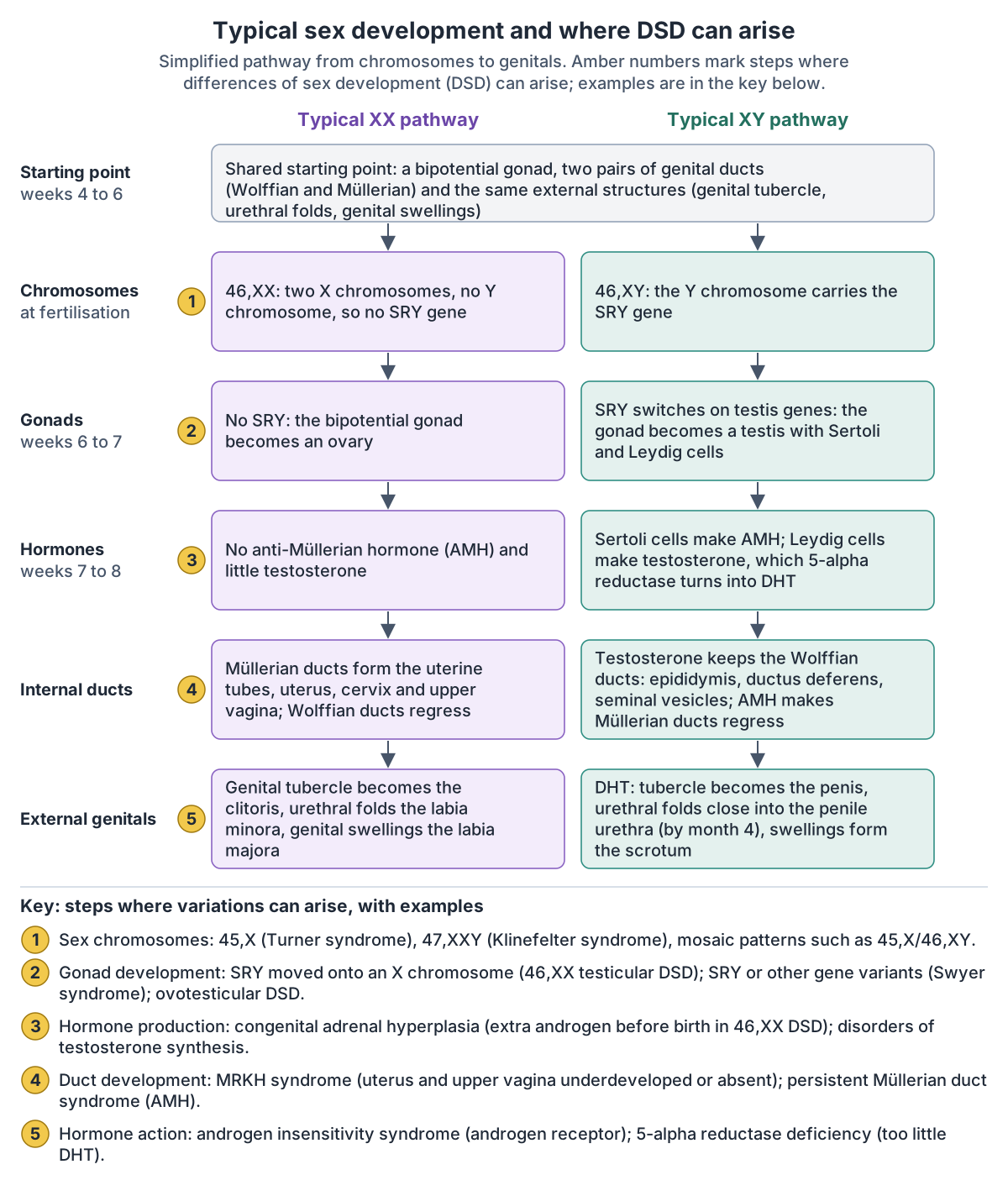
Sex development is a chain of steps in which each step depends on the one before. It starts with the sex chromosomes, usually XX or XY. About a month after conception the primordial gonads begin to form, and at first this tissue is bipotential: it can become either an ovary or a testis. (OpenStax Anatomy and Physiology 2e, 27.3: Development of the Male and Female Reproductive Systems.)
The switch is the SRY gene on the Y chromosome. Its protein is a transcription factor that starts the processes by which a fetus develops testes and stops the development of the uterus and fallopian tubes. (MedlinePlus Genetics: SRY gene.)
SRY recruits other genes that build the testes. Without SRY, the gonad develops into an ovary, in which oogonia form and primordial follicles develop. (OpenStax Anatomy and Physiology 2e, 27.3: Development of the Male and Female Reproductive Systems.)
TeachMeAnatomy gives the timing: germ cells migrate from the yolk sac in week 4 and reach the genital ridges in week 6, where they join the primitive sex cords to form the indifferent gonad. In a testis the cords become testis cords containing Sertoli cells, and Leydig cells start making testosterone in week 8. (TeachMeAnatomy: Development of the Reproductive System.)
Kenhub dates sexual differentiation from week 7, when Sertoli cells release anti-Müllerian hormone (AMH) and Leydig cells release testosterone, so sources put the start of testosterone production at about weeks 7 to 8. (Kenhub: Development of the reproductive system.)
For the external genitals, testosterone works through a stronger hormone: the enzyme steroid 5-alpha reductase 2 converts testosterone into dihydrotestosterone (DHT), which is essential for the development of male external genitalia before birth. (MedlinePlus Genetics: 5-alpha reductase deficiency.)
How the internal and external genitals form
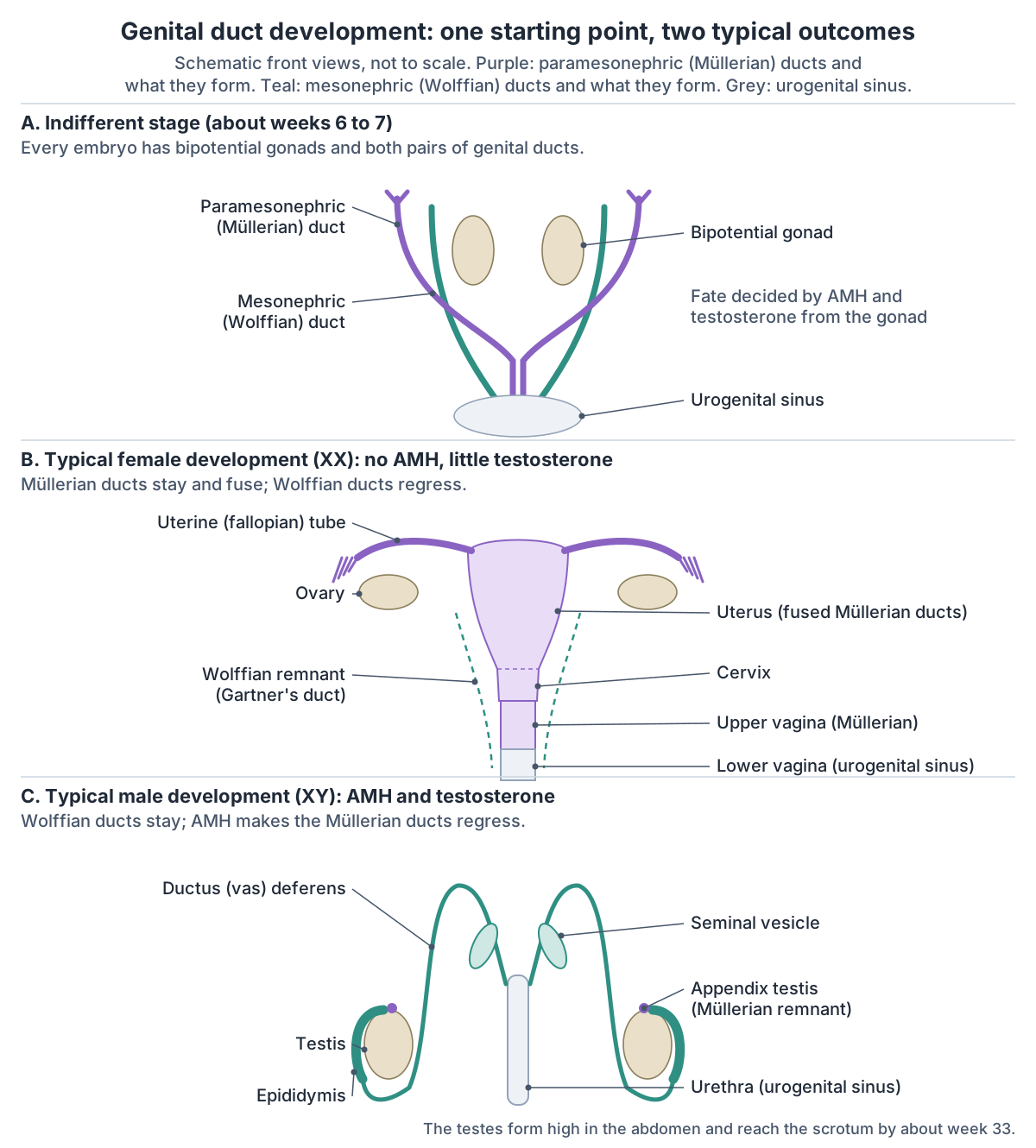
Every embryo starts with two pairs of genital ducts: the mesonephric (Wolffian) ducts and the paramesonephric (Müllerian) ducts. In typical male development testosterone keeps the Wolffian ducts, which form the efferent ductules, epididymis, vas deferens (ductus deferens) and seminal vesicles, while AMH from the Sertoli cells makes the Müllerian ducts regress, leaving a small remnant, the appendix testis. (TeachMeAnatomy: Development of the Reproductive System.)
In typical female development there is no AMH and little testosterone. The Wolffian ducts regress, leaving Gartner's duct, and the Müllerian ducts form the uterine (fallopian) tubes, while their lower parts fuse to form the uterus, cervix and upper vagina. The lower vagina forms from the sinovaginal bulbs of the urogenital sinus. (TeachMeAnatomy: Development of the Reproductive System.)
The external genitals also start the same in everyone, as a genital tubercle, urethral folds and genital swellings. Under the influence of the fetal testes the tubercle becomes the penis, the urethral folds close over the urethral groove to form the penile urethra and the genital swellings become the scrotum. Without that influence the tubercle forms the clitoris, the urethral folds the labia minora and the genital swellings the labia majora, and part of the urogenital sinus forms the vestibule. (Kenhub: Development of the reproductive system.)
The penile urethra is closed by the fourth month. The testes form in the upper lumbar region of the abdomen, pass through the inguinal canal at about week 28 and reach the scrotum by week 33, guided by the gubernaculum. In females the same cord becomes the ovarian ligament and the round ligament of the uterus. (TeachMeAnatomy: Development of the Reproductive System.)
Because both sexes grow from the same tissues, each organ has a counterpart (homologue) in the other. OpenStax gives the glans as an example: with testosterone its cells become the glans of the penis, and without it the same cells become the clitoris. The sections below describe what happens when one of these steps differs. (OpenStax Anatomy and Physiology 2e, 27.3: Development of the Male and Female Reproductive Systems.)
The uterus, uterine tubes and ovaries that the Müllerian ducts and gonads form, in 3D. Female reproductive system.
Shared embryonic structures and what they become
| Embryonic structure | Typical female | Typical male |
|---|---|---|
| Bipotential gonad | Ovary | Testis |
| Paramesonephric (Müllerian) ducts | Uterine tubes, uterus, cervix, upper vagina | Regress (appendix testis remains) |
| Mesonephric (Wolffian) ducts | Regress (Gartner's duct remains) | Epididymis, ductus deferens, seminal vesicles, ejaculatory duct |
| Genital tubercle | Clitoris | Penis |
| Urethral folds | Labia minora | Walls of the penile urethra |
| Genital swellings | Labia majora | Scrotum |
| Gubernaculum | Ovarian ligament and round ligament of uterus | Scrotal ligament |
From TeachMeAnatomy and Kenhub (development of the reproductive system).
Main types of DSD (intersex variations)
The 2006 consensus sorted DSD into three groups by chromosomes. Sex chromosome DSD includes 45,X (Turner syndrome), 47,XXY (Klinefelter syndrome) and mixed patterns such as 45,X/46,XY. 46,XY DSD includes disorders of testis development and of androgen production or action. 46,XX DSD includes disorders of ovary development and androgen excess, for example from 21-hydroxylase deficiency. (Hughes IA, Houk C, Ahmed SF, Lee PA. Consensus statement on management of intersex disorders. Arch Dis Child. 2006.)
MedlinePlus, which calls intersex an older term for DSD, uses four groups: 46,XX DSD, 46,XY DSD, ovotesticular DSD (both ovarian and testicular tissue) and complex or undetermined DSD for chromosome patterns other than simple 46,XX or 46,XY. It notes that the cause can stay unknown even with modern tests. (MedlinePlus Medical Encyclopedia: Differences of sex development.)
The NHS describes the same ground in plain words: XX chromosomes with genitals that look different from most girls'; XY chromosomes with genitals that may look female or between the two and some internal male structures; typical-looking genitals with different sex chromosomes; a typical vulva without a womb (Mayer-Rokitansky-Küster-Hauser, or MRKH, syndrome); and ovotesticular DSD. (NHS: Differences in sex development.)
At the time of the 2006 consensus a specific molecular diagnosis was found in only about 20% of people with DSD. (Hughes IA, Houk C, Ahmed SF, Lee PA. Consensus statement on management of intersex disorders. Arch Dis Child. 2006.)
Genetic testing has improved since then. Targeted gene panels now find a cause in almost half of people with 46,XY DSD, and the yield is high for hormone-production conditions such as congenital adrenal hyperplasia. (Vora KA, Srinivasan S. A guide to differences/disorders of sex development/intersex in children and adolescents. Aust J Gen Pract. 2020.)
Main types of DSD, with examples
| Group | Example | Chromosomes | Typical anatomy | Reported frequency |
|---|---|---|---|---|
| Sex chromosome DSD | Turner syndrome | 45,X or mosaic | Female-typical genitals; ovaries lose function early; short stature | About 1 in 2,000 female newborns |
| Sex chromosome DSD | Klinefelter syndrome | 47,XXY or mosaic | Male-typical genitals; small testes making less testosterone | About 1 in 650 male newborns (1 in 450 in an Australian review) |
| 46,XX DSD | Congenital adrenal hyperplasia (21-hydroxylase deficiency) | 46,XX | Ovaries and uterus; larger clitoris, fused labia | Classic forms about 1 in 14,000 to 15,000 newborns |
| 46,XX DSD | 46,XX testicular DSD | 46,XX (SRY on an X in about 80%) | Male-typical genitals, small testes | About 1 in 20,000 people with a male appearance |
| 46,XX (NHS grouping) | MRKH syndrome | 46,XX | Uterus and upper vagina absent or underdeveloped; typical ovaries and vulva | About 1 in 4,500 female newborns |
| 46,XY DSD | Complete androgen insensitivity | 46,XY | Female-typical genitals; internal testes; no uterus | 2 to 5 per 100,000 newborn females |
| 46,XY DSD | 5-alpha reductase deficiency | 46,XY | Testes; genitals at birth vary; virilisation at puberty | Rare; exact figure unknown |
| 46,XY DSD | Swyer syndrome | 46,XY | Female genitals, uterus and tubes; streak gonads | About 1 in 80,000 |
| Ovotesticular DSD | Ovotesticular DSD | XX, XY or both | Ovarian and testicular tissue | About 1 in 100,000 births |
Compiled from MedlinePlus Genetics, the NHS, MedlinePlus and Vora and Srinivasan 2020. Frequencies are from different populations and methods and are not directly comparable.
Sex chromosome DSD: Turner syndrome, Klinefelter syndrome and mosaicism
In Turner syndrome (monosomy X, 45,X) each cell has one X chromosome instead of two. Short stature is the most common feature and is evident by about age 5. Reduced ovarian function is very common because egg cells usually die early, so many girls need hormone therapy to go through puberty and most cannot conceive without medical help. It occurs in about 1 in 2,000 female newborns. Some people have the change in only some of their cells (mosaicism), a random event in early development. (MedlinePlus Genetics: Turner syndrome.)
In Klinefelter syndrome (47,XXY) there is one extra X chromosome. The testes are small and make less testosterone, which can delay puberty or leave it incomplete and can cause breast enlargement (gynaecomastia, US gynecomastia). It makes biological parenthood difficult, although many people can have children with assisted reproduction. It affects about 1 in 650 male newborns and is the most common sex chromosome condition. About 10% have a mosaic form, 46,XY/47,XXY, which often causes milder features. (MedlinePlus Genetics: Klinefelter syndrome.)
An Australian clinical review gives a higher figure for Klinefelter syndrome, 1 in 450 male births. (Vora KA, Srinivasan S. A guide to differences/disorders of sex development/intersex in children and adolescents. Aust J Gen Pract. 2020.)
The NHS sums up the anatomy of this group: the genitals usually look typical, but full puberty may not happen; for example, a girl may not start having periods. (NHS: Differences in sex development.)
Whether these conditions count as intersex is itself debated. The 2006 consensus placed Turner and Klinefelter syndromes in sex chromosome DSD, but some people with Klinefelter syndrome reject the intersex label while others welcome it, and some clinicians have argued that both should be treated as chromosome variations outside intersex. (Griffiths DA. Shifting syndromes: Sex chromosome variations and intersex classifications. Soc Stud Sci. 2018.)
Many are diagnosed late or never. A Swiss study found that sex chromosome DSD made up 47% of the DSD seen in paediatric endocrine centres, with Turner syndrome the largest group, yet its rates were below published figures of 25 to 50 per 100,000 females for Turner syndrome and 40 to 250 per 100,000 males for Klinefelter syndrome, which the authors put down to late diagnosis. (Metzger S, et al. Prevalence of Differences of Sex Development Among Pediatric Endocrine Care Centers in Switzerland From 2000 to 2019. J Endocr Soc. 2025.)
46,XX DSD: congenital adrenal hyperplasia and other examples
In 46,XX DSD a person has XX chromosomes and usually ovaries and a womb, but the external genitals look different from typical female genitals, for example with a larger clitoris and a closed vagina. The most common cause is congenital adrenal hyperplasia (CAH), in which the body lacks an enzyme needed to make cortisol and aldosterone and makes too much androgen before birth. (NHS: Differences in sex development.)
MedlinePlus describes the anatomy: exposure to extra male hormones before birth can fuse the labia and enlarge the clitoris, while most people have a typical uterus and fallopian tubes. Other causes are male hormones taken by or produced in the mother, for example by an ovarian tumour, and aromatase deficiency, which may not be noticed until puberty. (MedlinePlus Medical Encyclopedia: Differences of sex development.)
The commonest form of CAH is 21-hydroxylase deficiency, caused by variants in the CYP21A2 gene. Its classic salt-wasting and simple virilising forms affect about 1 in 15,000 newborns, and girls with these forms typically have external genitalia that do not look clearly male or female. The salt-wasting form can be life-threatening in early infancy. The mild non-classic form is far more common, at an estimated 1 in 1,000 people, and some have no symptoms. (MedlinePlus Genetics: 21-hydroxylase deficiency.)
CAH is the most common cause of atypical genitals in newborns. Because it affects cortisol and salt balance it is potentially life-threatening and needs urgent treatment, quite apart from any question about the genitals. The Australian review cites 1 in 14,000 births, close to the MedlinePlus figure. (Vora KA, Srinivasan S. A guide to differences/disorders of sex development/intersex in children and adolescents. Aust J Gen Pract. 2020.)
In the Swiss registry, androgen excess, mainly CAH, accounted for 99 of 118 children with 46,XX DSD, and the authors estimated that about 1 in 7,500 newborn girls had 46,XX CAH, which matches about 1 in 15,000 births of both sexes. (Metzger S, et al. Prevalence of Differences of Sex Development Among Pediatric Endocrine Care Centers in Switzerland From 2000 to 2019. J Endocr Soc. 2025.)
In 46,XX testicular DSD a person with two X chromosomes has a male appearance, male external genitalia and usually small testes; some have undescended testes or hypospadias, and a few have genitals that do not look clearly male or female. In about 80% of cases the SRY gene has been moved onto an X chromosome. It occurs in about 1 in 20,000 people with a male appearance. (MedlinePlus Genetics: 46,XX testicular difference of sex development.)
In MRKH syndrome the vagina and uterus are underdeveloped or absent in people with 46,XX chromosomes, typical external genitalia and working ovaries. The first sign is often that periods do not start by age 15. It affects about 1 in 4,500 female newborns; type 1 affects only the reproductive organs and type 2 also other organs such as the kidneys. (MedlinePlus Genetics: Mayer-Rokitansky-Küster-Hauser syndrome.)
In ovotesticular DSD both ovarian and testicular tissue are present, either in the same gonad (an ovotestis) or as one ovary and one testis. The chromosomes may be XX, XY or both, and the external genitals may look ambiguous, female or male. In most cases the cause is unknown. (MedlinePlus Medical Encyclopedia: Differences of sex development.)
The glands that make cortisol, aldosterone and adrenal androgens, which CAH affects. Adrenal gland.
46,XY DSD: androgen insensitivity, 5-alpha reductase deficiency and others
In 46,XY DSD a person has XY chromosomes but external genitals that are incompletely masculinised, ambiguous or female-typical. Typical male development needs enough testosterone and working receptors for it, so the causes fall into three groups: problems with the testes, problems making testosterone (including some forms of CAH) and problems using testosterone. Androgen insensitivity syndrome (AIS) is the most common cause. (MedlinePlus Medical Encyclopedia: Differences of sex development.)
In complete AIS the external sex characteristics are typical of females, but there is no uterus, and the testes are undescended, in the pelvis or abdomen. People with complete AIS do not menstruate, are infertile and have sparse or no pubic and underarm hair. MedlinePlus estimates 2 to 5 per 100,000 newborn females, and the partial form, in which the genitals range from female-typical to male-typical, is thought to be at least as common. Variants in the AR gene for the androgen receptor, on the X chromosome, cause it. (MedlinePlus Genetics: Androgen insensitivity syndrome.)
In 5-alpha reductase deficiency the testes are present but the body makes too little DHT before birth. The genitals at birth may look female, male-typical with a small penis and hypospadias, or neither clearly male nor female. At puberty rising testosterone brings muscle growth, a deeper voice, pubic hair and a growth spurt, but little facial or body hair. The exact incidence is unknown. (MedlinePlus Genetics: 5-alpha reductase deficiency.)
In Swyer syndrome (46,XY complete gonadal dysgenesis) the gonads do not develop into testes and remain small streaks of tissue. People have female external genitalia and usually a uterus and fallopian tubes, puberty often needs hormone therapy to start, and the streak gonads carry a cancer risk. It occurs in about 1 in 80,000 people, and SRY variants are found in about 15% of cases. (MedlinePlus Genetics: Swyer syndrome.)
The consensus classification also lists disorders of AMH, such as persistent Müllerian duct syndrome, and severe hypospadias among 46,XY DSD. (Vora KA, Srinivasan S. A guide to differences/disorders of sex development/intersex in children and adolescents. Aust J Gen Pract. 2020.)
Testes, epididymis, ductus deferens, seminal vesicles and penis, in 3D. Male reproductive system.
How common is intersex? Why estimates differ
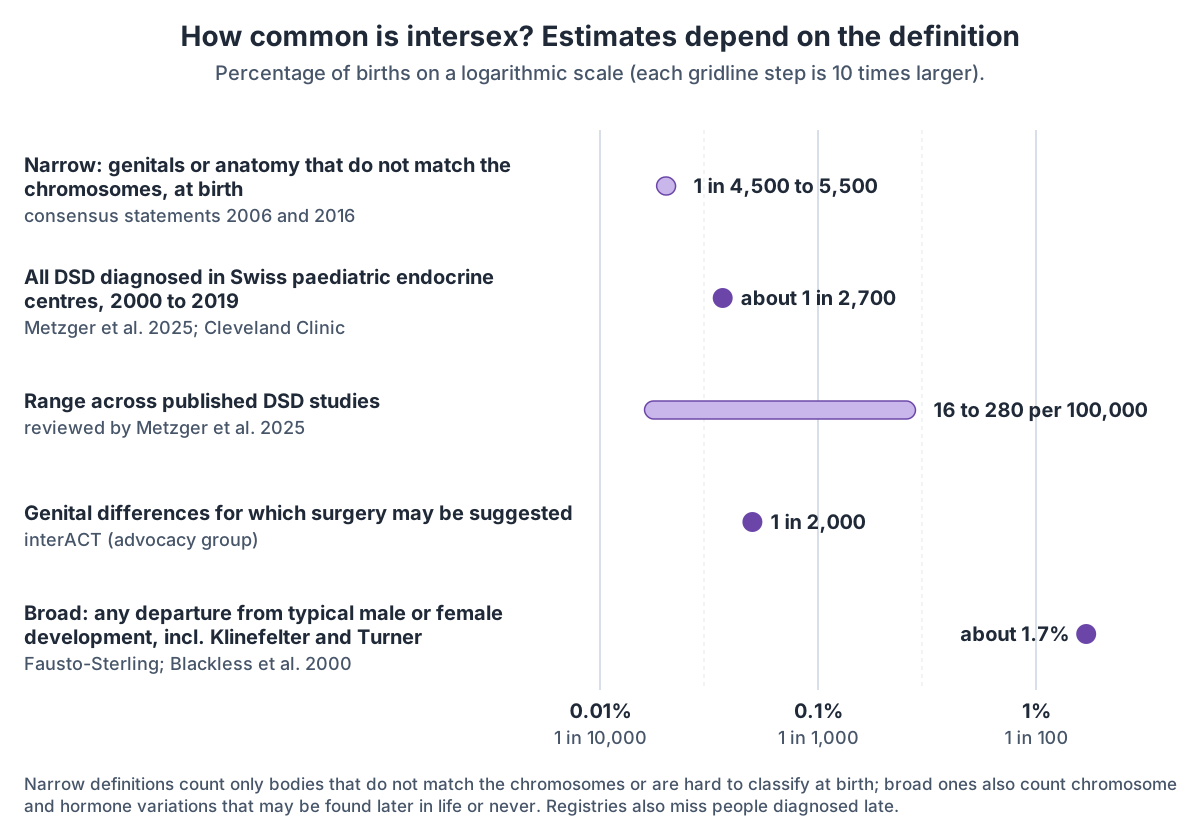
Cleveland Clinic says estimates vary with how providers define and diagnose intersex conditions. It cites one study suggesting that DSD occur in about 1 in 2,700 births and notes that older estimates included conditions that providers do not always count as intersex. (Cleveland Clinic: Intersex: Meaning & Anatomy.)
That study followed 561 children with DSD born in Switzerland from 2000 to 2019 and found 36.6 per 100,000 newborns per year, about 1 in 2,735: 17 per 100,000 for sex chromosome DSD, 12 for 46,XY DSD and 8 for 46,XX DSD. Earlier studies ranged from about 16 to 280 per 100,000 depending on how cases were defined, and a Scottish study found 53 per 100,000 newborns with suspected DSD, 30 of whom needed specialist consultation. (Metzger S, et al. Prevalence of Differences of Sex Development Among Pediatric Endocrine Care Centers in Switzerland From 2000 to 2019. J Endocr Soc. 2025.)
The 2006 consensus estimated that genital anomalies occur in 1 in 4,500 births. (Hughes IA, Houk C, Ahmed SF, Lee PA. Consensus statement on management of intersex disorders. Arch Dis Child. 2006.)
A 2016 global update, cited in the Australian review, put a mismatch between genetic sex and body sex at birth at 1 in 4,500 to 5,500 births, complete XX or XY 'sex reversal' at 1 in 20,000 and ovotesticular DSD at 1 in 100,000. The review stresses that the overall figure depends on which conditions are included. (Vora KA, Srinivasan S. A guide to differences/disorders of sex development/intersex in children and adolescents. Aust J Gen Pract. 2020.)
The highest figure comes from Anne Fausto-Sterling, who in 2000 estimated a frequency of 1.7% from about 50 years of medical literature, as an order-of-magnitude estimate rather than a precise count. Her definition was broad, any departure from typical male or female development at the chromosomal, genital, gonadal or hormonal level, and it included Turner and Klinefelter syndromes. In 2002 the psychologist Leonard Sax narrowed the definition to XY people with mainly female anatomy, XX people with mainly male anatomy and people with ambiguous genitals, and excluded both syndromes. (Griffiths DA. Shifting syndromes: Sex chromosome variations and intersex classifications. Soc Stud Sci. 2018.)
interACT quotes the broad figure: about 1.7% of people are born intersex, and about 1 in 2,000 babies (0.05%) are born with genital differences that a doctor might suggest changing with surgery. It bases both numbers on Fausto-Sterling's review and notes that they are hard to check because no one is required to track them. (interACT: What is intersex? Frequently asked questions.)
So the answer depends on three choices: which conditions count (only atypical genitals at birth, or also chromosome and hormone variations), when people are counted (at birth or across life), and how they are found (registries miss people who are diagnosed late or never). A narrow definition gives roughly 0.02% of births and the broadest about 1.7%.
Prevalence estimates and what they count
| Estimate | What is counted | Source |
|---|---|---|
| 1 in 4,500 to 5,500 births (about 0.02%) | Genital anomalies, or a mismatch between genetic and body sex, at birth | Hughes 2006; Lee 2016 cited by Vora and Srinivasan 2020 |
| About 1 in 2,700 births (36.6 per 100,000) | All DSD seen in Swiss paediatric endocrine centres, 2000 to 2019 | Metzger 2025; Cleveland Clinic |
| 16 to 280 per 100,000 | Range across earlier DSD studies with different definitions | Metzger 2025 |
| 1 in 2,000 births (0.05%) | Genital differences for which surgery might be suggested | interACT |
| About 1.7% | Any departure from typical male or female development, including Turner and Klinefelter syndromes | Fausto-Sterling 2000, described by Griffiths 2018; interACT |
When and how are intersex traits found?
Variations show up at different ages: atypical genitals in newborns, atypical puberty in childhood and adolescence, and hormone, fertility or sexual health concerns in adults. (Vora KA, Srinivasan S. A guide to differences/disorders of sex development/intersex in children and adolescents. Aust J Gen Pract. 2020.)
MedlinePlus lists signs that can lead to tests: genitals that look ambiguous at birth, a very small penis (micropenis), an enlarged clitoris (clitoromegaly), partly fused labia, undescended testes that turn out to be ovaries, groin lumps in girls that turn out to be testes, hypospadias (a urethral opening away from the tip of the penis), electrolyte problems, and delayed, absent or unexpected changes at puberty. (MedlinePlus Medical Encyclopedia: Differences of sex development.)
Tests can include chromosome analysis (karyotype), blood tests for testosterone, luteinising hormone (LH, US luteinizing) and follicle-stimulating hormone (FSH), electrolytes, specific molecular tests, an endoscopic look for a vagina or cervix, and ultrasound or MRI to look for internal organs such as a uterus. (MedlinePlus Medical Encyclopedia: Differences of sex development.)
In the NHS, babies whose genitals look different or whose testicles have not descended are assessed soon after birth with a specialist examination, an ultrasound scan of the internal organs and blood tests for genes and hormones. Births in England must be registered within 42 days, which is usually enough time for these tests. (NHS: Differences in sex development.)
Later signs include puberty that is delayed or does not match the sex assigned at birth, and difficulty becoming pregnant. Some intersex people conceive naturally, while others use assisted reproduction such as IVF, donated eggs, sperm or embryos, or a gestational carrier. (Cleveland Clinic: Intersex: Meaning & Anatomy.)
What do consensus statements say about care?
The 2006 consensus set out principles that are still widely cited: no gender assignment before expert evaluation in newborns, assessment and long-term care at a centre with an experienced multidisciplinary team, open communication with patients and families with their participation in decisions, and, where surgery is considered, an emphasis on function rather than a strictly cosmetic appearance. (Hughes IA, Houk C, Ahmed SF, Lee PA. Consensus statement on management of intersex disorders. Arch Dis Child. 2006.)
MedlinePlus explains that the approach has changed. The appearance of the external genitals used to take priority; experts now recognise that chromosomal, neural, hormonal, psychological and behavioural factors all matter, and many urge delaying definitive surgery for as long as is healthy, ideally until the child can take part in the decision, unless surgery is needed for the infant's health. (MedlinePlus Medical Encyclopedia: Differences of sex development.)
The NHS says many forms of DSD need no medical care beyond understanding how the child is developing. Care teams include a specialist nurse and a psychologist, and options may include hormone therapy, psychological support, vaginal stretching techniques and, if wanted, surgery to change the appearance of the genitals. (NHS: Differences in sex development.)
The Australian review calls surgery the most challenging and controversial area of DSD care, with no consensus on the need for or timing of many procedures. The risk of germ cell tumours varies by diagnosis and is highest in undifferentiated gonadal tissue, dysgenetic testes and testes inside the abdomen. Some patient groups call for a pause on genital or gonadal surgery until the person can consent. (Vora KA, Srinivasan S. A guide to differences/disorders of sex development/intersex in children and adolescents. Aust J Gen Pract. 2020.)
interACT's position, as an advocacy group, is that genital surgery should be the person's own choice and is urgently needed only rarely, for example if a baby cannot pass urine, while the hormone problems of CAH must be taken seriously. It says the United Nations regards such surgery without informed consent as a human rights violation. (interACT: What is intersex? Frequently asked questions.)
This guide summarises these positions for education. It does not give medical advice; decisions about care are made by the people concerned, their families and specialist teams.
Why anatomy books rarely show intersex anatomy
A study of 17 anatomy texts used in Australian medical schools found intersex in only 5 of 6,004 images. The authors recommend teaching sex characteristics as a continuum and showing intersex bodies more often, to reduce stigma and improve care. (University of Wollongong: Anatomy texts should show sex as a spectrum to include intersex people (2021).)
The 3D model on this site shows one typical adult male body and one typical adult female body, so it cannot show intersex variations. Use the diagrams on this page for the developmental pathway, and the male and female anatomy guides to compare the typical structures that each variation differs from: the ovaries and testes, the uterus and the ducts of the male tract, and the external genitals.
The typical male body and its reproductive organs, with a 3D model. Male anatomy.
Frequently asked questions
What does intersex mean?
Intersex is an umbrella term for people born with sex traits, such as chromosomes, gonads, hormones, internal reproductive organs or genitals, that do not fit typical male or female patterns. Some traits are seen at birth, others appear at puberty, and some are never noticed. Intersex describes the body; it is not a gender identity and does not determine sexual orientation.
Is intersex the same as DSD?
They cover largely the same conditions. DSD, for differences or disorders of sex development, is the medical umbrella term introduced in 2006 to replace older labels. Many intersex people and advocacy groups reject the word disorder and prefer intersex, while clinicians often use the name of the specific condition, such as congenital adrenal hyperplasia. Some people with Klinefelter syndrome do not consider themselves intersex.
How common is intersex?
It depends on the definition. Genitals or anatomy that do not match the chromosomes at birth occur in about 1 in 4,500 to 5,500 births. A Swiss registry of all DSD found about 1 in 2,700. The broadest estimate, about 1.7%, includes Klinefelter and Turner syndromes and other variations that are often found later in life or never.
What are examples of intersex conditions?
Examples include congenital adrenal hyperplasia in people with XX chromosomes, androgen insensitivity syndrome and 5-alpha reductase deficiency in people with XY chromosomes, Turner syndrome (45,X), Klinefelter syndrome (47,XXY), Swyer syndrome, MRKH syndrome and ovotesticular DSD. Whether every one of these counts as intersex is debated, especially for Turner and Klinefelter syndromes.
Can a person have both ovaries and testes?
Yes, in ovotesticular DSD, which occurs in about 1 in 100,000 births. Both ovarian and testicular tissue are present, either in the same gonad, called an ovotestis, or as one ovary and one testis. The chromosomes may be XX, XY or both, and the external genitals may look ambiguous, female or male. One person cannot have both a fully developed penis and a fully developed vagina.
Is intersex the same as transgender?
No. Intersex describes physical sex traits a person is born with or that develop in childhood. Transgender describes a gender that differs from the one assumed at birth, and most transgender people are not born with variations in their reproductive anatomy. Intersex people can be men, women or non-binary, and their sexual orientation varies like anyone else's.
Can intersex people have children?
Some can and some cannot; it depends on the condition and the body parts present. Some intersex people have ovaries, a uterus and a vagina and can conceive naturally. Others, for example people with complete androgen insensitivity or Turner syndrome, usually cannot without help, and may use assisted reproduction such as IVF, donated eggs, sperm or embryos, or a gestational carrier.
References
- Cleveland Clinic. Intersex: Meaning & Anatomy. Last updated 2026.
- NHS. Differences in sex development. Reviewed 16 March 2023.
- MedlinePlus Medical Encyclopedia. Differences of sex development (DSD). Reviewed 26 January 2026.
- Vora KA, Srinivasan S. A guide to differences/disorders of sex development/intersex in children and adolescents. Aust J Gen Pract. 2020;49(7). doi:10.31128/AJGP-03-20-5266.
- Hughes IA, Houk C, Ahmed SF, Lee PA; LWPES/ESPE Consensus Group. Consensus statement on management of intersex disorders. Arch Dis Child. 2006;91(7):554-563.
- Metzger S, Aebi-Ochsner C, Busiah K, et al. Prevalence of Differences of Sex Development Among Pediatric Endocrine Care Centers in Switzerland From 2000 to 2019. J Endocr Soc. 2025;9(8):bvaf099.
- Griffiths DA. Shifting syndromes: Sex chromosome variations and intersex classifications. Soc Stud Sci. 2018;48(1):125-148.
- interACT: Advocates for Intersex Youth. What is intersex? Frequently Asked Questions and Intersex Definitions (advocacy organisation).
- OpenStax. Anatomy and Physiology 2e, §27.3 Development of the Male and Female Reproductive Systems. Rice University, 2022.
- Theakston V. Development of the Reproductive System. TeachMeAnatomy, updated 2025.
- Ly D. Development of the reproductive system. Kenhub, reviewed 2026.
- MedlinePlus Genetics. SRY gene.
- MedlinePlus Genetics. Androgen insensitivity syndrome.
- MedlinePlus Genetics. Klinefelter syndrome.
- MedlinePlus Genetics. Turner syndrome.
- MedlinePlus Genetics. 21-hydroxylase deficiency.
- MedlinePlus Genetics. 5-alpha reductase deficiency.
- MedlinePlus Genetics. Mayer-Rokitansky-Küster-Hauser syndrome.
- MedlinePlus Genetics. Swyer syndrome. Updated 2022.
- MedlinePlus Genetics. 46,XX testicular difference of sex development.
- University of Wollongong. Anatomy texts should show sex as a spectrum to include intersex people. 26 October 2021.
Related anatomy
- Female anatomyFemale anatomy explained with a labelled body diagram and 3D model: reproductive organs, vulva, breasts, pelvis…
- Male anatomyMale anatomy diagram and 3D model: male body organs, urethra and bladder, pelvis, Adam's apple, muscle, pelvic floor…
- Female reproductive systemLabelled female reproductive system diagrams: uterus anatomy and layers, uterine tube parts, ovaries, ligaments…
- Male reproductive systemMale reproductive anatomy with labelled diagrams: scrotum, testes, epididymis, ductus deferens, seminal gland…
- Adrenal glandAnatomy of the adrenal glands with diagrams and a 3D model: right vs left shape, cortex zones and medulla, hormones…
Explore the whole body in the interactive 3D human anatomy model, or browse the A–Z list of human structures.