

How to study anatomy: methods that work, a weekly schedule and free tools
By Dr Shaista Andleeb · Last reviewed
The best way to study anatomy is to test yourself instead of rereading, and to spread short reviews over days and weeks. A major review of ten study techniques rated only practice testing and spaced practice as high utility. Add labelling and drawing from memory, plus a 3D model to see where structures sit.
Below, each method comes with what the research found and how strong that evidence is, then a sample weekly schedule, the common mistakes, and how to practise with the free anatomy quiz, 3D human anatomy model and printable anatomy worksheets on this site. New to the subject? Start with what anatomy is.
 Full size ⤢
What is the best way to study anatomy?
The best-supported way to study anatomy is to quiz yourself and to spread your study out over time. In a 2013 review of ten common study techniques, practice testing and distributed (spaced) practice were the only two rated high utility, because they helped learners of different ages and abilities on many kinds of test, including in real classes. (Dunlosky J et al. Improving Students' Learning With Effective Learning Techniques. Psychol Sci Public Interest. 2013.)
Rereading, highlighting and summarising were among the five techniques rated low. Most students rely on rereading and highlighting, but they do not consistently improve results, and the authors advise using other techniques in their place, such as practice testing instead of rereading. (Dunlosky J et al. Improving Students' Learning With Effective Learning Techniques. Psychol Sci Public Interest. 2013.)
The testing effect holds up in classrooms. A 2021 meta-analysis of 222 studies with 48,478 students found that quizzing raised achievement by a medium amount (g = 0.499). The size of the gain depended on factors such as corrective feedback and how many times students were tested. (Yang C et al. Testing (quizzing) boosts classroom learning: A systematic and meta-analytic review. Psychol Bull. 2021.)
In health professions education, a 2024 systematic review found 63 experiments on spaced practice and retrieval practice; 43 of them showed significant benefits over the comparison groups. (Trumble E et al. Systematic review of distributed practice and retrieval practice in health professions education. Adv Health Sci Educ. 2024.)
Anatomy also asks for skills most subjects do not. Western University's learning centre points out that you use visual, spatial and hands-on skills, not just words. So the steps below pair self-testing and spacing with labelling, drawing and 3D models. (Western University, Learning Development & Success: LDS "How To" Series: Studying Anatomy.)
- Preview: Look over the structures for 5 to 10 minutes before the lecture or lab. (LSU Health New Orleans School of Medicine: How to Study Anatomy in Your First Year of Medical School.)
- Learn one chunk: Study one system, organ or tissue at a time, and link each structure to its function. (Western University, Learning Development & Success: LDS "How To" Series: Studying Anatomy.)
- Place it in 3D: Ask where each structure sits in space, and find it on a model. (LSU Health New Orleans School of Medicine: How to Study Anatomy in Your First Year of Medical School.)
- Recall: Cover the labels or close the book, then name, write or draw what you remember. (LSU Health New Orleans School of Medicine: How to Study Anatomy in Your First Year of Medical School.)
- Check: Compare your answers with the source straight away; feedback is one of the things that makes quizzing work. (Yang C et al. Testing (quizzing) boosts classroom learning: A systematic and meta-analytic review. Psychol Bull. 2021.)
- Space: Come back to the topic after about 1 day, 3 days and 1 week. (LSU Health New Orleans School of Medicine: How to Study Anatomy in Your First Year of Medical School.)
- Mix and teach: At the end of the week, do practice questions on all your topics and teach one to a study partner. (LSU Health New Orleans School of Medicine: How to Study Anatomy in Your First Year of Medical School.)
To put the recall step into practice straight away, try the anatomy quiz.
Anatomy study methods and the evidence
| Method | How to do it | What the research found | Strength of evidence |
|---|---|---|---|
| Active recall (practice testing) | Close your notes, then answer questions, name structures or label a blank diagram before you check | Rated high utility across learners and tasks; in anatomy courses, brief quizzes improved retention | Strong |
| Spaced repetition | Return to each topic after growing gaps, such as 1 day, 3 days and 1 week | Rated high utility; spacing plus recall gave the best recall of muscle anatomy a week later | Strong |
| Labelling diagrams | Cover the labels, name each part from memory, then check | Naming parts is a recall test, and recall tests gave larger benefits than recognition tests | Strong when done from memory (it is a form of practice testing) |
| Drawing from memory | Sketch a structure, label it and explain it as you draw, then compare with a good diagram | Randomised trials in histology and spinal anatomy found gains; another found drawing no better than written summaries, and better-quality drawings or summaries went with better results | Moderate, mixed results |
| 3D models | Rotate a model, hide the labels, name and locate each structure | Small gain for facts (d = 0.30) and a larger one for spatial knowledge (d = 0.50); a physical model beat a screen model in one trial | Moderate, mainly for spatial knowledge |
| Teaching others | Prepare to explain a topic, explain it to a partner, then let them quiz you | Preparing to teach (g = 0.35) and teaching after preparing (g = 0.56) improved learning in a meta-analysis of 28 studies, not specific to anatomy | Moderate |
| Mnemonics | Use a phrase for a fixed list you must recall, alongside a diagram | The keyword mnemonic was rated low utility: it helps for a limited range of material and short retention intervals | Limited |
| Rereading and highlighting | Not recommended as a main method | Rated low utility: most students use them, but they do not consistently improve performance | Low |
The strength column is our plain-English summary of the reviews and trials cited in each section below, not a published grading. Effect sizes are quoted as the papers report them. Sources: Dunlosky J et al. Improving Students' Learning With Effective Learning Techniques. Psychol Sci Public Interest. 2013; Dobson JL. Retrieval practice is an efficient method of enhancing the retention of anatomy and physiology information. Adv Physiol Educ. 2013; Dobson JL, Perez J, Linderholm T. Distributed retrieval practice promotes superior recall of anatomy information. Anat Sci Educ. 2017; Rowland CA. The effect of testing versus restudy on retention: a meta-analytic review of the testing effect. Psychol Bull. 2014; Balemans MC et al. Actual drawing of histological images improves knowledge retention. Anat Sci Educ. 2016; Beach IR et al. Learning by drawing and modeling: Teaching modalities for spinal anatomy in medical students. Anat Sci Educ. 2023; Styn A et al. Effects of tablet-based drawing and paper-based methods on medical students' learning of gross anatomy. Anat Sci Educ. 2023; Yammine K, Violato C. A meta-analysis of the educational effectiveness of three-dimensional visualization technologies in teaching anatomy. Anat Sci Educ. 2015; Wainman B et al. The superiority of three-dimensional physical models to two-dimensional computer presentations in anatomy learning. Med Educ. 2018; Kobayashi K. Learning by Preparing-to-Teach and Teaching: A Meta-Analysis. Japanese Psychological Research. 2019.
What is active recall in anatomy?
Active recall, also called retrieval practice, means pulling information out of your memory instead of reading it again: you informally test yourself. Many students assume they learn by rereading and rote memorisation. Retrieval practice adds a step: you produce the answer before you look at it. (Azzam MB, Easteal RA. Retrieval Practice for Improving Long-Term Retention in Anatomical Education: A Quasi-Experimental Study. Med Sci Educ. 2021.)
In an undergraduate gross anatomy course with 248 students, mostly from life sciences, kinesiology and physical education, final exam performance was better when students took part in retrieval practice. The study was quasi-experimental (students were not randomly assigned), so it supports the method without pinning down the size of the gain. (Azzam MB, Easteal RA. Retrieval Practice for Improving Long-Term Retention in Anatomical Education: A Quasi-Experimental Study. Med Sci Educ. 2021.)
It does not take long. In an anatomy and physiology course, ten brief retrieval quizzes, about 2 hours in total, left students retaining an average of 41% more of the tested material at the end of the semester than a control group. (Dobson JL. Retrieval practice is an efficient method of enhancing the retention of anatomy and physiology information. Adv Physiol Educ. 2013.)
Make the test a recall test. A meta-analysis of the testing effect found that recall tests, where you produce the answer, gave larger benefits than recognition tests, where you pick it out. Naming a structure with the labels covered is recall; choosing from four options is recognition. (Rowland CA. The effect of testing versus restudy on retention: a meta-analytic review of the testing effect. Psychol Bull. 2014.)
- Cover the labels on a diagram, name each structure, then check. (LSU Health New Orleans School of Medicine: How to Study Anatomy in Your First Year of Medical School.)
- Put your notes away and practise in conditions like the real test. (Western University, Learning Development & Success: LDS "How To" Series: Studying Anatomy.)
- Vary the questions: label diagrams, list organ functions, describe specific features. (Western University, Learning Development & Success: LDS "How To" Series: Studying Anatomy.)
More anatomy studies on self-testing are summarised on the anatomy quiz page.
How does spaced repetition work for anatomy?
Spaced repetition means reviewing the same material several times with gaps in between, instead of in one long session. A 2006 analysis of 839 assessments of spaced study in 317 experiments found that the best gap between study sessions grew longer the longer you need to remember the material. (Cepeda NJ et al. Distributed practice in verbal recall tasks: A review and quantitative synthesis. Psychol Bull. 2006.)
A study of more than 1,350 people put numbers on this. For a test 1 week away, the best gap before a review was about 20 to 40% of that week (roughly 1.5 to 3 days). For a test a year away, it was about 5 to 10% of the year (roughly 2.5 to 5 weeks). (Cepeda NJ et al. Spacing effects in learning: a temporal ridgeline of optimal retention. Psychol Sci. 2008.)
Anatomy studies agree. When students learned sets of skeletal muscles in exactly 24 minutes of study arranged in different ways, spreading the sessions over days beat massing them, recalling beat restudying, and combining the two gave the greatest recall a week later. (Dobson JL, Perez J, Linderholm T. Distributed retrieval practice promotes superior recall of anatomy information. Anat Sci Educ. 2017.)
A simple rule from LSU Health New Orleans School of Medicine is to review at increasing intervals, such as after 1 day, 3 days and 1 week, and to avoid cramming by spreading study across days and weeks. (LSU Health New Orleans School of Medicine: How to Study Anatomy in Your First Year of Medical School.)
Flashcard schedules are one way to do this. A 2026 meta-analysis of 13 medical education studies with 21,415 learners found spaced repetition beat standard studying (standardised mean difference 0.78). The studies used mixed methods, from flashcards to emailed questions, and the authors say the best design still needs work. (Maye JA, Hurley F. The Effectiveness of Spaced Repetition in Medical Education: A Systematic Review and Meta-Analysis. Clin Teach. 2026.)
Studies on flashcard apps such as Anki are summarised on the anatomy quiz page.
Labelling and drawing anatomy from memory
Turn every diagram into a test. LSU Health's anatomy advice lists sketching structures from memory, labelling blank diagrams repeatedly and explaining aloud while you draw. The point is to produce the names and shapes yourself, which makes it a recall test rather than copying. (LSU Health New Orleans School of Medicine: How to Study Anatomy in Your First Year of Medical School.)
Drawing has been tested in randomised trials. In a crossover study of 384 medical and biomedical sciences students learning histology, the groups who drew the tissues remembered significantly more than those who did not, even four and six weeks later. (Balemans MC et al. Actual drawing of histological images improves knowledge retention. Anat Sci Educ. 2016.)
In a smaller trial on spinal anatomy, 62 first-year medical students had 15 minutes with a 3D anatomy app, either on its own, with drawing or with clay modelling. Only the drawing group's test scores improved significantly, by 11%. (Beach IR et al. Learning by drawing and modeling: Teaching modalities for spinal anatomy in medical students. Anat Sci Educ. 2023.)
Drawing is not automatically better, though. A trial comparing drawing on a tablet, drawing on paper and writing summaries found no overall difference between the groups, and the better each student's drawing or summary, the better their result. Draw with care, then check it against a good diagram. (Styn A et al. Effects of tablet-based drawing and paper-based methods on medical students' learning of gross anatomy. Anat Sci Educ. 2023.)
For practice sheets, print the blank, numbered diagrams in the anatomy worksheets guide, or use the interactive labelling worksheets on the anatomy quiz page.
Do 3D models help you learn anatomy?
Yes, mostly for spatial knowledge: where structures sit in relation to each other. A meta-analysis of 36 studies with 2,226 participants found that 3D visualisation tools gave a small gain in factual knowledge (d = 0.30) and a larger one in spatial knowledge (d = 0.50) compared with other teaching methods. (Yammine K, Violato C. A meta-analysis of the educational effectiveness of three-dimensional visualization technologies in teaching anatomy. Anat Sci Educ. 2015.)
How you use a model matters. A 2021 meta-analysis of 13 randomised trials found that true depth perception (stereoscopic 3D) helped learning when students could interact with the model, but had no effect with non-interactive 3D images. The authors also note that ordinary on-screen (monoscopic) 3D models seem to put students with lower visual-spatial ability at a disadvantage. In three trials, those students gained most from a stereoscopic view, and the gap between them and students with higher visual-spatial ability was no longer significant. (Bogomolova K et al. Stereoscopic three-dimensional visualisation technology in anatomy learning: A meta-analysis. Med Educ. 2021.)
Screens have limits. In one experiment, students naming structures on a pelvis scored 67 to 69% after learning from a physical model, against 41% after learning from a 3D computer model, and seeing the physical model with both eyes explained most of the gap. Handle real models or lab specimens when you can. (Wainman B et al. The superiority of three-dimensional physical models to two-dimensional computer presentations in anatomy learning. Med Educ. 2018.)
Dissection is not the only route either. A meta-analysis of 27 studies with 7,731 participants found that, for short-term knowledge, dissection was no better and no worse than prosections, digital media or models. (Wilson AB et al. A meta-analysis of anatomy laboratory pedagogies. Clin Anat. 2018.)
To use the free 3D human anatomy model actively, keep asking where each structure is in space. Open a system guide such as the skeletal system, note which bones carry key labels, switch off Key labels, rotate the body and name those bones aloud, then switch Key labels back on to check. Click any other bone to see its name. (LSU Health New Orleans School of Medicine: How to Study Anatomy in Your First Year of Medical School.)
Do mnemonics work for anatomy?
Mnemonics can help you recall a fixed list for a while, but the evidence is weaker than for self-testing. The 2013 review rated the keyword mnemonic low utility: it is hard to use in some contexts and seems to help only for a limited range of material and over short retention intervals. (Dunlosky J et al. Improving Students' Learning With Effective Learning Techniques. Psychol Sci Public Interest. 2013.)
Research on mnemonics in medical education is thin. A 2026 study notes that few earlier studies showed positive effects on knowledge. In its own 23 peer-led teaching sessions with mnemonics built in, students' scores rose from before to after the sessions, especially on mnemonic-linked questions (pre-session scores were missing for the last eight sessions), but there was no group taught without mnemonics to compare against. (Sarela S et al. Weird, Witty and Worthwhile: Exploring the Benefits of Mnemonic-Based Medical Education. Clin Teach. 2026.)
Use a mnemonic for a list you must recall in order, and make sure you can also point to each item on a diagram or model. LSU Health warns against memorising lists without understanding where the structures are. (LSU Health New Orleans School of Medicine: How to Study Anatomy in Your First Year of Medical School.)
Teaching others and study groups
Explaining anatomy to someone else is a good way to learn it. A 2019 meta-analysis of 28 studies found that preparing to teach improved learning (g = 0.35) and that teaching after preparing improved it more (g = 0.56), for deeper questions too and after a delay. Interactive teaching, with questions back and forth, gave larger benefits than one-way explaining. The studies were not specific to anatomy. (Kobayashi K. Learning by Preparing-to-Teach and Teaching: A Meta-Analysis. Japanese Psychological Research. 2019.)
In a study group, rotate roles: one person explains the structures while the others quiz them, as LSU Health's guide suggests. Keep the group small, and make sure everyone takes a turn as the teacher. (LSU Health New Orleans School of Medicine: How to Study Anatomy in Your First Year of Medical School.)
How to learn anatomy terms and link structure to function
Anatomical terms come from ancient Greek and Latin and are built from roots, prefixes and suffixes. The root often names an organ, tissue or condition, and the prefix or suffix describes it. Because those languages are no longer in everyday use, the meanings do not change, so a root you learn once keeps working. (OpenStax Anatomy and Physiology 2e, 1.6 Anatomical Terminology.)
Keep a word bank: flashcards, a document or a mind map with each term, its definition and an example, as Western University's learning centre suggests. Learn the directional terms early, since anatomy descriptions rely on them, and use the anatomical terms glossary for bone markings and word roots. (Western University, Learning Development & Success: LDS "How To" Series: Studying Anatomy.)
Asking yourself why a fact is true, and explaining how new information fits what you know, are called elaborative interrogation and self-explanation. The 2013 review rated both moderate utility: promising, but not yet well tested in real classrooms. In anatomy, that means asking why each structure is shaped the way it is. (Dunlosky J et al. Improving Students' Learning With Effective Learning Techniques. Psychol Sci Public Interest. 2013.)
Link anatomy to clinical cases and imaging
Ask why each structure matters clinically. LSU Health's medical school guide lists connecting anatomy to clinical practice as one of its four core habits, and suggests linking each structure to imaging, injury patterns and procedures. It also lists radiology images such as CT and MRI among the ways to learn anatomy in 3D. (LSU Health New Orleans School of Medicine: How to Study Anatomy in Your First Year of Medical School.)
A 2026 systematic review of 52 studies in medical students found that adding radiology, mostly ultrasound, to anatomy teaching improved multiple-choice knowledge scores (pooled d = 0.99), but only about a fifth of the studies had controlled designs and their results varied widely. (Alexander M, Montalbano MJ, Loukas M. Learning Anatomy With Radiology: A Systematic Review. Clin Anat. 2026.)
Should you study anatomy by system or by region?
Either works, as long as you break the material into chunks you can learn and test. Western University's learning centre suggests learning anatomy system by system, organ by organ and tissue by tissue, and connecting each structure to its function. (Western University, Learning Development & Success: LDS "How To" Series: Studying Anatomy.)
LSU Health's medical school guide chunks by compartments, layers and regions instead, and stresses relationships between structures over isolated facts. Follow the order your course and exams use, so your reviews match what you will be asked. (LSU Health New Orleans School of Medicine: How to Study Anatomy in Your First Year of Medical School.)
Once you know a group of similar structures, mix them up in practice. A meta-analysis of interleaved practice (59 studies) found a moderate benefit overall (g = 0.42), largest for visual material such as paintings and when categories looked alike; for words, blocking one topic at a time did better (g = -0.39). We read this as: mix when telling look-alike structures apart, block when first learning a word list. That rule is our reading of studies on other materials, not a tested anatomy finding. (Brunmair M, Richter T. Similarity matters: A meta-analysis of interleaved learning and its moderators. Psychol Bull. 2019.)
For how A&P courses link structure and function, see anatomy and physiology.
A weekly anatomy study schedule
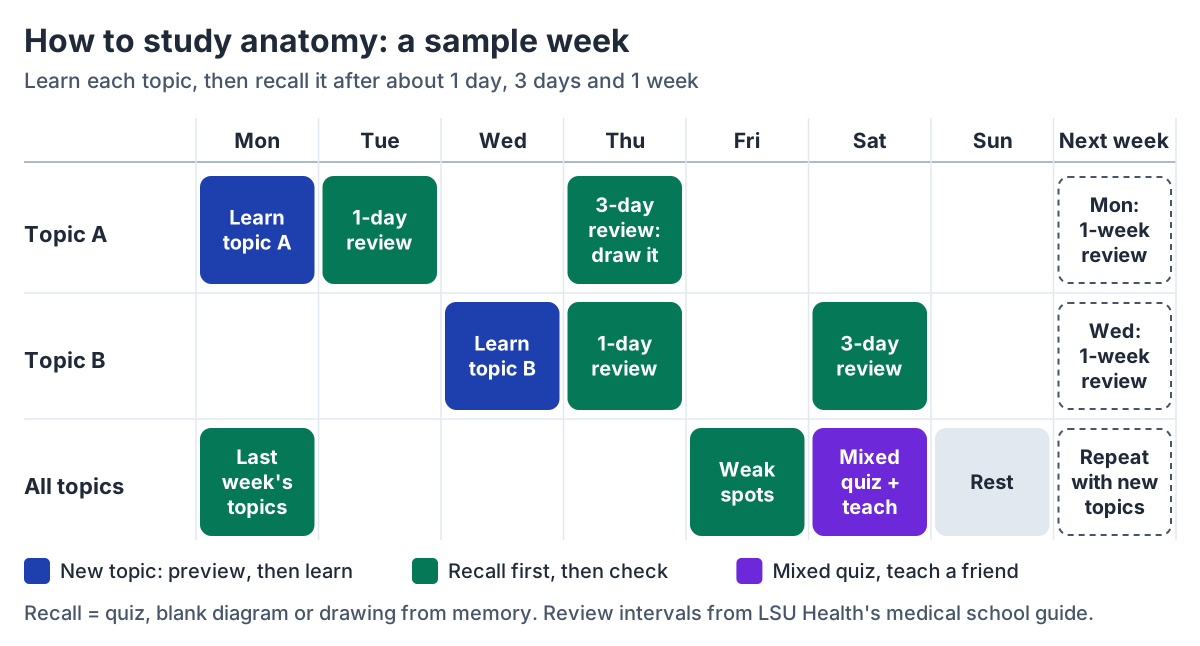
A good week mixes new material with short reviews of older topics. LSU Health suggests a 5 to 10 minute preview before each lecture or lab, an active review afterwards, flashcards later the same day, daily review of even 20 to 30 minutes, and practice questions and group teaching at the end of the week, spiralling back to older material weekly. (LSU Health New Orleans School of Medicine: How to Study Anatomy in Your First Year of Medical School.)
How much time you need overall depends on your course. One college guide gives a rule of thumb of 2 to 3 hours of study for each hour in class. (San Diego Miramar College: 9 Helpful Tips for Studying Human Anatomy.)
The sample plan below is for a course that teaches two new topics a week. Each topic comes back after about 1 day, 3 days and 1 week; for a test a week away, gaps of about 1.5 to 3 days worked best in the large spacing study above. It is an example to adapt, not a tested timetable. (Cepeda NJ et al. Spacing effects in learning: a temporal ridgeline of optimal retention. Psychol Sci. 2008.)
Sample weekly anatomy study schedule
| Day | New material | Review (spaced recall) | Free tool to use |
|---|---|---|---|
| Monday | Topic A: preview for 5 to 10 minutes, then learn it (for example, the bones of the upper limb) | Last week's topics: 1-week review | 3D model and the system guide |
| Tuesday | None | Topic A: 1-day review; label a blank diagram from memory | Printable worksheets |
| Wednesday | Topic B: preview, then learn it | None | 3D model with Key labels off |
| Thursday | None | Topic A: 3-day review, drawn from memory; Topic B: 1-day review | Paper, then a labelled diagram to check |
| Friday | None | Weak spots: anything you missed this week | Anatomy quiz |
| Saturday | None | Topic B: 3-day review; a mixed quiz on A, B and older topics; teach one topic to a friend | 3D find-the-structure game |
| Sunday | Rest | None | None |
A sample plan, not a tested timetable. Topic A comes back next Monday and Topic B next Wednesday for their 1-week reviews. Daily review can be as short as 20 to 30 minutes on top of learning new material. Sources: LSU Health New Orleans School of Medicine: How to Study Anatomy in Your First Year of Medical School; Cepeda NJ et al. Spacing effects in learning: a temporal ridgeline of optimal retention. Psychol Sci. 2008.
How to practise anatomy with free tools
Pick a main reference to learn from, such as your course textbook or an anatomy atlas, rather than relying only on lecture notes; LSU Health suggests combining text, lecture notes, lab sessions and videos for each topic. Then add tools for self-testing and 3D. To compare anatomy apps, including free and paid 3D atlases, see best anatomy apps. (LSU Health New Orleans School of Medicine: How to Study Anatomy in Your First Year of Medical School.)
No single method is enough on its own, so combine several. Everything below is free on EasyAnatomyLab, with no account or sign-up. (LSU Health New Orleans School of Medicine: How to Study Anatomy in Your First Year of Medical School.)
The 3D body is built from the BodyParts3D model of an adult male, with a female option that adds parts from the Human Reference Atlas. Some small structures, such as the ear ossicles, are not in the model and are shown in 2D diagrams on their guides instead.
- 3D human model: 3D human anatomy: rotate the body, switch systems on and off, and click any structure to read about it.
- System guides: the skeletal system, muscular system and organs guides, each with labelled diagrams, a 3D view and cited text.
- Anatomy quiz: the anatomy quiz: multiple-choice quizzes on bones, muscles, organs, the heart and directional terms, labelling worksheets and a 3D find-the-structure game.
- Printable worksheets: anatomy worksheets: blank, numbered diagrams with answer keys to label from memory.
- Checking answers: the human anatomy A–Z lists more than 800 structures from the 3D model, each with its own page.
- Anatomy for drawing: if you study anatomy for art, the anatomy drawing reference covers proportions, bony landmarks and the muscles that shape the figure.
Common mistakes when studying anatomy
Most anatomy study mistakes come from passive or last-minute study. LSU Health lists cramming before exams, memorising lists without understanding where structures are, relying only on lecture notes and not revisiting older material. (LSU Health New Orleans School of Medicine: How to Study Anatomy in Your First Year of Medical School.)
- Rereading and highlighting: they feel productive but were rated low utility; swap them for self-testing. (Dunlosky J et al. Improving Students' Learning With Effective Learning Techniques. Psychol Sci Public Interest. 2013.)
- Cramming: the same study time gave better recall of muscle anatomy when spread over days than when massed together. (Dobson JL, Perez J, Linderholm T. Distributed retrieval practice promotes superior recall of anatomy information. Anat Sci Educ. 2017.)
- Only recognising answers: multiple-choice practice is recognition; recall tests, where you produce the answer, gave larger benefits. (Rowland CA. The effect of testing versus restudy on retention: a meta-analytic review of the testing effect. Psychol Bull. 2014.)
- Watching instead of doing: in a meta-analysis, stereoscopic (true-depth) 3D helped learning when students could rotate and explore the model, but showed no benefit with fixed 3D images; rotate the model, hide the labels and test yourself. (Bogomolova K et al. Stereoscopic three-dimensional visualisation technology in anatomy learning: A meta-analysis. Med Educ. 2021.)
- Matching study to a learning style: a major review found virtually no evidence that teaching to a preferred style, such as visual, improves learning. (Pashler H, McDaniel M, Rohrer D, Bjork R. Learning Styles: Concepts and Evidence. Psychol Sci Public Interest. 2008.)
- Copying labels: copying a labelled diagram is not recall; cover the labels and test yourself first. (LSU Health New Orleans School of Medicine: How to Study Anatomy in Your First Year of Medical School.)
- Forgetting old topics: anatomy is cumulative, so spiral back to older material every week. (LSU Health New Orleans School of Medicine: How to Study Anatomy in Your First Year of Medical School.)
Preparing for an anatomy practical (bell-ringer) exam
In a bell-ringer exam you move between stations, each with a specimen, slide or question, and you usually have a few minutes at each before the bell. Once you leave a station you cannot go back. Practise the same way: test yourself in the lab, against the clock, on structures you have not just looked at. (Western University, Learning Development & Success: LDS "How To" Series: Studying Anatomy.)
If you cannot name a structure, identify the structures next to it first; they may lead you to the answer. Read the instructions at each station, and unless wrong answers lose marks, write something rather than leaving a blank. (Western University, Learning Development & Success: LDS "How To" Series: Studying Anatomy.)
Before each lab, preview the structures; during it, work actively; afterwards, review straight away. When you are away from the lab, do the same with a 3D model or a printed diagram. (LSU Health New Orleans School of Medicine: How to Study Anatomy in Your First Year of Medical School.)
Frequently asked questions
Can you learn anatomy on your own?
Yes. The methods with the best evidence, quizzing yourself and spacing your reviews over days and weeks, need no teacher. Learn one system or region at a time from a textbook or guide, test yourself with quizzes and blank diagrams, and use a 3D model to see where structures sit. A study partner helps too, because explaining a topic shows you what you have not learned yet.
How many hours a week should I study anatomy?
There is no single right number. One college guide suggests 2 to 3 hours of study for each hour in class, and LSU Health's medical school advises daily review of even 20 to 30 minutes instead of long sessions before exams. Spread the time out: in a muscle anatomy study, the same 24 minutes of study gave better recall when it was spread over several days.
Do mnemonics help you learn anatomy?
They can help you recall a fixed list for a while, but they are not a main study method. A major review rated the keyword mnemonic low utility because it helps only for some material and for short periods, and few medical education studies show clear gains. Use a mnemonic alongside self-testing and a diagram, so you also know where each structure is.
Is it better to learn anatomy from a 3D model or a textbook?
Use both. Textbooks and diagrams give you the names and facts, while 3D models help most with where structures sit: in a meta-analysis of 36 studies they improved spatial knowledge more than factual knowledge. A physical model beat a screen-based 3D model in one trial, so handle real models when you can, and test yourself with the labels hidden.
Should I study anatomy by body system or by region?
Follow the order your course and exams use. University study guides suggest chunking either way: system by system and organ by organ, or by compartments, layers and regions. Once you know a group of look-alike structures, such as the carpal bones, quiz them in mixed order, because mixing helped most with visual material whose categories look alike.
How do I memorise anatomy terms?
Learn the common Greek and Latin roots, prefixes and suffixes, because anatomical terms are built from them and their meanings do not change. Keep a word bank of each term with its definition and an example, and test yourself on it with flashcards. Learn the directional terms, such as anterior, posterior, medial and lateral, early on, since anatomy descriptions rely on them.
Does your learning style matter when studying anatomy?
Not in the way many people think. A major review found virtually no evidence that teaching to a preferred style, such as visual or auditory, improves learning, and some well-designed studies contradicted the idea. Choose methods by what the material needs instead: diagrams and 3D models for where structures are, self-testing for names, and spaced reviews for everything.
References
- Dunlosky J, Rawson KA, Marsh EJ, Nathan MJ, Willingham DT. Improving students' learning with effective learning techniques: promising directions from cognitive and educational psychology. Psychol Sci Public Interest. 2013;14(1):4-58.
- Yang C, Luo L, Vadillo MA, Yu R, Shanks DR. Testing (quizzing) boosts classroom learning: a systematic and meta-analytic review. Psychol Bull. 2021;147(4):399-435.
- Rowland CA. The effect of testing versus restudy on retention: a meta-analytic review of the testing effect. Psychol Bull. 2014;140(6):1432-1463.
- Dobson JL. Retrieval practice is an efficient method of enhancing the retention of anatomy and physiology information. Adv Physiol Educ. 2013;37(2):184-191.
- Azzam MB, Easteal RA. Retrieval practice for improving long-term retention in anatomical education: a quasi-experimental study. Med Sci Educ. 2021;31(4):1305-1310.
- Dobson JL, Perez J, Linderholm T. Distributed retrieval practice promotes superior recall of anatomy information. Anat Sci Educ. 2017;10(4):339-347.
- Cepeda NJ, Pashler H, Vul E, Wixted JT, Rohrer D. Distributed practice in verbal recall tasks: a review and quantitative synthesis. Psychol Bull. 2006;132(3):354-380.
- Cepeda NJ, Vul E, Rohrer D, Wixted JT, Pashler H. Spacing effects in learning: a temporal ridgeline of optimal retention. Psychol Sci. 2008;19(11):1095-1102.
- Maye JA, Hurley F. The effectiveness of spaced repetition in medical education: a systematic review and meta-analysis. Clin Teach. 2026;23(2):e70353.
- Trumble E, Lodge J, Mandrusiak A, Forbes R. Systematic review of distributed practice and retrieval practice in health professions education. Adv Health Sci Educ Theory Pract. 2024;29(2):689-714.
- Brunmair M, Richter T. Similarity matters: a meta-analysis of interleaved learning and its moderators. Psychol Bull. 2019;145(11):1029-1052.
- Balemans MC, Kooloos JG, Donders AR, Van der Zee CE. Actual drawing of histological images improves knowledge retention. Anat Sci Educ. 2016;9(1):60-70.
- Beach IR, D'Agostino EN, Thakrar R, Lunardini DJ. Learning by drawing and modeling: teaching modalities for spinal anatomy in medical students. Anat Sci Educ. 2023;16(6):1041-1045.
- Styn A, Scheiter K, Fischer MR, et al. Effects of tablet-based drawing and paper-based methods on medical students' learning of gross anatomy. Anat Sci Educ. 2023;16(2):266-279.
- Yammine K, Violato C. A meta-analysis of the educational effectiveness of three-dimensional visualization technologies in teaching anatomy. Anat Sci Educ. 2015;8(6):525-538.
- Bogomolova K, Hierck BP, Looijen AEM, et al. Stereoscopic three-dimensional visualisation technology in anatomy learning: a meta-analysis. Med Educ. 2021;55(3):317-327.
- Wainman B, Wolak L, Pukas G, Zheng E, Norman GR. The superiority of three-dimensional physical models to two-dimensional computer presentations in anatomy learning. Med Educ. 2018;52(11):1138-1146.
- Wilson AB, Miller CH, Klein BA, et al. A meta-analysis of anatomy laboratory pedagogies. Clin Anat. 2018;31(1):122-133.
- Kobayashi K. Learning by preparing-to-teach and teaching: a meta-analysis. Japanese Psychological Research. 2019;61(3):192-203.
- Sarela S, Shah M, Kelley E, et al. Weird, witty and worthwhile: exploring the benefits of mnemonic-based medical education. Clin Teach. 2026;23(5):e70518.
- Pashler H, McDaniel M, Rohrer D, Bjork R. Learning styles: concepts and evidence. Psychol Sci Public Interest. 2008;9(3):105-119.
- LSU Health New Orleans School of Medicine, Student Affairs. How to Study Anatomy in Your First Year of Medical School.
- Western University, Learning Development & Success. LDS "How To" Series: Studying Anatomy.
- San Diego Miramar College. 9 Helpful Tips for Studying Human Anatomy. 2025.
- OpenStax. Anatomy and Physiology 2e, 1.6 Anatomical Terminology. Rice University; 2022.
- Alexander M, Montalbano MJ, Loukas M. Learning anatomy with radiology: a systematic review. Clin Anat. 2026.
Related pages
- Anatomy quizFree anatomy quizzes and games: find-the-structure quizzes on 3D models and labelling practice.
- Anatomy worksheetsFree printable anatomy worksheets: unlabeled, numbered diagrams of the skeleton, muscles, heart, brain, digestive system, eye and ear, each with an answer key.
- Human anatomy1,000+ bones, muscles, organs, vessels and nerves from real anatomical data.
- Anatomy and physiologyHow structure and function fit together, the levels of organisation and the organ systems, with study tips.
- What is anatomy?What anatomy studies, its branches, how anatomists name and describe the body, and how to learn it.
- Best anatomy appsCompare anatomy apps by platform, free option, price, 3D models, quizzes, offline use, AR and AI, checked on official listings and sites on 30 October 2026.
About this guide
Published by Dr Shaista Andleeb. Drafted with AI assistance from the sources listed above and checked against them; last reviewed on 30 October 2026. The editorial policy explains how sources are chosen, how AI tools are used and how errors are corrected. To report a mistake, use the contact page.
More guides: Anatomy worksheets · Types of bone fractures · Best anatomy apps. Browse all anatomy guides, or explore the interactive 3D human anatomy model.