

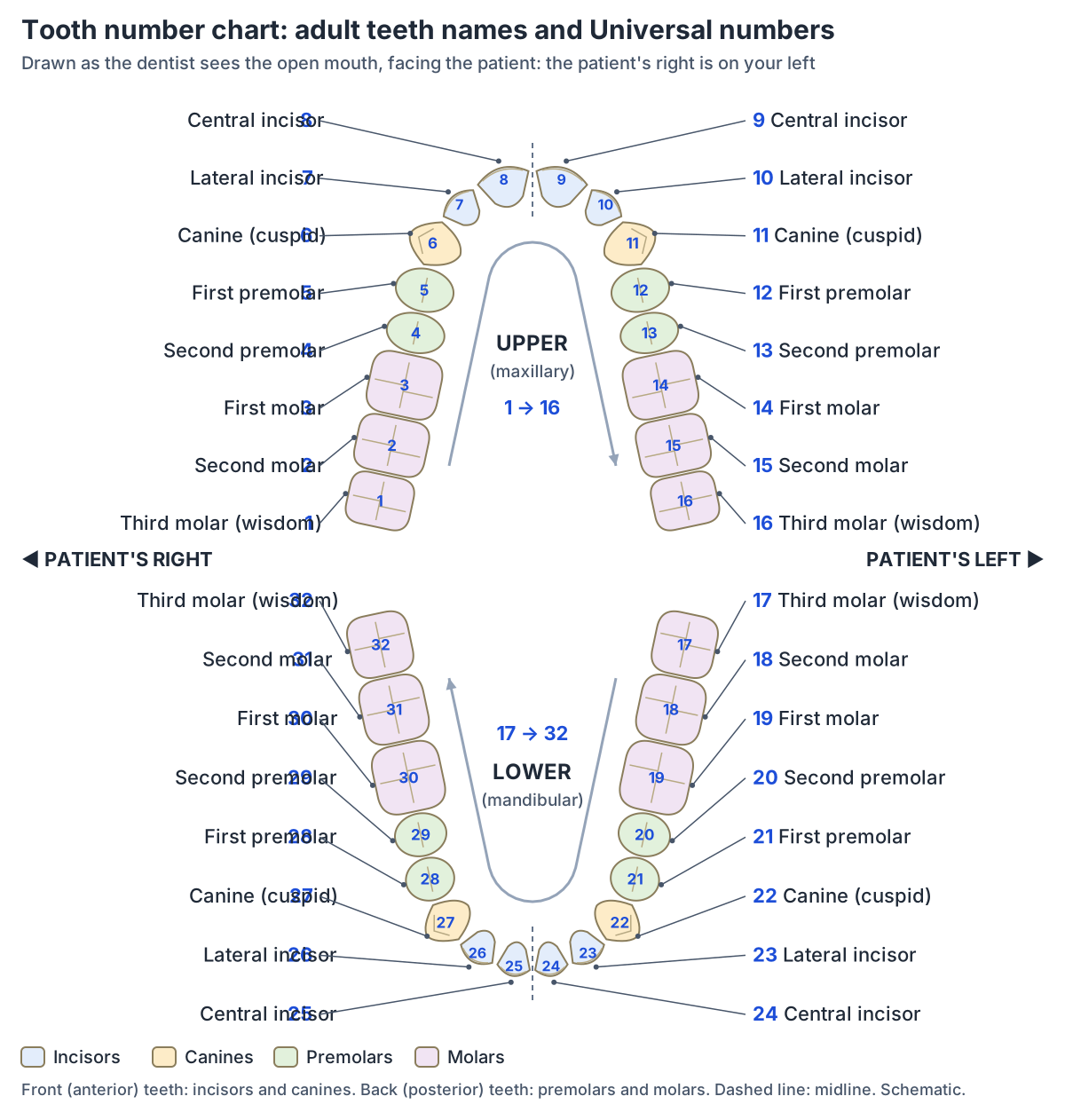
How are teeth numbered? Reading the tooth number chart
In the Universal system of the American Dental Association, the permanent teeth are numbered as a dentist sees them when looking into the open mouth, going clockwise from the back of the upper right side. Teeth 1 to 8 are the upper right teeth, from the third molar (1) to the central incisor (8). Teeth 9 to 16 are the upper left teeth, from the central incisor (9) to the third molar (16). (Radiopaedia: American Dental Association Universal Numbering System.)
The count then drops to the lower jaw on the same side. Teeth 17 to 24 are the lower left teeth, from the third molar (17) to the central incisor (24), and teeth 25 to 32 are the lower right teeth, from the central incisor (25) to the third molar (32). (Radiopaedia: American Dental Association Universal Numbering System.)
Cleveland Clinic describes the same path in plain words: number 1 is your upper right third molar and number 16 your upper left third molar; you then drop down to number 17, your lower left third molar, and count across the lower teeth to number 32, your lower right third molar. (Cleveland Clinic: Teeth.)
The American Dental Association's claim-form guidance gives the direction from the patient's side: the maxillary (upper) teeth are numbered 1 to 16 from the patient's right to left, and the mandibular (lower) teeth 17 to 32 from the patient's left to right. (American Dental Association: Reporting Area of the Oral Cavity and Tooth Anatomy by CDT Code (2025).)
Because a chart shows the mouth as seen from in front of the patient, the teeth on the right side of the page are on the patient's left, and the teeth on the left of the page are on the patient's right. Every chart on this page is drawn that way, so teeth 1 and 32, both on the patient's right, appear on the left of the chart. (Sivakumar A et al. Treatment planning in conservative dentistry. J Pharm Bioallied Sci. 2012.)
The numbers belong to positions, not to the teeth a person happens to have. Dentists still assign numbers to missing teeth, so that the chart in your records stays accurate. (Cleveland Clinic: Teeth.)
Tooth number chart: all 32 adult teeth (Universal, FDI and Palmer)
| Universal | FDI | Palmer (alphanumeric form) | Tooth name | Arch and side |
|---|---|---|---|---|
| 1 | 18 | UR8 | Third molar (wisdom tooth) | Upper (maxillary) right |
| 2 | 17 | UR7 | Second molar (12-year molar) | Upper (maxillary) right |
| 3 | 16 | UR6 | First molar (6-year molar) | Upper (maxillary) right |
| 4 | 15 | UR5 | Second premolar (bicuspid) | Upper (maxillary) right |
| 5 | 14 | UR4 | First premolar (bicuspid) | Upper (maxillary) right |
| 6 | 13 | UR3 | Canine (cuspid) | Upper (maxillary) right |
| 7 | 12 | UR2 | Lateral incisor | Upper (maxillary) right |
| 8 | 11 | UR1 | Central incisor | Upper (maxillary) right |
| 9 | 21 | UL1 | Central incisor | Upper (maxillary) left |
| 10 | 22 | UL2 | Lateral incisor | Upper (maxillary) left |
| 11 | 23 | UL3 | Canine (cuspid) | Upper (maxillary) left |
| 12 | 24 | UL4 | First premolar (bicuspid) | Upper (maxillary) left |
| 13 | 25 | UL5 | Second premolar (bicuspid) | Upper (maxillary) left |
| 14 | 26 | UL6 | First molar (6-year molar) | Upper (maxillary) left |
| 15 | 27 | UL7 | Second molar (12-year molar) | Upper (maxillary) left |
| 16 | 28 | UL8 | Third molar (wisdom tooth) | Upper (maxillary) left |
| 17 | 38 | LL8 | Third molar (wisdom tooth) | Lower (mandibular) left |
| 18 | 37 | LL7 | Second molar (12-year molar) | Lower (mandibular) left |
| 19 | 36 | LL6 | First molar (6-year molar) | Lower (mandibular) left |
| 20 | 35 | LL5 | Second premolar (bicuspid) | Lower (mandibular) left |
| 21 | 34 | LL4 | First premolar (bicuspid) | Lower (mandibular) left |
| 22 | 33 | LL3 | Canine (cuspid) | Lower (mandibular) left |
| 23 | 32 | LL2 | Lateral incisor | Lower (mandibular) left |
| 24 | 31 | LL1 | Central incisor | Lower (mandibular) left |
| 25 | 41 | LR1 | Central incisor | Lower (mandibular) right |
| 26 | 42 | LR2 | Lateral incisor | Lower (mandibular) right |
| 27 | 43 | LR3 | Canine (cuspid) | Lower (mandibular) right |
| 28 | 44 | LR4 | First premolar (bicuspid) | Lower (mandibular) right |
| 29 | 45 | LR5 | Second premolar (bicuspid) | Lower (mandibular) right |
| 30 | 46 | LR6 | First molar (6-year molar) | Lower (mandibular) right |
| 31 | 47 | LR7 | Second molar (12-year molar) | Lower (mandibular) right |
| 32 | 48 | LR8 | Third molar (wisdom tooth) | Lower (mandibular) right |
Universal numbers run clockwise as the dentist faces the patient (Radiopaedia; American Dental Association). FDI: quadrant digit then position from the midline (Radiopaedia; Kenhub). Palmer: position 1 to 8 from the midline (Radiopaedia), written in its typed alphanumeric form with the quadrant letters UR, UL, LL and LR (Radiopaedia); handwritten Palmer notation shows the quadrant with a bracket instead.
Names of teeth: the eight teeth in each quadrant
The teeth are arranged in two arches, the upper (maxillary) arch and the lower (mandibular) arch, and each arch is divided at the midline into a right and a left quadrant. In the permanent dentition there are 16 teeth in each arch and 8 in each quadrant. (Dentalcare: Types of Teeth, Structures, Location and Functions.)
Counting from the midline backwards, every adult quadrant holds the same eight teeth: central incisor, lateral incisor, canine, first premolar, second premolar, first molar, second molar and third molar. Dentists often refer to them simply as numbers, 1 (central incisor) to 8 (the third molar or wisdom tooth). (TeachMeAnatomy: Child and Adult Dentition.)
Most adults have 32 permanent teeth: eight incisors, four canines, eight premolars and twelve molars, three in each quadrant. (Cleveland Clinic: Teeth.)
Each type has its own job. The eight incisors are the sharp front teeth used for biting into food. The four cuspids (canines) flank the incisors and have a pointed cusp to tear food. Behind them, the eight premolars (bicuspids) have two rounded cusps for mashing food, and the molars have several cusps that crush food so it is ready to swallow. (OpenStax Anatomy and Physiology 2e, 23.3: The Mouth, Pharynx, and Esophagus.)
Several teeth have everyday names that dentists also use: canine and cuspid are the same tooth, premolars are bicuspids, the first molar is the 6-year molar, the second molar the 12-year molar and the third molar the wisdom tooth. (Radiopaedia: American Dental Association Universal Numbering System.)
The molar nicknames come from the age at which the teeth arrive. The first permanent molars, the "6 year molars", come in between the ages of 5 and 7, and the second permanent molars, the "12 year molars", between 11 and 14. (National Institute of Dental and Craniofacial Research: Seal Out Tooth Decay (2025).)
The upper two canines have a third name: they are also often known as eye teeth. (Colgate: Do You Know All the Human Teeth Names?.)
Cleveland Clinic explains the name by the canines' position directly under the eyes. (Cleveland Clinic: Teeth.)
A tooth's full name runs from the general to the specific: dentition, arch, quadrant, then tooth type. "Permanent mandibular right lateral incisor", for example, is an adult tooth in the lower jaw on the patient's right, the second tooth from the midline. (TeachMeAnatomy: Child and Adult Dentition.)
How each type of tooth is shaped, with its cusps and roots, and what the crown, enamel, dentin and pulp are. Tooth anatomy and types of teeth.
Teeth names and their numbers in each quadrant
| Position from midline | Tooth name | Other names | Universal (UR, UL, LL, LR) | FDI (UR, UL, LL, LR) |
|---|---|---|---|---|
| 1 | Central incisor | (none in common use) | 8, 9, 24, 25 | 11, 21, 31, 41 |
| 2 | Lateral incisor | (none in common use) | 7, 10, 23, 26 | 12, 22, 32, 42 |
| 3 | Canine | Cuspid; the upper canines are also called eye teeth | 6, 11, 22, 27 | 13, 23, 33, 43 |
| 4 | First premolar | First bicuspid | 5, 12, 21, 28 | 14, 24, 34, 44 |
| 5 | Second premolar | Second bicuspid | 4, 13, 20, 29 | 15, 25, 35, 45 |
| 6 | First molar | 6-year molar | 3, 14, 19, 30 | 16, 26, 36, 46 |
| 7 | Second molar | 12-year molar | 2, 15, 18, 31 | 17, 27, 37, 47 |
| 8 | Third molar | Wisdom tooth | 1, 16, 17, 32 | 18, 28, 38, 48 |
UR upper right, UL upper left, LL lower left, LR lower right. The position number is also the tooth's Palmer number and the second digit of its FDI number. Names from Radiopaedia, TeachMeAnatomy, Cleveland Clinic, Colgate and NIDCR.
Front teeth names: incisors and canines (anterior teeth)
Dentists split the teeth into front (anterior) teeth, which are the incisors and canines, and back (posterior) teeth, which are the premolars and molars. Front teeth have a single cutting edge (the incisal edge), while back teeth have broader, flatter chewing surfaces called occlusal surfaces. (Kenhub: Tooth anatomy.)
So each arch has six front teeth. In the upper jaw they are Universal teeth 6 to 11: the right canine (6), right lateral incisor (7), the two central incisors (8 and 9), the left lateral incisor (10) and the left canine (11). In the lower jaw they are teeth 22 to 27: the left canine (22), left lateral incisor (23), the central incisors (24 and 25), the right lateral incisor (26) and the right canine (27). (Radiopaedia: American Dental Association Universal Numbering System.)
The four front teeth in each jaw are the incisors. Each usually has a single root and has a sharp incisal edge for cutting food, and the lower (mandibular) central incisor is the smallest of all the incisors. The canines tear food and have the longest root of any tooth. (Dentalcare: Types of Teeth and their Functions.)
The incisors are the most visible teeth in the mouth, four in the upper jaw and four in the lower. (Cleveland Clinic: Teeth.)
Back teeth names: premolars and molars (posterior teeth)
The US National Institute of Dental and Craniofacial Research describes the back teeth as the premolars and molars. (National Institute of Dental and Craniofacial Research: Seal Out Tooth Decay (2025).)
Each quadrant has five back teeth: two premolars and three molars. In the Universal system the upper right back teeth are 1 to 5 (from the third molar to the first premolar), the upper left back teeth 12 to 16, the lower left back teeth 17 to 21 and the lower right back teeth 28 to 32. (Radiopaedia: American Dental Association Universal Numbering System.)
There are eight premolars. They can have two or three cusps (the lower second premolar typically has three), and the upper first premolar usually has two roots while the other premolars have one. (Dentalcare: Types of Teeth and their Functions.)
The molars are the most posterior teeth, with three in each quadrant: the first, second and third molar. They have broad, flat surfaces, usually with four or five cusps, and the largest crowns of all the teeth, and the upper molars typically have three roots. The first molars, usually the lower ones, are normally the first permanent teeth to erupt. (Dentalcare: Types of Teeth and their Functions.)
TeachMeAnatomy gives a wider range for the cusps of a molar: their number varies between three and five. (TeachMeAnatomy: Child and Adult Dentition.)
Upper vs lower teeth names (top and bottom teeth)
The top sixteen teeth are called maxillary teeth and the bottom sixteen mandibular teeth. Each arch is similar but not identical to the other. (Kenhub: Teeth.)
The upper (maxillary) arch is fixed, while the lower (mandibular) arch moves through the temporomandibular joint. (Dentalcare: Types of Teeth, Structures, Location and Functions.)
So top and bottom teeth share the same names, with the arch in front. The top teeth are the maxillary central and lateral incisors, maxillary canines, maxillary first and second premolars and maxillary first, second and third molars; the bottom teeth have the same names with "mandibular" in place of "maxillary". (Dentalcare: Adult Teeth.)
On a Universal chart the number alone tells you the jaw: every upper tooth has a number from 1 to 16 and every lower tooth a number from 17 to 32. (American Dental Association: Reporting Area of the Oral Cavity and Tooth Anatomy by CDT Code (2025).)
In FDI notation the first digit tells you the jaw and the side: 1 is upper right, 2 upper left, 3 lower left and 4 lower right. (Radiopaedia: FDI World Dental Federation notation.)
The gums, palate, tongue and jaws that surround the upper and lower teeth. Mouth anatomy.
Teeth 1 to 8: upper right teeth (tooth 3 and tooth 8)
Teeth 1 to 8 are the upper right (maxillary right) teeth, numbered from the back towards the midline: 1 third molar (wisdom tooth), 2 second molar, 3 first molar, 4 second premolar, 5 first premolar, 6 canine, 7 lateral incisor and 8 central incisor. So tooth number 3 is the upper right first molar and tooth 8 the upper right central incisor, one of the two upper front teeth. (Radiopaedia: American Dental Association Universal Numbering System.)
In FDI notation the same teeth are 18 down to 11: the first digit 1 means upper right, and the second digit counts from the central incisor (11) to the third molar (18). (Radiopaedia: FDI World Dental Federation notation.)
This quadrant shows how easily the systems are confused: the upper right first premolar is tooth 5 in the Universal system but tooth 4 in Palmer notation. (Akram A et al. Comparison of the learning of two notations: a pilot study. J Adv Med Educ Prof. 2017.)
Teeth 9 to 16: upper left teeth (tooth 14)
Teeth 9 to 16 are the upper left (maxillary left) teeth, numbered from the midline backwards: 9 central incisor, 10 lateral incisor, 11 canine, 12 first premolar, 13 second premolar, 14 first molar, 15 second molar and 16 third molar (wisdom tooth). (Radiopaedia: American Dental Association Universal Numbering System.)
Tooth number 14 is therefore the upper left first molar. The British Dental Journal printed a correction on exactly this point in 2019, after a table had given the tooth as 16: in the Universal system the upper left first permanent molar is 14. (Jadun S, Ashley M, Pemberton MN. Trends in referral format and dental notation (correction). Br Dent J. 2018.)
In FDI notation the upper left teeth are 21 to 28, counted from the central incisor (21) to the third molar (28). (Radiopaedia: FDI World Dental Federation notation.)
Teeth 17 to 24: lower left teeth (tooth 18, 19 and 24)
Teeth 17 to 24 are the lower left (mandibular left) teeth, numbered from the back towards the midline: 17 third molar (wisdom tooth), 18 second molar, 19 first molar, 20 second premolar, 21 first premolar, 22 canine, 23 lateral incisor and 24 central incisor. (Radiopaedia: American Dental Association Universal Numbering System.)
So tooth number 19 is the lower left first molar, tooth 18 the lower left second molar just behind it, and tooth 24, the last number of the lower left quadrant, the lower left central incisor next to the midline. The first molars of all four quadrants (3, 14, 19 and 30) are the 6-year molars. (Radiopaedia: American Dental Association Universal Numbering System.)
In FDI notation the lower left quadrant is 3, so its teeth run from 31 (central incisor) to 38 (third molar), and the lower left first molar is 36. (Radiopaedia: FDI World Dental Federation notation.)
Teeth 25 to 32: lower right teeth (tooth 30)
Teeth 25 to 32 are the lower right (mandibular right) teeth, numbered from the midline backwards: 25 central incisor, 26 lateral incisor, 27 canine, 28 first premolar, 29 second premolar, 30 first molar, 31 second molar and 32 third molar (wisdom tooth). So tooth number 30 is the lower right first molar. (Radiopaedia: American Dental Association Universal Numbering System.)
News-Medical's summary of the system gives the same four corners: 1 is the upper right third molar, 16 the upper left third molar, 17 the lower left third molar and 32 the lower right wisdom tooth. (News-Medical: Universal Numbering System for Teeth.)
In FDI notation the lower right quadrant is 4, so its teeth run from 41 (central incisor) to 48 (third molar), and the lower right first molar is 46. (Radiopaedia: FDI World Dental Federation notation.)
Universal tooth numbering system (US)
The Universal system was proposed by the German dentist Julius Parreidt in 1882. It uses consecutive numbers, starting with the upper right third molar as 1 and counting clockwise around the dentition to the lower right third molar, 32. (Al-Johany SS. Tooth Numbering System in Saudi Arabia: Survey. Saudi Dent J. 2016.)
The American Dental Association adopted the system in 1968, and it is widely used in the USA and Canada. Its advantage is that every tooth has its own number; its drawbacks are that the numbers and letters have to be memorised and that a number does not show which side of the midline the tooth is on. (Shehabeldin RR, Hamama HH. Introduction of "qpdb" teeth numbering system. Heliyon. 2024.)
News-Medical gives the same history: first proposed by Parreidt in 1882 and accepted by the American Dental Association in 1968. (News-Medical: Universal Numbering System for Teeth.)
In American dental records most offices use the Universal system, with permanent teeth numbered 1 to 32 and primary teeth lettered A to T. The numbering always begins at the patient's upper right, moves across to the upper left, down to the lower left and finishes at the lower right. (Dentalcare: Making Entries in the Patient Records.)
Outside North America it is rarely used. A 2016 survey of 16 dental hospitals in the UK and Ireland, of which 12 replied, found that none used the Universal system; in order of frequency they used the Alphanumeric, Palmer and FDI systems. (Pemberton MN, Ashley M. The use and understanding of dental notation systems in UK and Irish dental hospitals. Br Dent J. 2017.)
FDI tooth numbering system (two-digit, ISO)
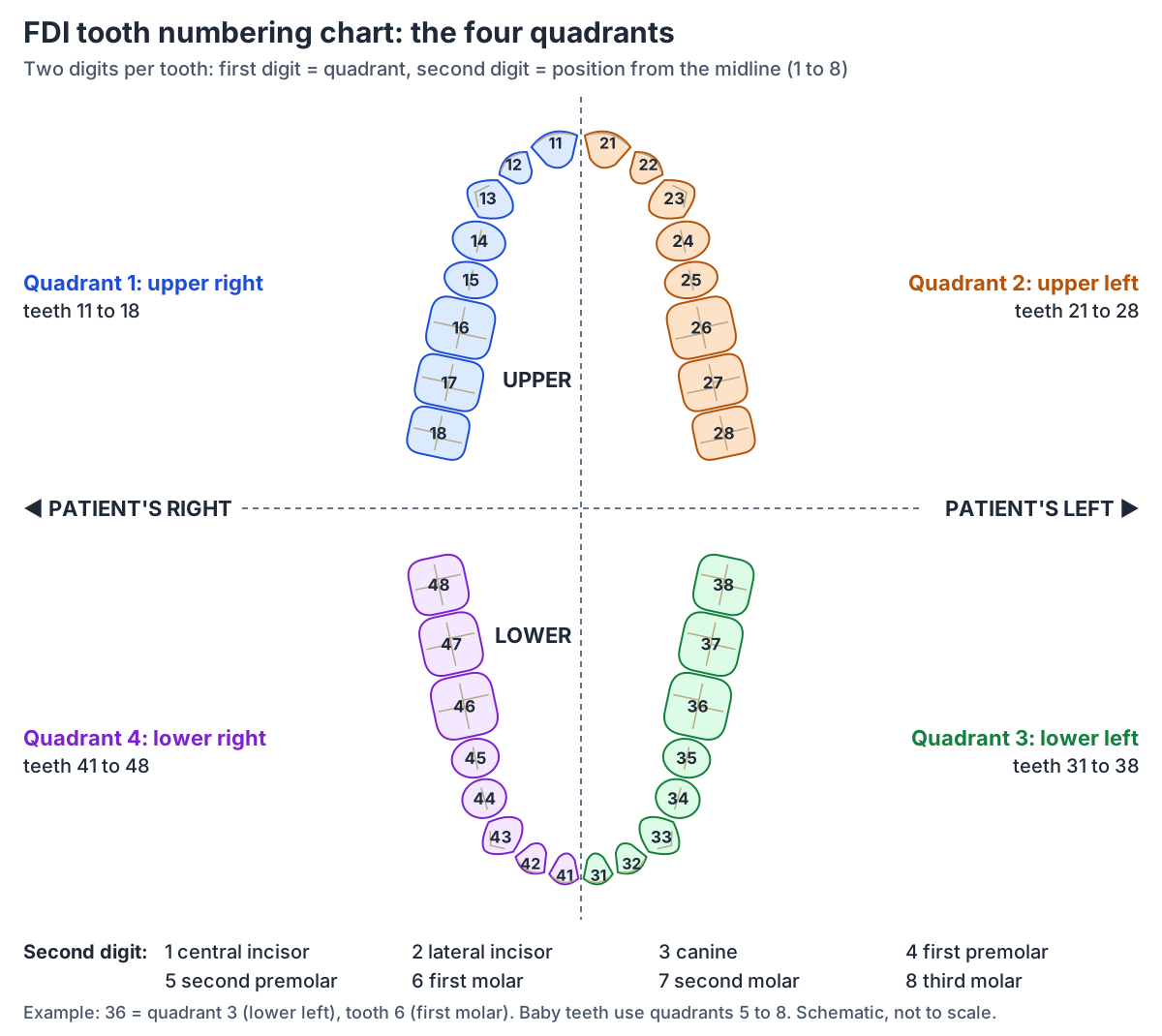
The FDI World Dental Federation system gives each tooth two digits. The first is the quadrant: 1 upper right, 2 upper left, 3 lower left and 4 lower right. The second is the tooth's position counted from the midline: 1 central incisor, 2 lateral incisor, 3 canine, 4 first premolar, 5 second premolar, 6 first molar, 7 second molar and 8 third molar. So 21 is the permanent upper left central incisor. (Radiopaedia: FDI World Dental Federation notation.)
Kenhub calls FDI notation, also known as the ISO system, the international standard, and gives 25 as the notation for the second premolar of the upper left quadrant. (Kenhub: Teeth.)
The system is also known as ISO 3950. Permanent teeth are numbered 11 to 18, 21 to 28, 31 to 38 and 41 to 48 for the upper right, upper left, lower left and lower right quadrants, which helps prevent errors between right and left and between upper and lower teeth. (Akram A et al. Comparison of the learning of two notations: a pilot study. J Adv Med Educ Prof. 2017.)
The FDI proposed the two-digit system for worldwide use in 1970, judging that it met the requirements of an ideal numbering system: simple to understand and teach, easy to say aloud and dictate, easy to print and easy to enter into a computer. By 1989 it had been adopted by the International Organization for Standardization, the World Health Organization and Interpol, among others. (Al-Johany SS. Tooth Numbering System in Saudi Arabia: Survey. Saudi Dent J. 2016.)
It is considered the most widely used system in the world, but confusion remains: in a questionnaire of 66 dental students, interns, dentists and technicians, only 56% correctly recognised which numbering system the questions used. (Shehabeldin RR, Hamama HH. Introduction of "qpdb" teeth numbering system. Heliyon. 2024.)
Palmer notation (Zsigmondy system, UK)
Palmer notation, also called the Zsigmondy or Zsigmondy-Palmer system, numbers the teeth 1 to 8 within each quadrant, from the central incisor (1) to the third molar (8), and partly encloses each number in a right-angled bracket that shows the quadrant. Radiopaedia notes that it is used primarily in the United Kingdom. (Radiopaedia: Palmer notation.)
The idea is older than the Universal system. Adolf Zsigmondy proposed numbering each quadrant from 1 (central incisor) to 8 (third molar) in 1861, with a grid symbol around the number to show the quadrant, and the American dentist Corydon Palmer described a similar method in 1870. (Al-Johany SS. Tooth Numbering System in Saudi Arabia: Survey. Saudi Dent J. 2016.)
In the United States, orthodontic practices often use Palmer (symbolic) notation: each quadrant is numbered 1 to 8 from the midline with a bracket to show the quadrant, and primary teeth are lettered A to E. (Dentalcare: Making Entries in the Patient Records.)
The bracket has a practical drawback: it takes more space in patient files and is not easily typed in electronic records. (Shehabeldin RR, Hamama HH. Introduction of "qpdb" teeth numbering system. Heliyon. 2024.)
In UK and Irish dental hospitals a typed Alphanumeric notation is now the most common, ahead of Palmer and FDI, and most dentists' referral letters assessed in Manchester used it. The authors link this to the move to electronic recording of information about teeth. (Pemberton MN, Ashley M. The use and understanding of dental notation systems in UK and Irish dental hospitals. Br Dent J. 2017.)
The typed form of Palmer notation, called alphanumeric notation, was made for electronic records. It writes the quadrant as letters before the number 1 to 8: UR (upper right), UL (upper left), LL (lower left) and LR (lower right), so UR1 is the permanent upper right central incisor. Radiopaedia notes that it too is used mainly in the United Kingdom. (Radiopaedia: Alphanumeric system of dental notation.)
Akram and colleagues give UL7 for the upper left second molar, written with its FDI number as UL7 [27]. The Palmer column of the tables on this page uses this alphanumeric form, so UR8 is the upper right third molar and LL6 the lower left first molar. (Akram A et al. Comparison of the learning of two notations: a pilot study. J Adv Med Educ Prof. 2017.)
Universal vs FDI vs Palmer: one tooth, three numbers
The same tooth has a different code in each system, and this is a known cause of mistakes. Akram and colleagues write that communication gaps caused by multiple tooth notations are a major reason for malpractice in dentistry, and that in the United States orthodontists mostly use Palmer notation while oral surgeons use the Universal system. (Akram A et al. Comparison of the learning of two notations: a pilot study. J Adv Med Educ Prof. 2017.)
Numbers that exist in more than one system are the main trap. In the Universal system tooth 18 is the lower left second molar and tooth 28 the lower right first premolar. (Radiopaedia: American Dental Association Universal Numbering System.)
In FDI notation, 18 is the upper right third molar and 28 the upper left third molar, so a chart or referral must always say which system it uses. (Radiopaedia: FDI World Dental Federation notation.)
Dentalcare's course on dental records makes the same point: it is important to note which system is being used so that all documentation and referrals are read correctly. (Dentalcare: Making Entries in the Patient Records.)
Universal vs FDI vs Palmer tooth numbering compared
| Feature | Universal (ADA) | FDI (ISO 3950) | Palmer (Zsigmondy) |
|---|---|---|---|
| Where it is mainly used | United States | International standard, most of the world | United Kingdom; also US orthodontic practices |
| Adult teeth | 1 to 32, one number per tooth | Two digits, 11 to 48 | 1 to 8 in each quadrant, plus a quadrant bracket |
| Baby teeth | Letters A to T | Two digits, quadrants 5 to 8 (51 to 85) | Letters A to E in each quadrant |
| Where counting starts | Upper right third molar (1) | Central incisor of each quadrant (1) | Central incisor of each quadrant (1) |
| Upper right first molar | 3 | 16 | UR6 |
| Upper left central incisor | 9 | 21 | UL1 |
| Lower left first molar | 19 | 36 | LL6 |
| Wisdom teeth | 1, 16, 17, 32 | 18, 28, 38, 48 | UR8, UL8, LL8, LR8 |
| Origin | Parreidt, 1882; adopted by the ADA in 1968 | Proposed by the FDI in 1970; ISO 3950 | Zsigmondy, 1861; Palmer, 1870 |
Palmer examples are written in the typed alphanumeric form (UR6); handwritten Palmer notation uses a quadrant bracket instead of the letters. Sources: Radiopaedia (Universal, FDI, Palmer and alphanumeric notation), Kenhub, Dentalcare, Akram et al. (2017), Al-Johany (2016), Shehabeldin and Hamama (2024), News-Medical.
Wisdom teeth numbers and location (teeth 1, 16, 17 and 32)
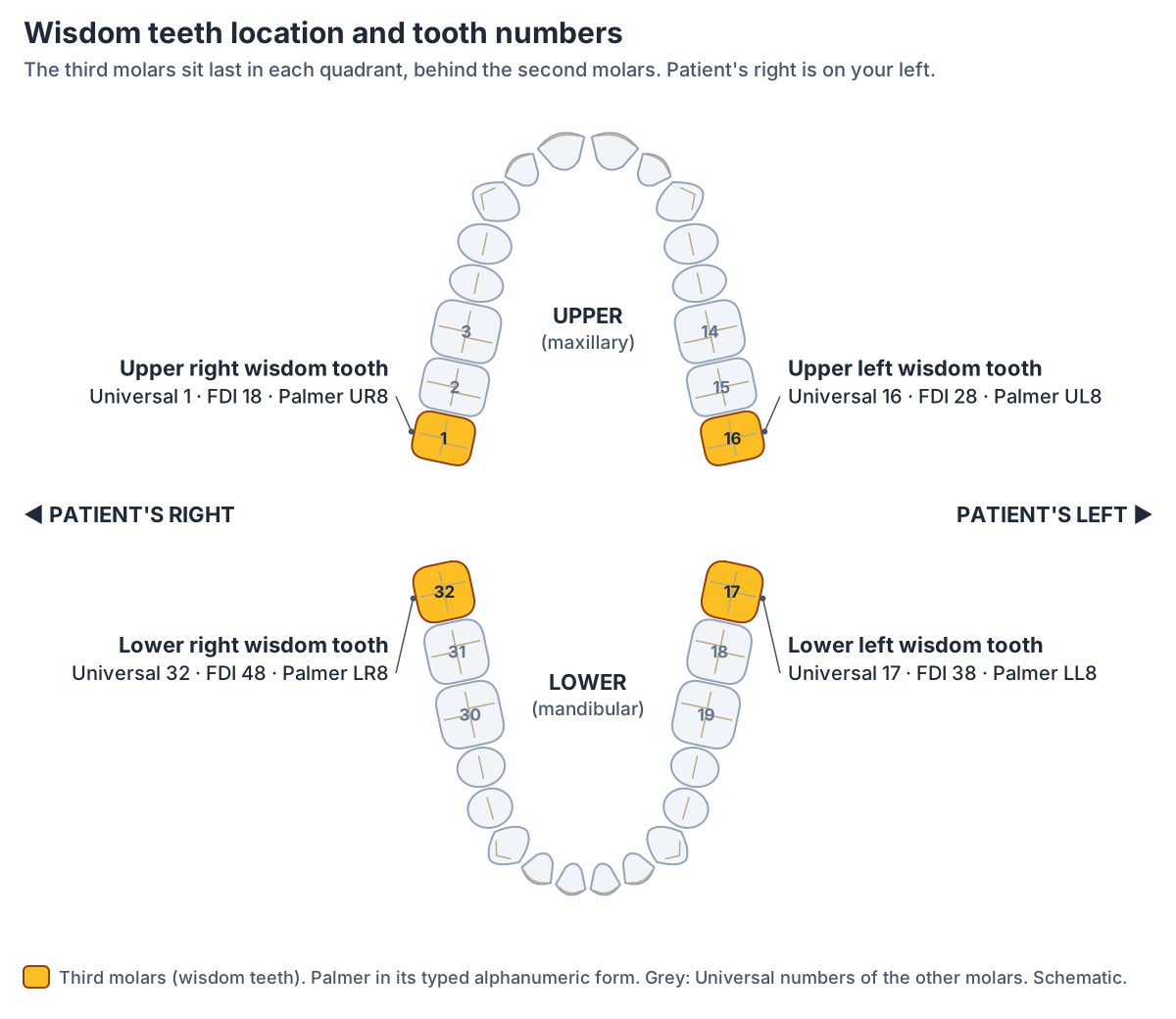
The wisdom teeth are the third molars, the last tooth in each quadrant. In the Universal system they are teeth 1 (upper right), 16 (upper left), 17 (lower left) and 32 (lower right). (Radiopaedia: American Dental Association Universal Numbering System.)
In FDI notation the third molar is position 8 of each quadrant, so the wisdom teeth are 18, 28, 38 and 48. (Radiopaedia: FDI World Dental Federation notation.)
In Palmer notation each wisdom tooth is an 8 with its quadrant bracket, because the third molar is the eighth tooth from the midline. (Radiopaedia: Palmer notation.)
Where are they? Wisdom teeth erupt at the very back of the mouth, just behind the second molars. We have four wisdom teeth, one in each quadrant, but not all of them erupt. (Cleveland Clinic: Wisdom Teeth.)
Why are they called wisdom teeth? The American Dental Association explains that historically these teeth have been called wisdom teeth because they come through at a more mature age, usually between 17 and 21. (American Dental Association (MouthHealthy): Wisdom Teeth.)
Cleveland Clinic gives the same reason: they are called wisdom teeth because they come in much later than the other permanent teeth, usually between the ages of 17 and 25, and with older age comes wisdom. (Cleveland Clinic: Wisdom Teeth.)
The anatomy textbook OpenStax puts it the same way: the third molars are commonly called wisdom teeth because their eruption is usually delayed until early adulthood. It is not uncommon for them to fail to erupt and stay impacted in the jaw. (OpenStax Anatomy and Physiology 2e, 23.3: The Mouth, Pharynx, and Esophagus.)
Radiopaedia places the final eruption of the third molar between 18 and 24 years, so the age range differs a little between sources. (Radiopaedia: Teeth.)
Missing wisdom teeth are common. In Dentalcare's example a patient has 31 teeth because his upper right third molar never came in. (Dentalcare: Adult Teeth.)
The 3D model on this page highlights the 28 permanent teeth in the BodyParts3D data: the incisors, canines, premolars and first and second molars of all four quadrants. It has no third molars, so the wisdom teeth appear only in the diagrams.
How to read a dental chart
A dental chart shows the teeth as seen from in front of the patient, so the teeth on the right side of the page are on the patient's left and vice versa. On a two-row chart the horizontal line between the upper and lower teeth stands for the tongue: the lingual or palatal surfaces are the ones nearest that line, and the buccal or labial surfaces are at the top of the top row and the bottom of the bottom row. (Sivakumar A et al. Treatment planning in conservative dentistry. J Pharm Bioallied Sci. 2012.)
Each tooth has named surfaces. Mesial is the surface closest to the midline of the face and distal the surface away from it; buccal faces the cheeks and labial the lips (both are facial surfaces); lingual faces the tongue; the occlusal surface is the chewing surface of a back tooth and the incisal edge the biting edge of a front tooth. (Dentalcare: Surfaces of the Teeth.)
The marks on a chart divide each back tooth into occlusal, mesial, distal, buccal and lingual surfaces, and each front tooth into the same surfaces except that a front tooth has no occlusal surface. (Sivakumar A et al. Treatment planning in conservative dentistry. J Pharm Bioallied Sci. 2012.)
Surfaces are written as single letters: M mesial, O occlusal, D distal, B buccal, L lingual, F facial (or labial) and I incisal. (American Dental Association: Reporting Area of the Oral Cavity and Tooth Anatomy by CDT Code (2025).)
The letters are combined to describe a lesion or anatomy that spans several surfaces: MO means mesial-occlusal, MOD mesial-occlusal-distal and MODB mesial-occlusal-distal-buccal. (American Dental Association: ADAT Acronyms and Abbreviations Guide (2025).)
Put together with a tooth number, the letters pinpoint a spot. Dentalcare's example, the mesio-lingual surface of #3, is the part of the upper right first molar that is closest to the front of the mouth and on the tongue side. (Dentalcare: Surfaces of the Teeth.)
A labelled arch showing the mesial, distal, buccal, labial, lingual and occlusal surfaces, with the parts of a tooth. Tooth anatomy: tooth surfaces diagram.
Baby teeth letters A to T
Baby (primary) teeth are lettered, not numbered, in the Universal system, in the same clockwise order: A to E are the upper right teeth, F to J the upper left, K to O the lower left and P to T the lower right. Each quadrant runs between the second molar and the central incisor, so A is the upper right second molar, J the upper left second molar, K the lower left second molar and T the lower right second molar. (Radiopaedia: American Dental Association Universal Numbering System.)
The 20 primary teeth, when each one comes in and falls out, and their FDI numbers. Baby teeth chart.
Tooth chart in the 3D model
- Lower central secondary incisor tooth
- The permanent lower central incisor, the smallest tooth in the mouth, one on each side of the midline of the lower jaw.
- Lower first secondary molar tooth
- The permanent lower first molar, the largest lower tooth and the first permanent tooth to erupt.
- Lower first secondary premolar tooth
- The permanent lower first premolar, a canine-like tooth with one large and one small cusp.
- Lower lateral secondary incisor tooth
- The permanent lower lateral incisor, a chisel-shaped cutting tooth between the central incisor and the canine.
- Lower second secondary molar tooth
- The permanent lower second molar, a four-cusped grinding tooth at the back of the lower arch in this model.
- Lower second secondary premolar tooth
- The permanent lower second premolar, a crushing tooth in front of the first molar, often with three cusps.
- Lower secondary canine tooth
- The permanent lower canine, a pointed single-cusped tooth at the corner of the lower dental arch.
- Upper central secondary incisor tooth
- The permanent upper central incisor, the largest and most prominent incisor, beside the midline of the upper jaw.
- Upper first secondary molar tooth
- The permanent upper first molar, a large three-rooted grinding tooth whose roots lie close to the maxillary sinus.
- Upper first secondary premolar tooth
- The permanent upper first premolar, a two-cusped tooth that usually has two roots.
- Upper lateral secondary incisor tooth
- The permanent upper lateral incisor, a smaller cutting tooth between the central incisor and the canine.
- Upper second secondary molar tooth
- The permanent upper second molar, a three-rooted grinding tooth at the back of the upper arch in this model.
- Upper second secondary premolar tooth
- The permanent upper second premolar, a two-cusped tooth that usually has one root.
- Upper secondary canine tooth
- The permanent upper canine (eye tooth), which has the longest root of any tooth.
Frequently asked questions
What tooth is number 19?
Tooth number 19 is the lower left first molar in the Universal system used in the US. It sits in the lower jaw on the patient's left, behind the two premolars (20 and 21) and in front of the second molar (18) and the wisdom tooth (17). It is one of the four 6-year molars. In FDI notation the same tooth is 36, and in Palmer notation it is LL6.
What number is a wisdom tooth?
In the Universal system the wisdom teeth, or third molars, are numbers 1 (upper right), 16 (upper left), 17 (lower left) and 32 (lower right). In FDI notation they are 18, 28, 38 and 48, and in Palmer notation each one is an 8 in its quadrant. The numbers stay reserved on a dental chart even when the wisdom teeth are missing.
Why are they called wisdom teeth?
Wisdom teeth are the third molars. They got the name because they come through much later than the other permanent teeth, at a more mature age: usually between about 17 and 21, or up to 25 in some sources, when a person is an adult. Many people have one or more wisdom teeth that never erupt.
What are the names of the front teeth?
The front (anterior) teeth are the incisors and canines. In each jaw there are two central incisors either side of the midline, a lateral incisor beside each of them and a canine (cuspid) at each corner; the upper canines are also called eye teeth. In the Universal system the upper front teeth are 6 to 11 and the lower front teeth 22 to 27; the upper central incisors are teeth 8 and 9.
How do you read a tooth number chart?
Read it as if you are facing the patient: the patient's right side is on the left of the chart. In the Universal system, start at the upper right third molar (1), count across the top teeth to the upper left third molar (16), drop to the lower left third molar (17) and count back across the bottom teeth to the lower right third molar (32).
What is the difference between the Universal and FDI tooth numbering systems?
The Universal system, used mainly in the US, gives each adult tooth one number from 1 to 32. The FDI system, the international (ISO) standard, gives each tooth two digits: the quadrant (1 upper right, 2 upper left, 3 lower left, 4 lower right) and the position from the midline (1 to 8). So the upper right first molar is 3 in the Universal system and 16 in FDI notation.
What is tooth number 14?
In the Universal system, tooth number 14 is the upper left first molar: the large back tooth in the upper jaw on the patient's left, between the second premolar (13) and the second molar (15). In FDI notation it is 26. Do not confuse it with FDI 14, which is a different tooth, the upper right first premolar (Universal 5).
What is tooth number 30?
Tooth number 30 is the lower right first molar: in the lower jaw on the patient's right, between the second premolar (29) and the second molar (31). Like teeth 3, 14 and 19 it is a 6-year molar. In FDI notation it is 46 and in Palmer notation LR6. Its partner on the other side of the lower jaw is tooth 19.
References
- Radiopaedia. American Dental Association Universal Numbering System (rID 69592).
- Radiopaedia. FDI World Dental Federation notation.
- Radiopaedia. Palmer notation.
- Radiopaedia. Teeth.
- Radiopaedia. Alphanumeric system of dental notation.
- Kenhub. Teeth.
- Kenhub. Tooth anatomy.
- TeachMeAnatomy. Child and Adult Dentition.
- OpenStax. Anatomy and Physiology 2e, §23.3 The Mouth, Pharynx, and Esophagus. Rice University, 2022.
- Cleveland Clinic. Teeth: Anatomy, Types, Function and Care (updated 26 January 2023).
- Cleveland Clinic. Wisdom Teeth: Function and Location (updated 23 June 2025).
- American Dental Association, MouthHealthy. Wisdom Teeth.
- American Dental Association. ADA Dental Claim Data Recommendation: Reporting Area of the Oral Cavity and Tooth Anatomy by CDT Code. Effective 1 January 2025.
- American Dental Association. Advanced Dental Admission Test (ADAT) Acronyms and Abbreviations Guide. Updated 25 November 2025.
- Foster VP. An Overview of Dental Anatomy: Types of Teeth and their Functions. Dentalcare (Procter & Gamble) continuing education course CE500.
- Foster VP. An Overview of Dental Anatomy: Surfaces of the Teeth. Dentalcare CE500.
- Foster VP. An Overview of Dental Anatomy: Types of Teeth, Structures, Location and Functions. Dentalcare CE500.
- Dentalcare. Professional Dental Terminology for the Dental Assistant and Hygienist: Adult Teeth. Course CE542.
- Dentalcare. Dental Records: Best Practices for Information Management and Retention: Making Entries in the Patient Records. Course CE532.
- Sivakumar A, Thangaswamy V, Ravi V. Treatment planning in conservative dentistry. J Pharm Bioallied Sci. 2012;4(Suppl 2):S406-S409.
- Al-Johany SS. Tooth Numbering System in Saudi Arabia: Survey. Saudi Dent J. 2016;28(4):183-188.
- Shehabeldin RR, Hamama HH. Introduction of "qpdb" teeth numbering system. Heliyon. 2024;10(2):e24367.
- Akram A, Fuad MD, Malik AM, et al. Comparison of the learning of two notations: a pilot study. J Adv Med Educ Prof. 2017;5(2):67-72.
- Pemberton MN, Ashley M. The use and understanding of dental notation systems in UK and Irish dental hospitals. Br Dent J. 2017;223:429-434.
- Jadun S, Ashley M, Pemberton MN. Trends in referral format and dental notation used in primary care referrals to dental specialists. Br Dent J. 2018;225:953-956 (correction 8 February 2019).
- Sahi A. Universal Numbering System for Teeth. News-Medical, 23 April 2019.
- National Institute of Dental and Craniofacial Research. Seal Out Tooth Decay: fact sheet for parents. NIH Publication No. 25-489, June 2025.
- Colgate. Do You Know All the Human Teeth Names? 9 January 2023.
- Mitsuhashi N. et al. (2009). BodyParts3D: 3D structure database for anatomical concepts. Nucleic Acids Research 37, D782–D785. Data © The Database Center for Life Science, CC BY 4.0.
About this page
Drafted with AI assistance from the sources listed above, checked against them and reviewed by Dr Shaista Andleeb; last reviewed on 3 November 2026. The editorial policy explains how sources are chosen and how errors are corrected. To report a mistake, use the contact page.
Related anatomy
- TeethTooth anatomy with labeled diagrams and a 3D model: crown, root, enamel, dentin, pulp and cementum, incisors, canines…
- Baby teethBaby teeth chart with labelled diagrams: when each of the 20 primary teeth comes in and falls out, the order, letters…
- Mouth anatomyMouth anatomy with a 3D model and labelled diagrams: lips, cheeks, hard and soft palate, uvula, tongue, teeth, gums…
- MandibleMandible anatomy with a labelled diagram: body, ramus, angle, condylar and coronoid processes, foramina, muscle…
- MaxillaMaxilla bone anatomy: the body and four processes, palatine and alveolar processes, maxillary sinus, articulations, Le…
- Temporomandibular joint (TMJ)TMJ anatomy: the condyle, fossa, articular disc, capsule and ligaments of the temporomandibular joint and how it…
Explore the whole body in the interactive 3D human anatomy model, or browse the A–Z list of human structures.